Anthropic and the White House negotiate AI rules at the G7 while the company's models remain banned
Dario Amodei, CEO of Anthropic, is attending the G7 summit and holding direct talks with American officials on rules for the safe use of AI. The talks come about a week after the US banned the company's flagship models on national security grounds. The negotiations give Anthropic a rare chance to shape international industry standards from the inside.
AI-processed from 3DNews AI; edited by Hamidun News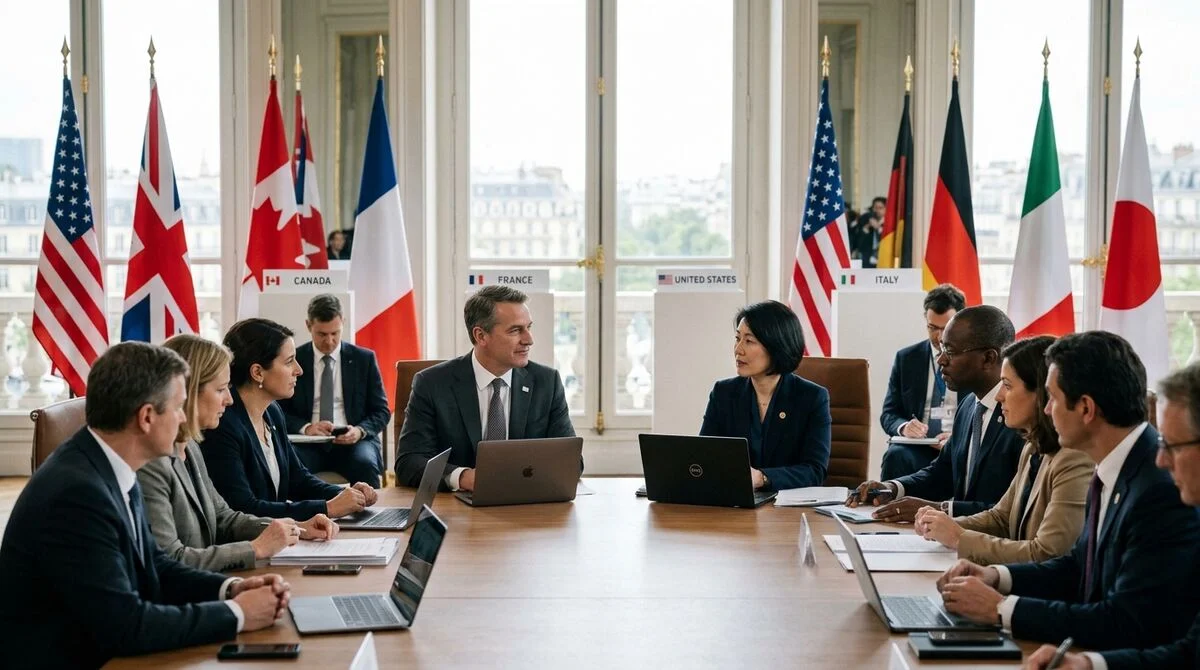
Dario Amodei, CEO of Anthropic, attended the G7 summit and used it for direct talks with senior American officials on rules for the safe use of AI models. The circumstances are unusual: the company's own flagship models have been banned in the US for about a week over national security concerns.
Models banned, CEO at the G7 table
About a week ago, US authorities restricted the use of Anthropic's advanced AI systems in a number of federal contexts. The official reasons relate to national security. The precise details have not yet been made public, which is typical for decisions of this kind.
For the company the situation is paradoxical: its technology has been deemed potentially sensitive, and at the same time its CEO sits at the same table as senior officials who decide the fate of that very technology. The G7 gave Amodei an opportunity most AI startups do not have: to discuss regulatory frameworks directly with the people who shape them.
What is on the summit agenda
At the G7, AI safety has its own place on the agenda. The world's largest economies are trying to develop joint approaches to regulation before the technology finally outruns the law. For Anthropic, taking part means it can not only protect its products from ill-considered restrictions but also influence international standards that will ultimately affect the whole industry.
Agenda items include:
- International norms for safety-testing AI systems before they reach the market
- Criteria under which models may be considered sensitive from a national security standpoint
- Risk-assessment methodologies and their alignment among allied states
- Transparency requirements for training data and model architectures
- Mechanisms for joint response when critical threats are identified
The talks with American officials also offer Anthropic a practical benefit: a chance to get clarity on a question that remains open, namely on what exact grounds the models were banned and what it would take to lift the ban.
Why Anthropic matters in these talks
The picture looks paradoxical: a company whose models are temporarily blocked is simultaneously helping write rules for such models. But that is the essence of the current moment in AI regulation. Governments have realized that without developers' participation in rulemaking, the rules risk being either so strict that they slow progress, or so empty that they fail to achieve their stated goals.
Since its founding, Anthropic has positioned itself as a company where safety is built into the research agenda rather than added as marketing claims. The company is known for developing neural network interpretability methods and for a policy of responsible disclosure of its systems' capabilities and limitations. All this makes it a valuable partner for governments that seriously want to understand what happens inside frontier language models.
The talks benefit both sides. Governments gain access to insider expertise that no external report provides. The company gets a chance to make its case: which restrictions make sense, and which create regulatory barriers without actually reducing risk.
What this means
The dialogue between Anthropic and the White House on the sidelines of the G7 is a sign that AI regulation is shifting from a reactive mode to a preventive one. Banning flagship models while negotiating with their creator is not a contradiction but a working tactic: first understand the risks, then write the rules together with those who understand the technology best.
The next step is concrete agreements that could form the basis of international standards for the whole industry.
Key Questions Answered
What are the key details on Models banned, CEO at the G7 table?
About a week ago, US authorities restricted the use of Anthropic's advanced AI systems in a number of federal contexts. The official reasons relate to national security. The precise details have not yet been made public, which is typical for decisions of this kind. For the company the situation is paradoxical: its technology has been deemed potentially sensitive, and at the same time its CEO sits at the same table as senior officials who decide the fate of that very technology. The G7 gave Amodei an opportunity most AI startups do not have: to discuss regulatory frameworks
What is on the summit agenda?
At the G7, AI safety has its own place on the agenda. The world's largest economies are trying to develop joint approaches to regulation before the technology finally outruns the law. For Anthropic, taking part means it can not only protect its products from ill-considered restrictions but also influence international standards that will ultimately affect the whole industry. Agenda items include: International norms for safety-testing AI systems before they reach the market Criteria under which models may be considered sensitive from a national security standpoint Risk-asse
Why Anthropic matters in these talks?
The picture looks paradoxical: a company whose models are temporarily blocked is simultaneously helping write rules for such models. But that is the essence of the current moment in AI regulation. Governments have realized that without developers' participation in rulemaking, the rules risk being either so strict that they slow progress, or so empty that they fail to achieve their stated goals. Since its founding, Anthropic has positioned itself as a company where safety is built into the research agenda rather than added as marketing claims. The company is known for develo
Test Frontier LLMs & Autonomous Agents in One Workspace
Run Claude Opus 5.5, GPT-6, Gemini 3.1, and DeepSeek side-by-side in Nomad AI (nomadnet.ai) — unified model routing, deep research, and multimodal workflows under one subscription.
The AI world, distilled — once a week
Seven stories that actually mattered, hand-picked. No noise, no reposts, no press releases.
Done! Check your inbox for a confirmation.