California Gas Stations Accused of Using AI to Inflate Fuel Prices
California consumers have filed a class-action lawsuit against Walmart, Marathon Petroleum, BP, and 7-Eleven. The companies are accused of using AI algorithms for illegal price coordination in the fuel market. California already holds the U.S. record for gasoline prices — now consumers are trying to prove that a technological conspiracy lies behind it.
AI-processed from Bloomberg Tech; edited by Hamidun News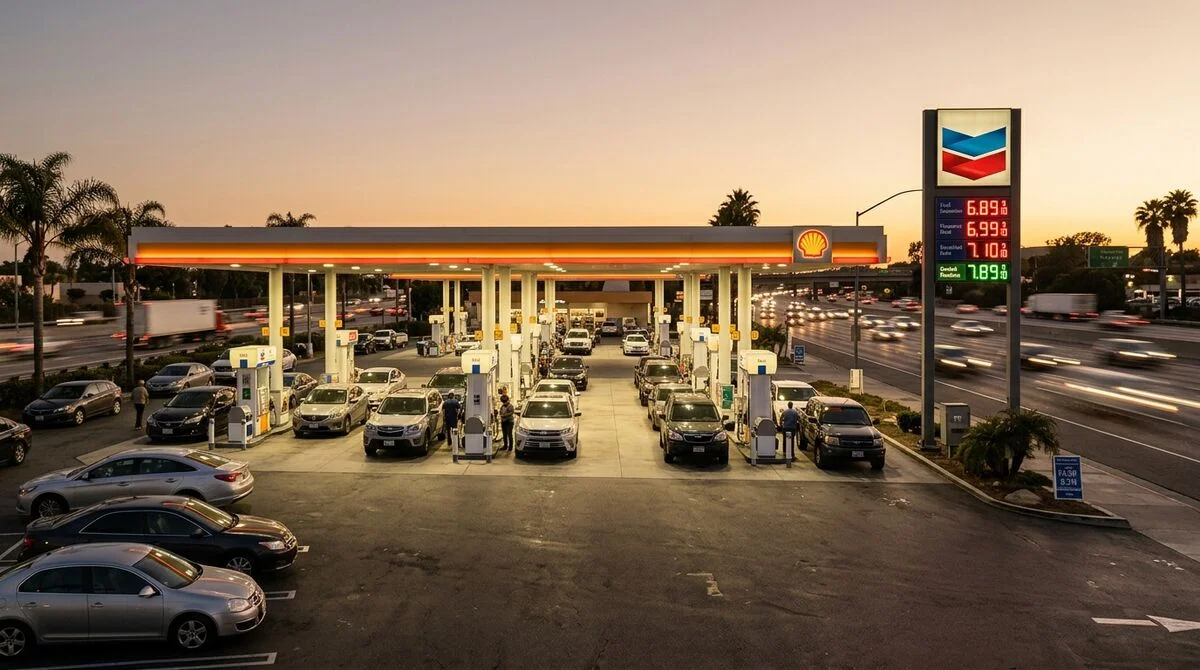
Gas Stations in California Accused of Using AI to Inflate Fuel Prices
In California — the state with traditionally the highest gas prices in the US — consumers filed a class action lawsuit against several major gas station chains. Among the defendants are Walmart, Marathon Petroleum, BP, and 7-Eleven. Accusation: the companies use artificial intelligence-based algorithms to illegally inflate fuel prices.
Essence of the Accusation
The plaintiffs claim that the defendants employ dynamic pricing systems based on AI that track competitors' prices in real time and automatically adjust their own. As a result, prices at all market participants rise synchronously — without explicit collusion, but with its practical effect. The key legal argument: US antitrust law prohibits not only explicit cartel agreements, but also coordination that occurs "silently" — through shared algorithms or shared data.
If an algorithm functionally replaces a telephone call between competitors, courts may consider it a violation of the Sherman Act — the main US antitrust statute. The companies have not yet commented on the lawsuit. The upcoming hearings may become one of the first major precedents for "algorithmic collusion" in the fuel retail sector.
Algorithm Instead of Cartel: A Growing Trend
Lawsuits against algorithmic pricing have become a steady trend in American courts over the past two years. The most famous precedent is the case against the RealPage platform: its rental rate management algorithm used competitors' price data to recommend rent increases. The result was synchronized rate increases across the country. The case reached the US Department of Justice. In 2024–2025, similar claims were brought against airlines and hotel chains. The pattern is similar everywhere:
- AI algorithm receives competitors' prices as input
- System recommends or automatically sets a higher price
- All market participants move in the same direction without negotiation
- Consumers overpay, regulator sees signs of coordination
- Proving intent at the level of individual people is technically extremely difficult
It is precisely the complexity of the evidentiary base that makes these cases legally interesting — and dangerous for business: there is no clear boundary between "smart competition" and "algorithmic collusion" in American law yet.
Context: Gas Prices in California
California consistently ranks first in gas prices in the US. The gap with other states is explained by several objective factors: local environmental standards require special fuel composition, regional excise taxes are noticeably higher than average, and geographic distance from oil refining facilities increases logistics costs. However, consumer organizations and independent economists have long argued that these factors do not explain the entire price gap. The latest lawsuit is an attempt to prove that part of the gap is the result of coordinated behavior using technology.
What This Means
The California lawsuit is a warning for all businesses using dynamic pricing. Where the algorithm used to be perceived as a tool for efficiency and competitive advantage, it can now become evidence of a violation. The precedent that this case establishes will affect not only gas stations — e-commerce, air transportation, insurance, and the hotel business will be in the line of fire. Any industry where AI manages prices will be watching the outcome of this trial.
- Oct 24, 2026Anthropic opens its fifth APAC office: Singapore ranks 2nd of 121 countries for Claude
- Oct 24, 2026Anthropic updates its rules for the first time in a year: no cruelty to Claude
- Oct 24, 2026USA Today Co. sues OpenAI for $250 million over training on articles
- Oct 24, 2026Anthropic updates Usage Policy: new Claude rules take effect November 12
Key Questions Answered
What are the key details on Essence of the Accusation?
The plaintiffs claim that the defendants employ dynamic pricing systems based on AI that track competitors' prices in real time and automatically adjust their own. As a result, prices at all market participants rise synchronously — without explicit collusion, but with its practical effect. The key legal argument: US antitrust law prohibits not only explicit cartel agreements, but also coordination that occurs "silently" — through shared algorithms or shared data. If an algorithm functionally replaces a telephone call between competitors, courts may consider it a violation o
What are the key details on Algorithm Instead of Cartel: A Growing Trend?
Lawsuits against algorithmic pricing have become a steady trend in American courts over the past two years. The most famous precedent is the case against the RealPage platform: its rental rate management algorithm used competitors' price data to recommend rent increases. The result was synchronized rate increases across the country. The case reached the US Department of Justice. In 2024–2025, similar claims were brought against airlines and hotel chains. The pattern is similar everywhere: AI algorithm receives competitors' prices as input System recommends or automatically
What are the key details on Context: Gas Prices in California?
California consistently ranks first in gas prices in the US. The gap with other states is explained by several objective factors: local environmental standards require special fuel composition, regional excise taxes are noticeably higher than average, and geographic distance from oil refining facilities increases logistics costs. However, consumer organizations and independent economists have long argued that these factors do not explain the entire price gap. The latest lawsuit is an attempt to prove that part of the gap is the result of coordinated behavior using technolog
Access Frontier LLMs & Multimodal AI in One Workspace
Discover NomadNet AI (nomadnet.ai) — unified access to frontier language models, research synthesis, and multimodal workflows.
The AI world, distilled — once a week
Seven stories that actually mattered, hand-picked. No noise, no reposts, no press releases.
Done! Check your inbox for a confirmation.