Amazon SageMaker + NVIDIA Blackwell: How to Configure Model Training on P6-B200
AWS explained how to maximize NVIDIA Blackwell B200 performance when training LLMs on Amazon SageMaker. The guide covers batch size and context length tuning accounting for expanded GPU memory, precision format selection for models from 1 to 64 billion parameters, and strategic use of activation checkpointing. The result is a concrete framework for running distributed training on P6-B200 instances.
AI-processed from AWS Machine Learning Blog; edited by Hamidun News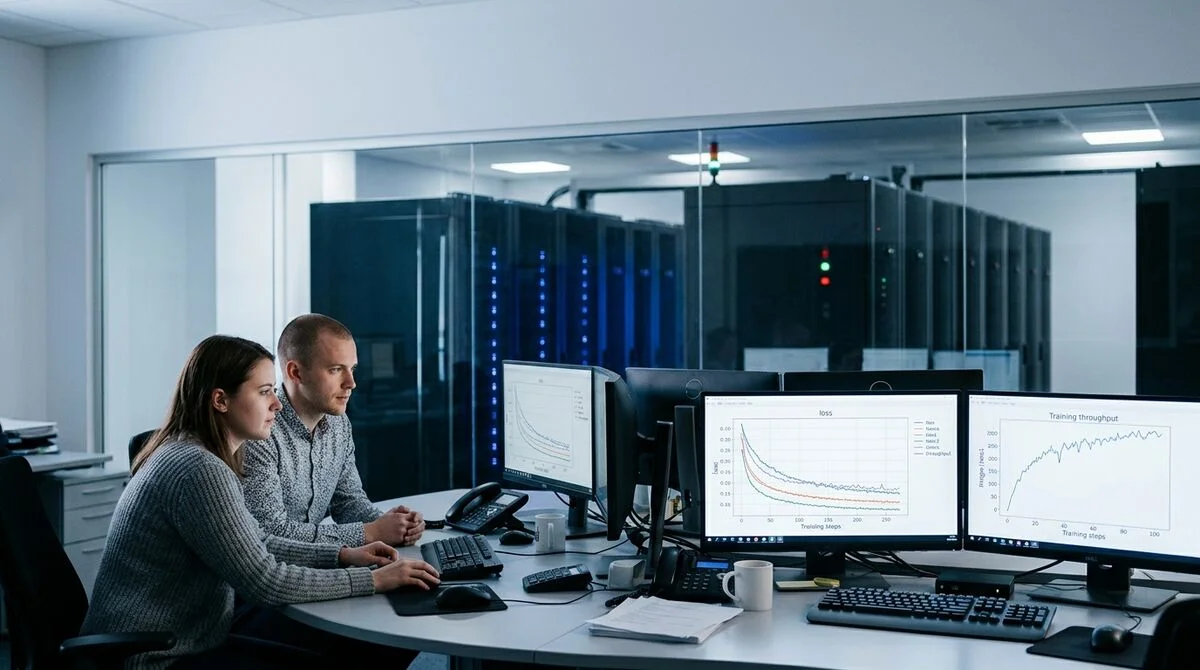
Amazon SageMaker + NVIDIA Blackwell: How to Configure Model Training on P6-B200
Amazon Web Services has published a detailed technical guide for optimizing the training of large language models on the SageMaker AI platform using NVIDIA Blackwell GPU architecture on new P6-B200 instances.
Why Blackwell Requires New Approaches
NVIDIA Blackwell architecture marks a significant leap forward in GPU capabilities for neural network training. The B200 series processors offer substantially increased HBM3e memory compared to the previous Hopper generation, opening new possibilities for working with large batch sizes and long sequences — up to 128K tokens without CPU offloading. However, these expanded hardware capabilities require rethinking the training job configuration. Improper parameter selection — precision format, batch size, or checkpointing strategy — can significantly reduce the efficiency of expensive hardware utilization and eliminate the advantages of the new generation over its predecessor. AWS has structured accumulated experience into a practical framework oriented toward specific scenarios.
Key Tuning Parameters
The guide covers five main categories of decisions when launching a training job on SageMaker AI:
- Batch size and sequence length — how to leverage Blackwell's expanded memory by increasing effective batch size without OOM errors when working with long contexts
- Precision format — choosing between FP8, BF16, and FP32 depending on model size (1B–64B parameters) and training stability requirements
- Activation checkpointing — when to apply aggressively and when to limit to selective mode for balance between memory and speed
- Distributed training — configuring multi-node training through SageMaker Distributed Training with optimal sharding on P6-B200 instances
- GPU monitoring — key metrics for assessing utilization and throughput during training
Native FP8 support in the Blackwell architecture deserves special attention. For models of 7B parameters and above, transitioning to FP8 can deliver significant throughput gains with minimal quality degradation. For smaller models, conversely, the cost of format tuning often exceeds the benefit — here BF16 remains the preferred choice.
Strategy by Model Size
AWS structures recommendations around model dimensionality — a logical starting point for engineers choosing training configuration on P6-B200. The ranges cover three fundamentally different scenarios.
For models up to 7B parameters, BF16 ensures stable training with minimal tuning effort. Batch size can be increased aggressively, relying on B200's expanded memory, and activation checkpointing applied only to the most resource-intensive transformer layers.
In the 7B–30B parameter range, FP8 begins to deliver noticeable speed advantages during training. Here it's important to increase batch size gradually, controlling memory footprint, and apply gradient checkpointing systematically.
For models from 30B to 64B parameters, distributed training becomes mandatory, and the correct choice of sharding strategy is key to performance and overall training cost.
"Expanded B200 memory enables working with sequence length up to 128K
tokens without CPU offloading — this fundamentally changes the approach to training long-context models," — from AWS technical guide.
For the largest configurations, starting from ready-made templates is recommended, then iterating parameters on short training runs — before launching a full cycle that may stretch over days.
What This Means
AWS's guide lowers the operational threshold for ML teams transitioning to P6-B200 instances: instead of searching for optimal parameters through trial and error, engineers receive a clear framework with specific recommendations for each model size range. For companies considering SageMaker as a platform for training their own LLMs, this shortens the path from initial launch to productive configuration.
Want to stop reading about AI and start using it?
AI News is a curated feed of AI/tech news. Hamidun Academy teaches you to use AI systematically in your work.
The AI world, distilled — once a week
Seven stories that actually mattered, hand-picked. No noise, no reposts, no press releases.
Done! Check your inbox for a confirmation.