Europe's heat shuts down power plants as IBM challenges Moore's law
Europe is sweltering under record heat, and the strain is hitting the power grid: several power plants have been shut down because river water used for…
AI-processed from MIT Technology Review; edited by Hamidun News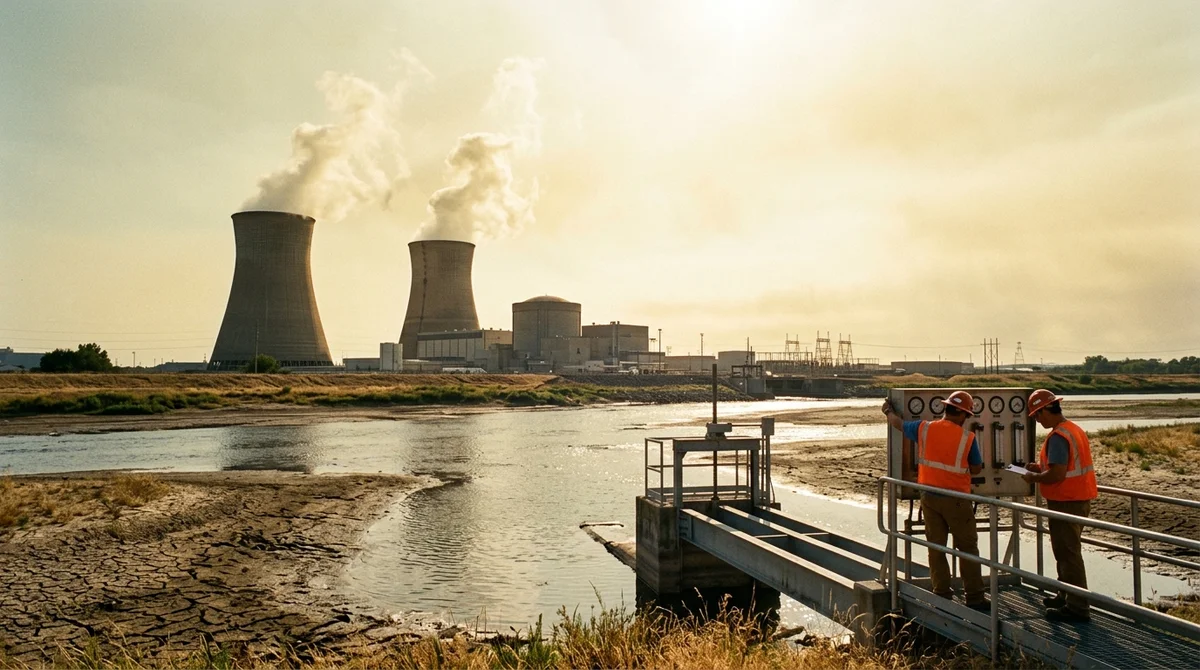
Europe is experiencing one of the hottest periods in the entire history of weather observations, and energy grids are straining at the seams: several major power plants have been forced to reduce output or shut down entirely. On the same day, IBM announced the next generation of semiconductor chips aimed at continuing Moore's Law.
Heat vs. Energy System
Record temperatures in Europe at the end of June 2026 have created a double blow to the continent's electrical grids. On one hand, air conditioners are running at maximum capacity, creating an unprecedented peak demand. On the other hand, thermal and nuclear power plants, which require cold river water to cool reactors and turbines, are facing water that has warmed beyond acceptable regulatory thresholds. In France, where nuclear generation provides about 70% of electricity production, several reactors were forced to reduce power: water in the Rhone and Loire rivers warmed so much that its use for cooling violated environmental standards — discharging water that was too warm back into the rivers harms fish and ecosystems.
- Spain and Italy recorded record daily peaks in electricity consumption
- Grid operators in several countries imposed restrictions on energy-intensive industrial consumers
- Solar generation partially compensated for the deficit — on hot days, solar insolation is at its maximum
- Norway and Sweden limited electricity exports to preserve reserves for their own grids
- Analysts warned: such crises will occur increasingly frequently as the climate warms
IBM Challenges the Limits of Physics
Against the backdrop of climate news, IBM published details about the next generation of its semiconductor chips. The company is targeting the continuation of Moore's Law — Gordon Moore's empirical rule that the number of transistors on a single chip doubles roughly every two years, leading to proportional growth in computing power. In recent years, the industry has faced increasing difficulties in maintaining this pace: silicon transistors have reached sizes at which quantum effects begin to interfere with their operation, the cost of developing new manufacturing processes has skyrocketed, and heat dissipation problems limit clock frequencies. IBM is betting on three-dimensional layering of transistor arrays and alternative semiconductor materials.
"We are convinced that scaling can continue — just differently,"
follows from the company's position.
Energy as a Common Thread
Both events are symptoms of one deep problem: computational progress is inseparable from the growth in energy consumption, and the energy system is increasingly vulnerable to climate stress. Global data centers already consume 1 to 2% of all electricity produced, and this figure is growing rapidly along with the spread of AI. IBM may create a chip with twice the computational density — but the question of where to get energy and how to cool systems will not go away.
What This Means
Summer 2026 clearly shows: technological progress and climate resilience are no longer separate topics. For the next generation of chips to truly accelerate the world, parallel acceleration is needed in the areas of clean energy and smart grids. Otherwise, breakthroughs in silicon physics will be determined by the temperature of water in the nearest river.
Need AI working inside your business — not just in your newsfeed?
I build production AI for companies — custom CRM, internal tools, autonomous agents, workflow automation. Owned by you, shaped to your process, no per-seat tax. Built by Zhemal Khamidun, CPO of AlpinaGPT (AI platform, 6,000+ users).