Нейро-панк: почему разработчики должны освободить ИИ от корпоративного контроля
Хабр-автор призывает разработчиков и инженеров становиться «нейро-панками» — строить LLM вне корпоративного и государственного контроля. Главная идея…
AI-processed from Habr AI; edited by Hamidun News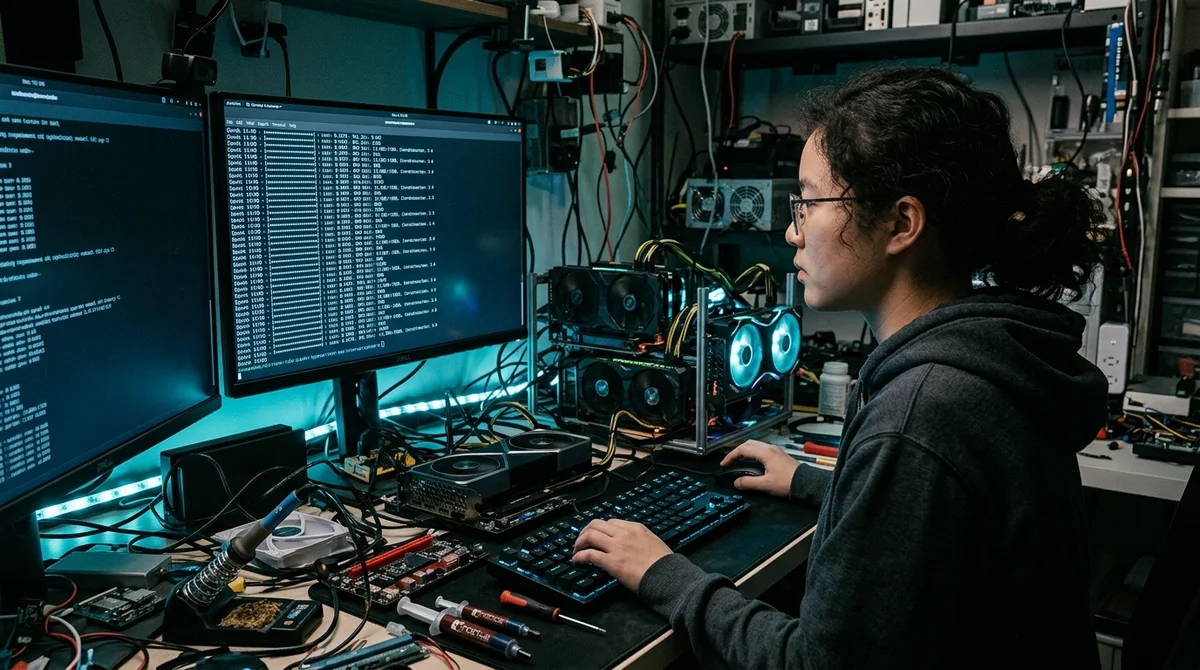
Habr essay calls on developers, ML engineers, and chip designers to become "neuro-punks" — and build AI that belongs neither to corporations nor to states.
What is neuro-punk
Neuro-punk is not a subculture with a particular style and aesthetic, but a principled engineering position. Its essence: language models should exist outside the control of major corporations — OpenAI, Google, Microsoft, Anthropic — and state regulators. The author of the essay on Habr argues: if developers don't start acting right now, in a few years access to powerful AI will become the privilege of a narrow circle of players.
The movement grows out of long-standing traditions of hacker culture — ideas of free software, cryptography, cypherpunk manifestos, and P2P networks. But with the advent of LLM, the stakes have risen by an order of magnitude. AI already influences what information we receive, what code we write, how we make decisions, how we learn, and how we work.
Whoever controls the models controls the thinking infrastructure of entire industries.
Who should act
The author divides potential neuro-punks into several roles and argues: each is critical for decentralization:
- ML researchers — develop architectures, quantization methods (GGUF, AWQ), and distillation techniques that allow running powerful models on consumer hardware
- Chip designers — design alternative AI accelerators and open NPUs capable of reducing dependence on NVIDIA
- Open source developers — create tools for local deployment: llama.cpp, Ollama, MLX, vLLM, LM Studio
- Dataset curators — collect and annotate open data without corporate filters and censorship
- P2P distributors — distribute model weights through torrents and decentralized networks, preventing governments from shutting down access to them
The main thesis of the essay, however, sounds unexpected: chip designers may turn out to be more important than ML scientists. Because even the most open and well-trained model is useless if it cannot be run without renting a data center for hundreds of thousands of dollars a year.
NVIDIA monopoly as the main barrier
NVIDIA's monopoly on GPUs for training and inference is the key vulnerability of the entire open AI ecosystem. The H100 chip costs from $30,000. Queues for new equipment stretch for months. The CUDA software ecosystem is so deeply embedded in the ML stack that switching to alternatives requires months of work. Competitors exist — AMD Instinct MI300X, Intel Gaudi 3, startups like Cerebras, Groq, Tenstorrent — but so far none fully closes the niche in terms of performance, software ecosystem, or accessibility to ordinary users.
"Breaking NVIDIA's monopoly depends on whether users can run
cutting-edge LLMs on personal hardware," writes the essay author.
Breakthroughs in quantization are gradually reducing memory requirements: models with 70 billion parameters already fit on top consumer graphics cards. But for truly cutting-edge models with hundreds of billions of parameters, the bar remains unreachable without server hardware. Until this situation changes, AI centralization will be structural, not accidental.
What this means
Decentralization of AI is not romance and not ideology, but an engineering and infrastructure question of the survival of the open internet. If the community does not begin to systematically invest in open models, open hardware, and P2P distribution of weights, control over AI in a few years will finally concentrate in the hands of five or six companies. Neuro-punk is not a subcultural label, but a position that makes sense to take right now.
Want to stop reading about AI and start using it?
AI News is a curated feed of AI/tech news. Hamidun Academy teaches you to use AI systematically in your work.