China to Pour $295 Billion into AI Computing Infrastructure, Challenging the US
China has announced a $295 billion program to develop AI infrastructure. State funds will go toward data centers, computing clusters and high-speed networks across the country. Beijing is betting on computing power as its key weapon in the contest with American tech giants. Those US companies are themselves expanding their data center investments at record rates.
AI-processed from Bloomberg Tech; edited by Hamidun News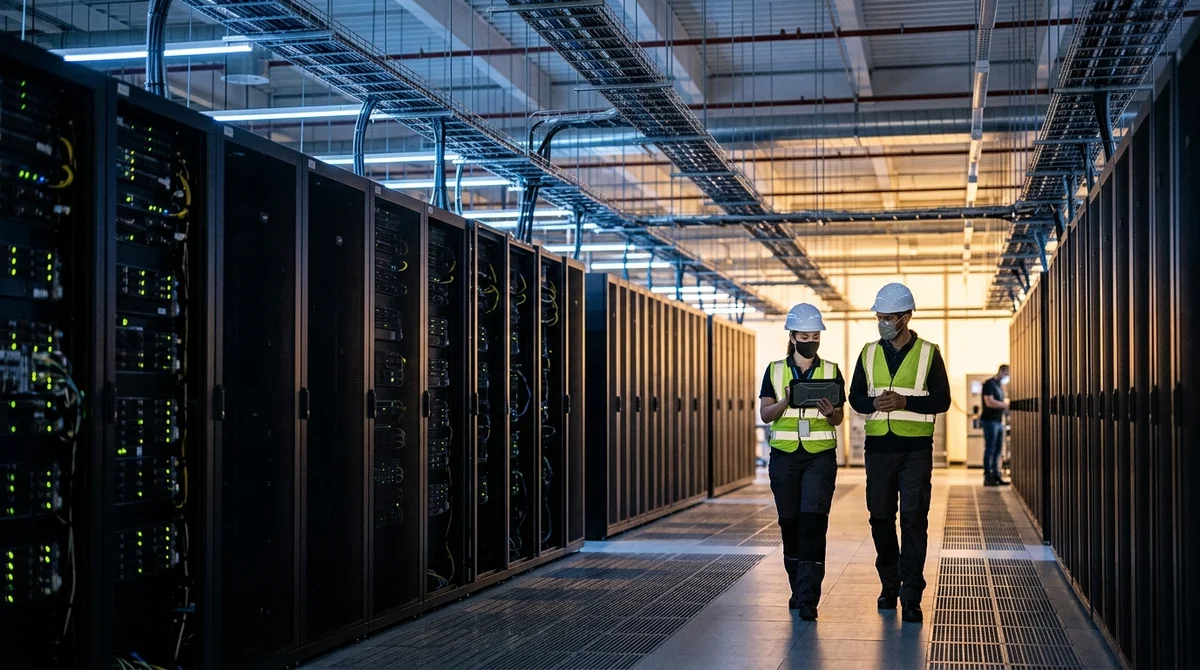
China is launching a large-scale state program to develop AI infrastructure with a budget of $295 billion, the largest bet on computing power in the country's history as it competes with the US.
Scale and structure of the program
The investment plan covers several key areas. Funds will go toward building new data centers in strategically important regions, laying high-speed data transmission networks, creating state computing clusters for training large AI models, and subsidizing equipment purchases for Chinese technology companies.
- Construction of large data centers in several regions of the country
- Development of fiber-optic and satellite networks for fast data transmission
- State computing clusters for training foundation models
- Subsidies for purchases of GPU clusters by private AI companies
- Integration of AI infrastructure with industrial and government systems
The program is designed to run for several years and will be carried out through a combination of direct state investment and private capital backed by state guarantees. Notably, Beijing is moving AI infrastructure into the category of strategic national assets, comparable in status to energy and transport.
The race with American data centers
An equally large expansion is under way on the other side of the Pacific. Microsoft, Google, Amazon and Meta* together plan to spend more than $300 billion on expanding computing capacity in 2025–2026 alone. At the same time, the US administration is steadily tightening export restrictions on advanced chips, above all the NVIDIA H100 and its successors.
Here lies China's main structural challenge: without access to the latest American processors, the country has to build its infrastructure around alternatives, namely domestic Huawei Ascend designs and less powerful GPUs bought before sanctions were imposed. According to analysts, this creates a substantial gap in real computing power despite comparable financial investment.
Barriers: chips, energy, talent
Money solves a lot, but not everything. The program faces three serious structural constraints.
First, chips. The US is systematically cutting China off from advanced semiconductors. Domestic alternatives, including the Huawei Ascend 910C, still trail American counterparts in performance on large-model training tasks.
Second, energy. A modern data center for training foundation AI models consumes gigawatts of electricity. Concentrating the load in individual regions puts serious pressure on power grids, and generation expansion does not always keep up with demand.
Third, talent. Despite the country's huge engineering potential, leading AI researchers still gravitate toward American companies and universities, which offer higher pay and greater academic freedom.
What this means
Computing power is becoming the new oil in the global technology race. China's $295 billion investment signals that Beijing treats access to compute as a matter of national sovereignty, not just a business opportunity. For the global AI industry, this means that competition between American and Chinese systems over the next decade will be determined not only by the quality of algorithms, but by who has more computing power, and whether governments are ready to pay for it with public money.
*Meta has been designated an extremist organization and banned in Russia.
- Nov 1, 202616 models tested on 7 search tools: Exa averaged 10.5 out of 14, SearXNG about 3
- Nov 1, 2026Google's StreamVibe video agent beats other models by 10.7% on response timing and quality
- Nov 1, 2026OpenAI Rewrites GPT Behavior Rules: Five Values and a Chain of Command
- Nov 1, 2026Voice bots built on LLMs turn to Jev, a fast classifier, for decisions in 200–500 ms
Key Questions Answered
What are the key details on Scale and structure of the program?
The investment plan covers several key areas. Funds will go toward building new data centers in strategically important regions, laying high-speed data transmission networks, creating state computing clusters for training large AI models, and subsidizing equipment purchases for Chinese technology companies. Construction of large data centers in several regions of the country Development of fiber-optic and satellite networks for fast data transmission State computing clusters for training foundation models Subsidies for purchases of GPU clusters by private AI companies Integ
What are the key details on The race with American data centers?
An equally large expansion is under way on the other side of the Pacific. Microsoft, Google, Amazon and Meta together plan to spend more than $300 billion on expanding computing capacity in 2025–2026 alone. At the same time, the US administration is steadily tightening export restrictions on advanced chips, above all the NVIDIA H100 and its successors. Here lies China's main structural challenge: without access to the latest American processors, the country has to build its infrastructure around alternatives, namely domestic Huawei Ascend designs and less powerful GPUs boug
What are the key details on Barriers: chips, energy, talent?
Money solves a lot, but not everything. The program faces three serious structural constraints. First, chips. The US is systematically cutting China off from advanced semiconductors. Domestic alternatives, including the Huawei Ascend 910C, still trail American counterparts in performance on large-model training tasks. Second, energy. A modern data center for training foundation AI models consumes gigawatts of electricity. Concentrating the load in individual regions puts serious pressure on power grids, and generation expansion does not always keep up with demand. Third, ta
Test Frontier LLMs & Autonomous Agents in One Workspace
Run Claude Opus 5.5, GPT-6, Gemini 3.1, and DeepSeek side-by-side in Nomad AI (nomadnet.ai) — unified model routing, deep research, and multimodal workflows under one subscription.
The AI world, distilled — once a week
Seven stories that actually mattered, hand-picked. No noise, no reposts, no press releases.
Done! Check your inbox for a confirmation.