Why AI Spots Threats in Industrial Networks Where Antivirus Is Powerless
Traditional antivirus tools struggle against attacks on industrial systems. They rely on outdated signatures and simply don't know about new threats. AI and ML take a different approach: they analyze device behavior and network traffic, catching anomalies before an attack causes damage. The main difficulty is that OT systems generate noisy, incomplete data that needs serious preprocessing before a model can be trained on it.
AI-processed from Habr AI; edited by Hamidun News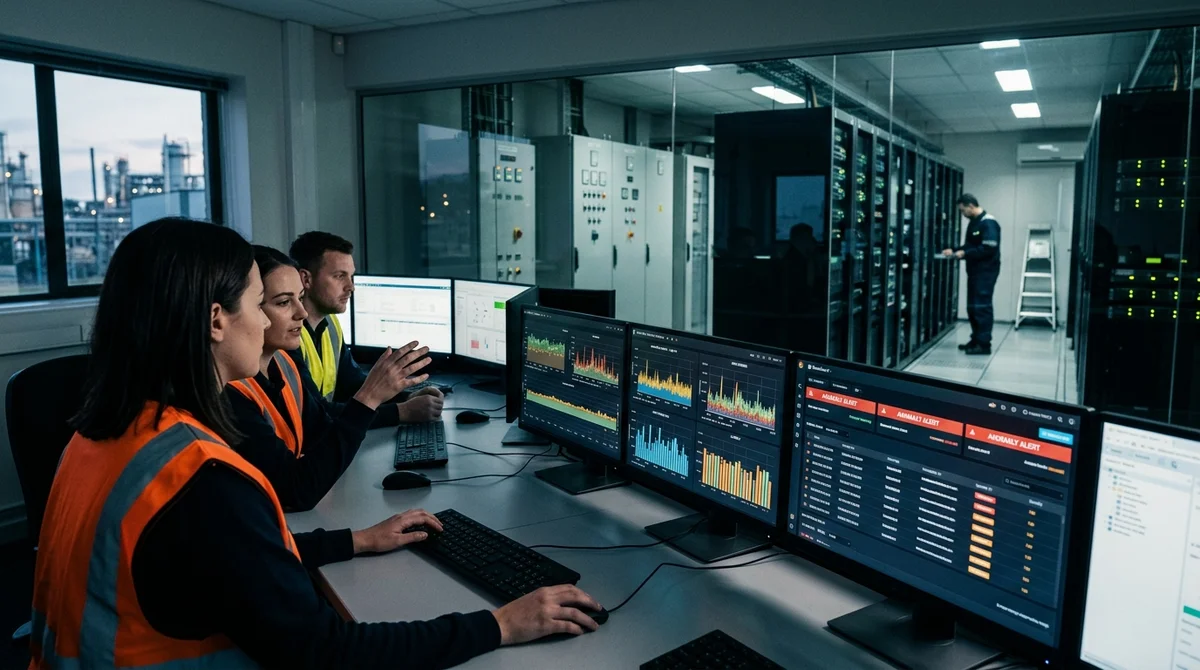
AI now protects industrial networks, because traditional antivirus tools can no longer handle the job. Machine learning models running in real time now detect anomalies in operational technology and industrial control systems.
Why signatures don't work
Signature-based antivirus and intrusion detection systems were built for IT environments. Their logic is simple: compare code against a database of known threats. Industry is fundamentally different. Attacks on industrial control systems (ICS) are often unique, tailored to specific equipment, and leave no familiar "fingerprints" in antivirus databases. By the time a vendor updates its database, the attack is already over.
In critical infrastructure such as energy, oil refining and water supply, a delay of a few hours means enormous losses or a real threat to human safety. Industrial protocols such as Modbus, DNP3 and OPC-UA were also designed without cybersecurity in mind, which makes classic threat analysis even less effective.
How AI sees hidden threats
ML-based systems don't look for specific malicious code. They build a behavioral model of the network's "normal" state and flag any significant deviation. Unusual traffic between a controller and SCADA, an atypical command frequency, an unexpected access to a device registry: each becomes an alarm signal long before an attack is fully deployed.
Time-series analysis is especially valuable: ML models see patterns that unfold over hours or even days. This is exactly how APT groups operate, methodically and slowly, trying to stay under detection thresholds. AI notices such slow anomalies where a human operator has long since moved on to other tasks.
This approach fundamentally changes how industrial facilities are defended:
- Machine learning identifies previously unknown attack vectors without a ready-made signature
- Behavioral analysis works even against zero-day threats
- Anomalies are detected in real time, before damage is done
- AI improves visibility across the entire lifecycle of an industrial system
- Automated monitoring reduces operator workload and the risk of human error
The main difficulty: noisy OT data
Deploying AI in OT environments is considerably harder than it looks at first glance. For decades, industrial systems were built to prioritize reliability and continuous operation, not data quality for analytics. As a result, sensors, programmable logic controllers (PLCs) and SCADA systems produce unstructured, incomplete and "noisy" data streams. Before a model can be trained, this data must be carefully filtered and cleaned using deep domain expertise. Without that, an ML system will react to "ghosts" instead of real threats and flood operators with false alarms.
Another problem is the age of the equipment and the scale of the data. Many SCADA systems have been running since the 1990s, while a large industrial site generates terabytes of data per day. Integrating this legacy hardware with modern ML platforms requires special adapters and rare specialists who can work in both the IT and OT worlds.
"Data in an OT environment has fundamentally different characteristics.
This is not just IT with different hardware," industrial cybersecurity specialists stress.
What this means
The shift from signature-based protection to behavioral AI in industrial networks is already happening; it is not a future concept. For enterprises with industrial control systems, it means completely rethinking security strategy: they need the right tools, quality data and teams with expertise at the intersection of IT and OT.
Companies that make this transition before others will gain a fundamental advantage in protecting critical infrastructure from threats that are invisible to traditional antivirus.
Key Questions Answered
Why signatures don't work?
Signature-based antivirus and intrusion detection systems were built for IT environments. Their logic is simple: compare code against a database of known threats. Industry is fundamentally different. Attacks on industrial control systems (ICS) are often unique, tailored to specific equipment, and leave no familiar "fingerprints" in antivirus databases. By the time a vendor updates its database, the attack is already over. In critical infrastructure such as energy, oil refining and water supply, a delay of a few hours means enormous losses or a real threat to human safety. I
How AI sees hidden threats?
ML-based systems don't look for specific malicious code. They build a behavioral model of the network's "normal" state and flag any significant deviation. Unusual traffic between a controller and SCADA, an atypical command frequency, an unexpected access to a device registry: each becomes an alarm signal long before an attack is fully deployed. Time-series analysis is especially valuable: ML models see patterns that unfold over hours or even days. This is exactly how APT groups operate, methodically and slowly, trying to stay under detection thresholds. AI notices such slow
What are the key details on The main difficulty: noisy OT data?
Deploying AI in OT environments is considerably harder than it looks at first glance. For decades, industrial systems were built to prioritize reliability and continuous operation, not data quality for analytics. As a result, sensors, programmable logic controllers (PLCs) and SCADA systems produce unstructured, incomplete and "noisy" data streams. Before a model can be trained, this data must be carefully filtered and cleaned using deep domain expertise. Without that, an ML system will react to "ghosts" instead of real threats and flood operators with false alarms. Another
Test Frontier LLMs & Autonomous Agents in One Workspace
Run Claude Opus 5.5, GPT-6, Gemini 3.1, and DeepSeek side-by-side in Nomad AI (nomadnet.ai) — unified model routing, deep research, and multimodal workflows under one subscription.
The AI world, distilled — once a week
Seven stories that actually mattered, hand-picked. No noise, no reposts, no press releases.
Done! Check your inbox for a confirmation.