OpenAI Released Specialized GPT-Rosalind Model for Biomedical Research
OpenAI introduced a new version of GPT-Rosalind—a specialized AI model for biological research at the enterprise level. It combines the power of GPT-5.5 with advanced tools for drug development, analysis, and design, molecular modeling, and laboratory experiment automation. The model is designed to significantly accelerate the processes of drug discovery and development in the pharmaceutical industry.
AI-processed from @OpenAI; edited by Hamidun News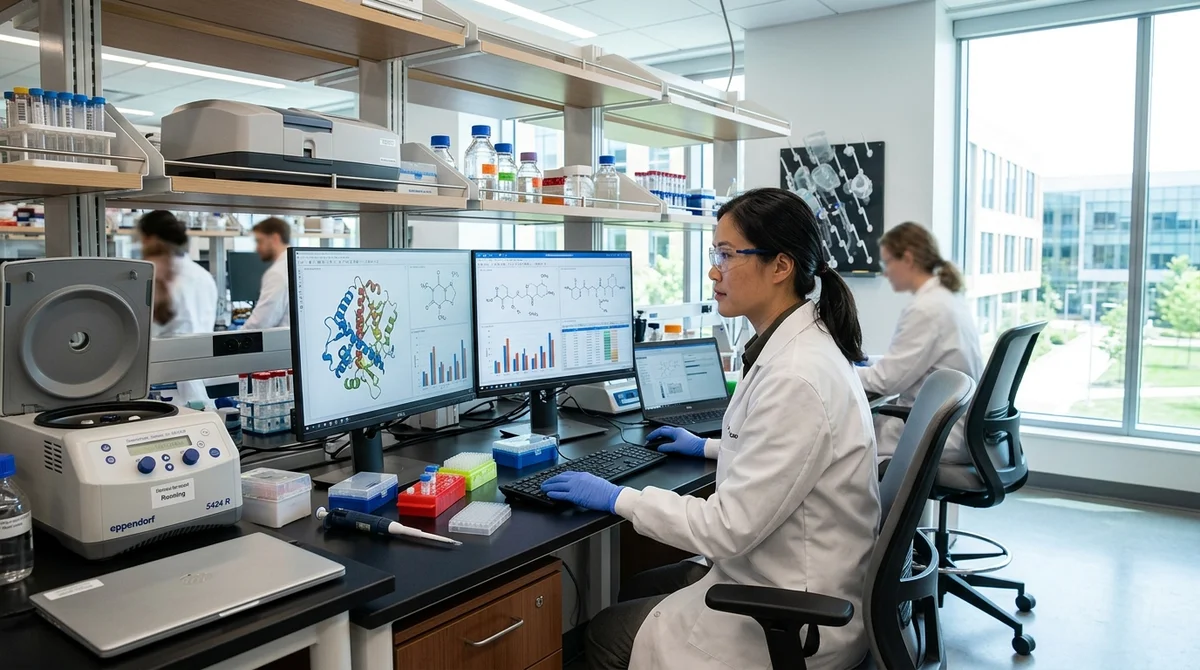
OpenAI presented an updated version of GPT-Rosalind—a specialized AI model created specifically for research in life sciences and molecular biology. Unlike the universal GPT-5.5, this solution was retrained on a vast corpus of scientific literature, chemical databases, and biomedical research to better understand the context and logic of work in this field.
Architecture and Key Capabilities
The new generation of GPT-Rosalind integrates several powerful components. First, it has agentic coding capabilities—the system can write, test, and execute specialized code for analyzing large volumes of biological and chemical data. Second, the model possesses advanced tool use capabilities—it can work directly with scientific software, molecular structure databases, molecular dynamics simulators, and 3D protein modeling and other biological system tools. Thanks to deep training on specialized data, GPT-Rosalind goes beyond simple information analysis. The model can generate new hypotheses for experiments, propose molecular structure designs with required properties, and predict outcomes based on molecular characteristics and historical data. Essentially, this transforms the model from an information processing tool into an active participant in the scientific research process.
Applications in Pharmaceuticals and Biomedicine
OpenAI positions GPT-Rosalind as a tool for accelerating several critical stages of drug development:
- Drug discovery—automated identification of new molecular targets and screening of millions of potential compounds
- Molecular design—creation of new chemical structures with specified pharmacological properties
- Data analysis—automatic processing of experimental results and interpretation of complex biomedical information flows
- Experiment planning—automated design, optimization, and prediction of laboratory research outcomes
- Candidate optimization—refinement of molecular structures before proceeding to clinical trials
The model is available at enterprise scale, making it possible to integrate it into existing scientific workflows, laboratory information management systems (LIMS), and scale to large research teams. This is especially important for pharmaceutical companies working with confidential information and required to meet strict regulatory and information security requirements.
What This Means
The release of GPT-Rosalind confirms the trend toward creating specialized AI models for specific professional domains. Instead of attempting to apply a universal model to all tasks, developers are creating solutions optimized specifically for biology, chemistry, finance, or other fields with their own specialized language, logic, and reliability requirements. For the life sciences industry, this opens significant opportunities: acceleration of the drug development cycle, reduction of costs at early research stages, increased probability of experimental success, and leveling of competitive capabilities for small companies in computational chemistry and bioinformatics.
Need AI working inside your business — not just in your newsfeed?
I build production AI for companies — custom CRM, internal tools, autonomous agents, workflow automation. Owned by you, shaped to your process, no per-seat tax. Built by Zhemal Khamidun, CPO of AlpinaGPT (AI platform, 6,000+ users).
The AI world, distilled — once a week
Seven stories that actually mattered, hand-picked. No noise, no reposts, no press releases.
Done! Check your inbox for a confirmation.