Gareth Edwards on Why AI Will Beat CGI in Filmmaking
Gareth Edwards, director of Rogue One and Jurassic World Rebirth, has come out in support of generative AI in filmmaking. Speaking at an Amazon conference in California, he said AI is better than traditional CGI and compared it to the camera, one of a director's main tools. His remarks have stirred debate in Hollywood, where attitudes toward AI remain deeply conflicted.
AI-processed from Guardian; edited by Hamidun News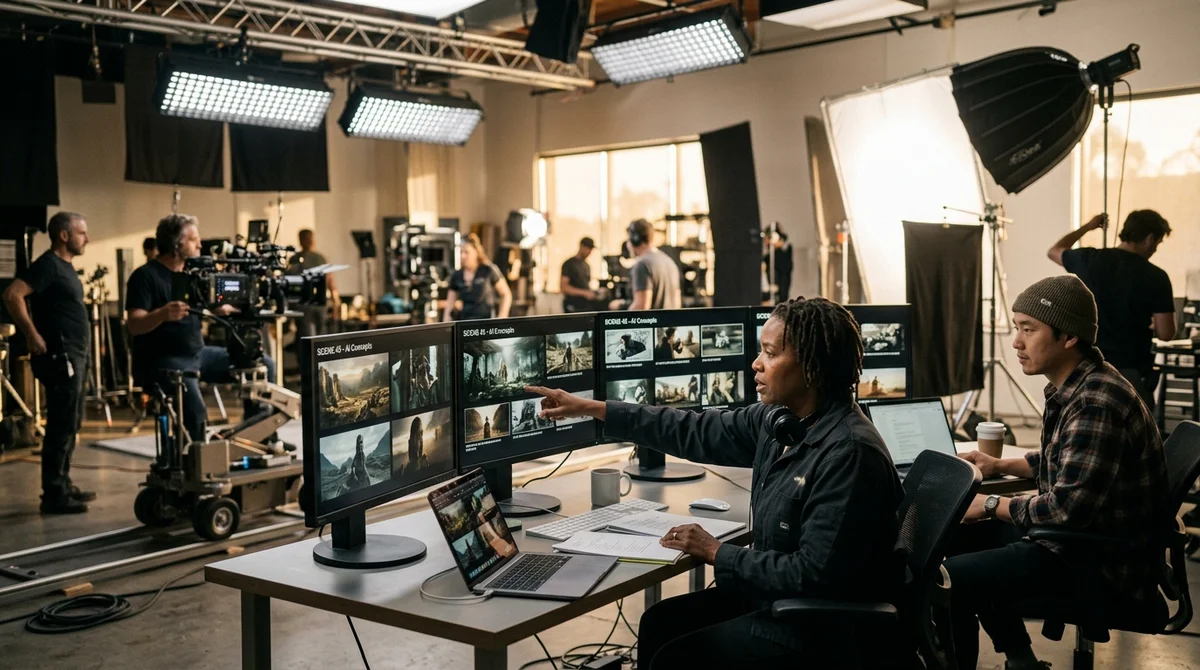
Gareth Edwards, director of Rogue One and the upcoming Jurassic World Rebirth, spoke at Amazon's AI on the Lot conference in California and openly endorsed generative AI in filmmaking. His comments caused a stir in Hollywood, where attitudes toward AI remain full of contradictions.
How Edwards sees AI's place in filmmaking
The director's position was categorical and clear: generative AI is a tool on the level of the film camera, with no exaggeration or speculation. He said outright that he sees no reason why a professional director would not want to use the technology in their work. Edwards stressed that AI can handle practically any creative request and already beats traditional CGI on both quality of results and speed of production.
At the conference, the director called AI a genius assistant in a filmmaker's work, using vivid language to convey his enthusiasm. In an interview with The Hollywood Reporter he developed the thought further, comparing AI with other revolutionary technologies that once seemed impossible in the industry:
"I don't see why you wouldn't be interested in this.
It's clearly a tool that stands alongside the camera. It will be better than CGI."
What exactly is changing in film production
A statement from a director of Edwards' stature is not just one person's opinion; it is a significant signal for the whole industry. When star directors start talking publicly about AI as an evolution of the toolset rather than a threat, it changes how studios, producers and investors perceive the technology.
Traditional CGI requires months of painstaking work, complex software and large specialized teams. AI, by Edwards' logic, can speed up the whole process many times over, give directors creative freedom and let them experiment almost in real time without significant budget losses. That could radically change the economics of film production.
The specific advantages Edwards sees:
- Cutting the time to create visual effects from months to days or weeks
- Faster iteration on visual concepts right on set
- Lower costs for expensive traditional CGI and lengthy rendering
- The ability to experiment with scenarios and effects in real time without reworking
- Wider creative options for the director without the technical limits of software packages
Why this matters right now
Edwards spoke at an event organized by Amazon, a company that is actively investing in AI for media and film. His support is no accident: it is part of a broader trend in which major studios and directors are starting to integrate AI into their workflows. Over the past year, several Hollywood projects have experimented with AI for creating backgrounds, improving compositing and other supporting elements, with mixed success.
However, directors and filmmakers in the industry have real concerns about how AI will affect jobs, creative rights and authorship. Edwards' position is an attempt to reframe the discussion: not replacing people, but expanding their toolset and creative possibilities.
What this means for the film industry
When major Hollywood directors start talking about AI as their assistant and tool, it means the technology has stopped being an experiment and become a practical reality. For filmmaking, this may mean an upheaval in how special effects are created, how directors work with virtual worlds and how films are made overall.
Edwards in effect gives the green light for adopting AI across the industry, and his voice will be heard in meetings with investors and producers.
- Nov 2, 2026The Verge reviewer builds a $50 Meta Muse Charm alternative with Claude Code
- Oct 31, 2026Worldwide Express hands disputed invoices to AI agents and cuts unresolved disputes by 75%
- Oct 30, 2026AWS gives coding agents a live site preview straight from an isolated session
- Oct 30, 2026Agent traffic on Zocdoc is up 30x since July, and ChatGPT faces two health lawsuits
Key Questions Answered
How Edwards sees AI's place in filmmaking?
The director's position was categorical and clear: generative AI is a tool on the level of the film camera, with no exaggeration or speculation. He said outright that he sees no reason why a professional director would not want to use the technology in their work. Edwards stressed that AI can handle practically any creative request and already beats traditional CGI on both quality of results and speed of production. At the conference, the director called AI a genius assistant in a filmmaker's work, using vivid language to convey his enthusiasm. In an interview with The Holl
What exactly is changing in film production?
A statement from a director of Edwards' stature is not just one person's opinion; it is a significant signal for the whole industry. When star directors start talking publicly about AI as an evolution of the toolset rather than a threat, it changes how studios, producers and investors perceive the technology. Traditional CGI requires months of painstaking work, complex software and large specialized teams. AI, by Edwards' logic, can speed up the whole process many times over, give directors creative freedom and let them experiment almost in real time without significant bud
Why this matters right now?
Edwards spoke at an event organized by Amazon, a company that is actively investing in AI for media and film. His support is no accident: it is part of a broader trend in which major studios and directors are starting to integrate AI into their workflows. Over the past year, several Hollywood projects have experimented with AI for creating backgrounds, improving compositing and other supporting elements, with mixed success. However, directors and filmmakers in the industry have real concerns about how AI will affect jobs, creative rights and authorship. Edwards' position is
Ship AI Faster with Founders, Engineers & Weekly Architecture Reviews
Inside Vibe Club (hamidun.com/club) — weekly live masterminds with Zhemal Khamidun, Tech Radar, full LMS access, and 370+ production Claude Code skills.
The AI world, distilled — once a week
Seven stories that actually mattered, hand-picked. No noise, no reposts, no press releases.
Done! Check your inbox for a confirmation.