Google I/O 2026: 12 key announcements on Gemini Omni and other AI services
At I/O 2026, Google announced key updates to the Gemini lineup: Omni, a new multimodal model for complex analytical tasks; Gemini 3.5 Flash, a lightweight model for mobile devices; and deeper AI integration in Search, Gmail, Docs and Sheets. The company bet mainly on processing speed, energy efficiency, deeper understanding of context and accessible tools for developers.
AI-processed from Google AI Blog; edited by Hamidun News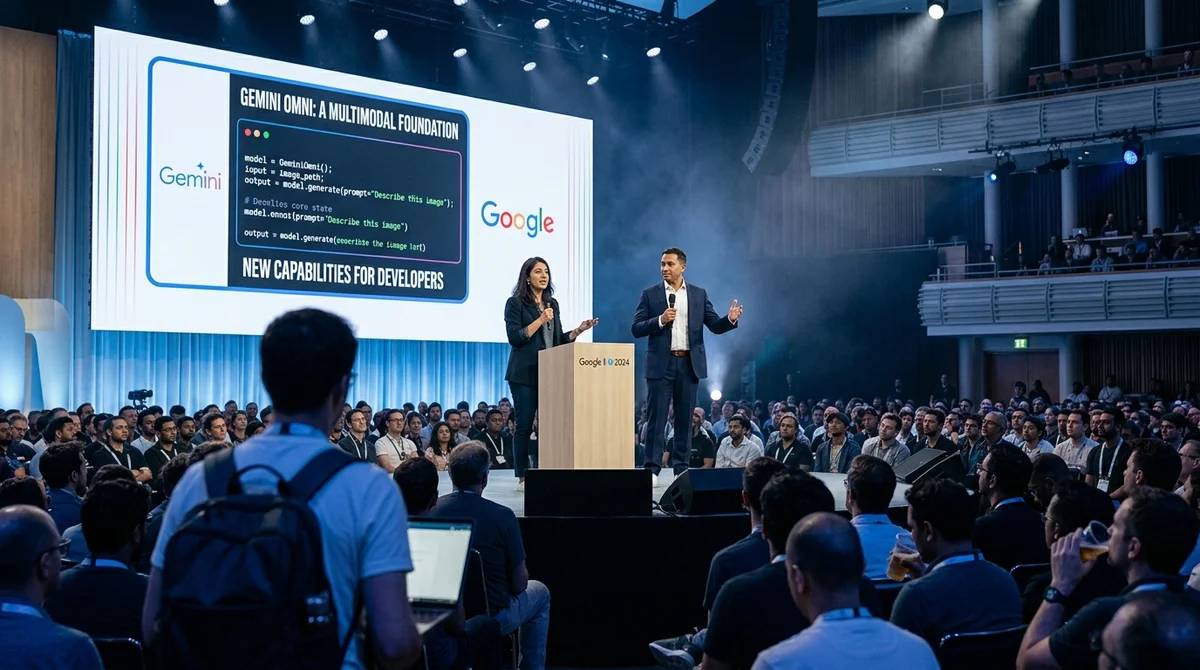
At Google I/O 2026, the company presented an ambitious set of 12 key announcements that redefine its position in the AI race. The focus is on new versions of the Gemini model, the integration of artificial intelligence into everyday Google services, and developer tools that widen access to these technologies.
Gemini Omni: a universal model for complex tasks
The multimodal Gemini Omni was the star of the conference. What sets Omni apart from earlier versions is its ability to analyze text, images, video and audio at the same time, processing information with a depth of context not available before. Omni is designed for complex analytical tasks, from analyzing video with a text commentary overlay to processing multichannel data streams in real time.
Omni's main practical advantage is speed. The model runs noticeably faster, which makes it suitable for production applications that require low latency and high throughput. Google demonstrated Omni on video analysis and simultaneous translation from several languages.
Gemini 3.5
Flash: a lightweight version for mobile ecosystems
The second group of updates covered Gemini 3.5 Flash, a lightweight version optimized for mobile devices, smartwatches, embedded systems and IoT applications.
Flash's main advantage is energy efficiency. The model consumes significantly fewer resources than full-size versions, letting apps run longer on a single charge and reducing processor load. Flash also improved at understanding the context of short utterances, which is critical for voice assistants and quick interaction through messaging apps. The company promises to build Flash into the Android ecosystem starting next quarter.
Built-in AI in everyday Google services
The second half of the announcements covered how Gemini is being integrated into services used by hundreds of millions of people:
- Google Search — Gemini now helps rephrase queries and gives detailed explanations of complex search results
- Gmail — the AI assistant automatically suggests draft replies and summarizes long email threads
- Google Docs and Sheets — built-in document editing and data analysis powered by Gemini
- Google Photos — automatic organization of photos by context, creation of collections, and search by the meaning of images
- Google Meet — real-time translation and automatic meeting summaries
The integration was designed not to slow down the services themselves. Gemini works in the background and offers help unobtrusively, without cluttering the interface.
"We want AI to be a useful assistant, not distracting noise in your work,"
Google's developers said at the conference.
Price cuts and new developer tools
Google announced a significant price cut for the Gemini API for small and medium-sized teams. The new pricing scheme is based on actual token consumption in the request context, which lets developers save on large processing volumes.
Developers got an expanded set of tools:
- Detailed model usage analytics and performance metrics
- Ready-made templates for a quick start in Python, JavaScript, Go and other languages
- Updated documentation with examples for Omni and Flash
- An SDK with built-in monitoring and debugging support
What this means
Google clearly wants to speed up AI's move from research labs into real applications and business processes. Its three strategic focuses, Omni's performance for analytics, Flash's energy efficiency for mobile devices and built-in availability in everyday services, show that the company is now competing not on hype around new models but on how convenient and practical they are to use.
The coming months will show how quickly developers and companies start using these new tools in their projects.
- Nov 1, 2026Google's StreamVibe video agent beats other models by 10.7% on response timing and quality
- Nov 1, 2026OpenAI Rewrites GPT Behavior Rules: Five Values and a Chain of Command
- Nov 1, 2026Voice bots built on LLMs turn to Jev, a fast classifier, for decisions in 200–500 ms
- Nov 1, 2026Google admits AI Mode cuts search revenue, shares fall 15%
Key Questions Answered
What are the key details on Gemini Omni: a universal model for complex tasks?
The multimodal Gemini Omni was the star of the conference. What sets Omni apart from earlier versions is its ability to analyze text, images, video and audio at the same time, processing information with a depth of context not available before. Omni is designed for complex analytical tasks, from analyzing video with a text commentary overlay to processing multichannel data streams in real time. Omni's main practical advantage is speed. The model runs noticeably faster, which makes it suitable for production applications that require low latency and high throughput. Google d
What are the key details on Gemini 3.5 Flash: a lightweight version for mobile ecosystems?
The second group of updates covered Gemini 3.5 Flash, a lightweight version optimized for mobile devices, smartwatches, embedded systems and IoT applications. Flash's main advantage is energy efficiency. The model consumes significantly fewer resources than full-size versions, letting apps run longer on a single charge and reducing processor load. Flash also improved at understanding the context of short utterances, which is critical for voice assistants and quick interaction through messaging apps. The company promises to build Flash into the Android ecosystem starting nex
What are the key details on Built-in AI in everyday Google services?
The second half of the announcements covered how Gemini is being integrated into services used by hundreds of millions of people: Google Search — Gemini now helps rephrase queries and gives detailed explanations of complex search results Gmail — the AI assistant automatically suggests draft replies and summarizes long email threads Google Docs and Sheets — built-in document editing and data analysis powered by Gemini Google Photos — automatic organization of photos by context, creation of collections, and search by the meaning of images Google Meet — real-time translation a
Test Frontier LLMs & Autonomous Agents in One Workspace
Run Claude Opus 5.5, GPT-6, Gemini 3.1, and DeepSeek side-by-side in Nomad AI (nomadnet.ai) — unified model routing, deep research, and multimodal workflows under one subscription.
The AI world, distilled — once a week
Seven stories that actually mattered, hand-picked. No noise, no reposts, no press releases.
Done! Check your inbox for a confirmation.