Samsung to Distribute £310,000 Bonuses to Employees Due to AI Boom in Memory
Samsung will distribute average bonuses of £310,000 to each employee in its memory division through a new profit-sharing agreement driven by growing revenues from the global AI boom. Labor unions backed the deal, with 74% of 62,000 employees voting in favor. This clearly demonstrates how accelerating demand for AI chips is transforming revenues for the world's largest memory manufacturers.
AI-processed from Guardian; edited by Hamidun News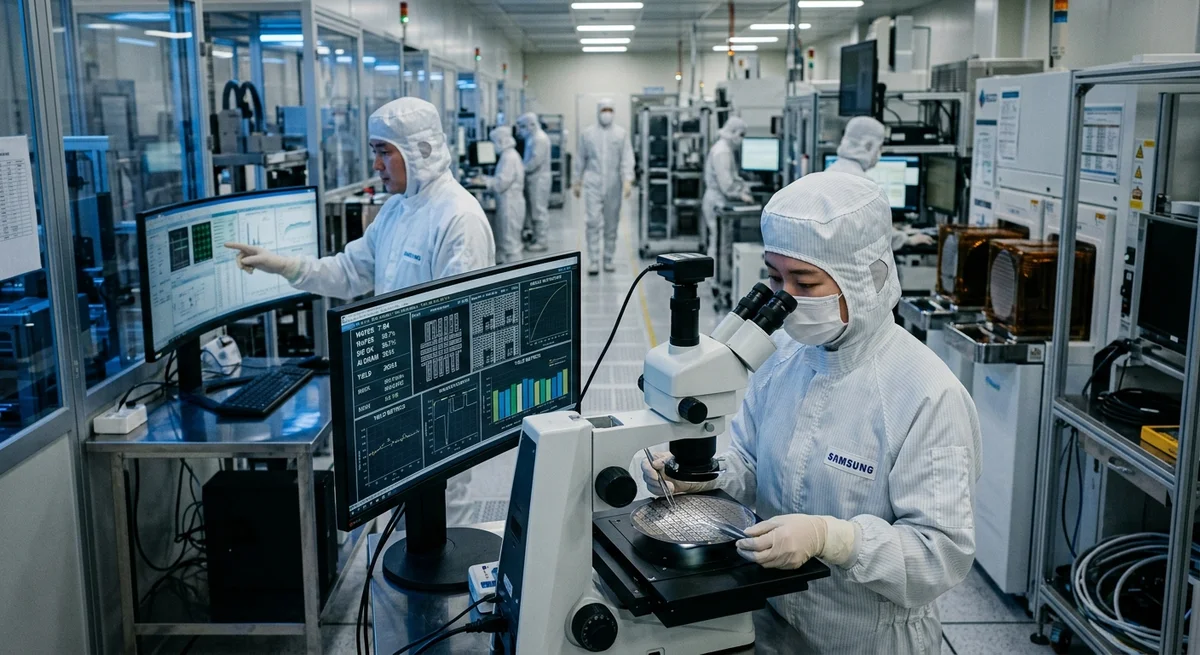
Samsung will distribute historic bonuses to its memory division employees through a profit-sharing agreement born from the AI boom wave. This final agreement demonstrates how rapidly semiconductor manufacturers' revenues are growing amid artificial intelligence demand, and how companies are willing to generously reward workers for their contribution to this prosperity.
Trillion-Level Bonuses
Two major Samsung labor unions notified employees of the successful completion of lengthy negotiations. Each of the 62,616 memory division employees will receive an average of £310,000 in bonuses — a sum that attracts many to this work. The vote showed overwhelming support: 74% of those who voted approved the agreement, successfully averting the threat of a major strike.
This is not a typical bonus size for the electronics industry. Such bonuses became possible thanks to Samsung's sharp increase in profitability in recent months. Demand for memory chips needed for deploying AI systems and large language models has skyrocketed exponentially. Prices for DRAM (random access memory) and NAND (flash memory) have reached historic highs. Samsung, as the world's largest memory manufacturer, is capturing the lion's share of this enormous revenue stream and is now sharing the fruits with the workers who created this product.
Competition for Talent and Stability
Over the past two years, all major semiconductor manufacturers — Samsung, SK Hynix, TSMC, Intel — have engaged in fierce competition for talented engineers and technicians, who have become critical resources in the rapidly growing industry. A shortage of skilled workers has led to wage increases and intense competition for top talent. Samsung faces particularly acute pressure: its manufacturing facilities are operating at maximum capacity, and any downtime on production lines costs the company billions in lost sales.
If the union had initiated a strike, Samsung could have lost billions given such extraordinary demand for its products. Therefore, generous bonuses represent a strategic investment in production stability. Additionally, these payments strengthen worker loyalty at a company known for its demanding corporate culture.
Maintaining stability at manufacturing facilities during the AI boom is not merely desirable — it is a critical necessity.
The Trillion-Dollar Club and Memory's New Reality
Two weeks ago, Samsung and its main competitor SK Hynix joined the so-called trillion-dollar club — a group of companies with market capitalization exceeding $1 trillion. This happened almost simultaneously and became a clear symbol of the industry's transformation. Previously, memory manufacturers were considered a boring, low-margin segment of the electronics industry, producing 'commoditized' goods. Today, it is one of the most profitable and fastest-growing sectors in all of electronics. This transformation has been driven by explosive demand for computing power for AI.
Chip demand is growing much faster than manufacturing capacity can expand:
- NVIDIA and AMD are expanding GPU production to meet growing demand for AI computing
- TSMC, Samsung, and Intel are competing for contract orders to manufacture advanced nodes for new AI chips
- DRAM and NAND memory prices remain at historic highs due to acute supply shortages
- Investments in new fabs have reached record levels — companies are investing hundreds of billions in expanding production capacity
What This Means
Samsung's agreement demonstrates that the AI boom is not limited to software companies and startups — it is fundamentally transforming the economics of hardware and the entire supply chain. The benefits of AI demand are flowing up the supply chain, reaching memory and processor manufacturers. And now these benefits are beginning to be shared with the workers who create these critical components. However, beneath this optimism lies a deeper signal: the industry is at the peak of cyclical demand. When demand for AI chips eventually stabilizes, prices will inevitably fall, profits will shrink, and such generous bonuses may become rare.
Need AI working inside your business — not just in your newsfeed?
I build production AI for companies — custom CRM, internal tools, autonomous agents, workflow automation. Owned by you, shaped to your process, no per-seat tax. Built by Zhemal Khamidun, CPO of AlpinaGPT (AI platform, 6,000+ users).
The AI world, distilled — once a week
Seven stories that actually mattered, hand-picked. No noise, no reposts, no press releases.
Done! Check your inbox for a confirmation.