Semiconductors Are Entering a Growth Supercycle, NewEdge Strategist Says
Cameron Dawson, chief investment strategist at NewEdge Wealth, believes semiconductor stocks are entering a growth supercycle. He forecasts that demand for AI chips, electric vehicles and data centers will sustain a multi-year bull trend for the industry. Dawson calls the current state of the industry the "mother of all supercycles," a historically significant growth period that he says will redefine the investment landscape for years to come.
AI-processed from Bloomberg Tech; edited by Hamidun News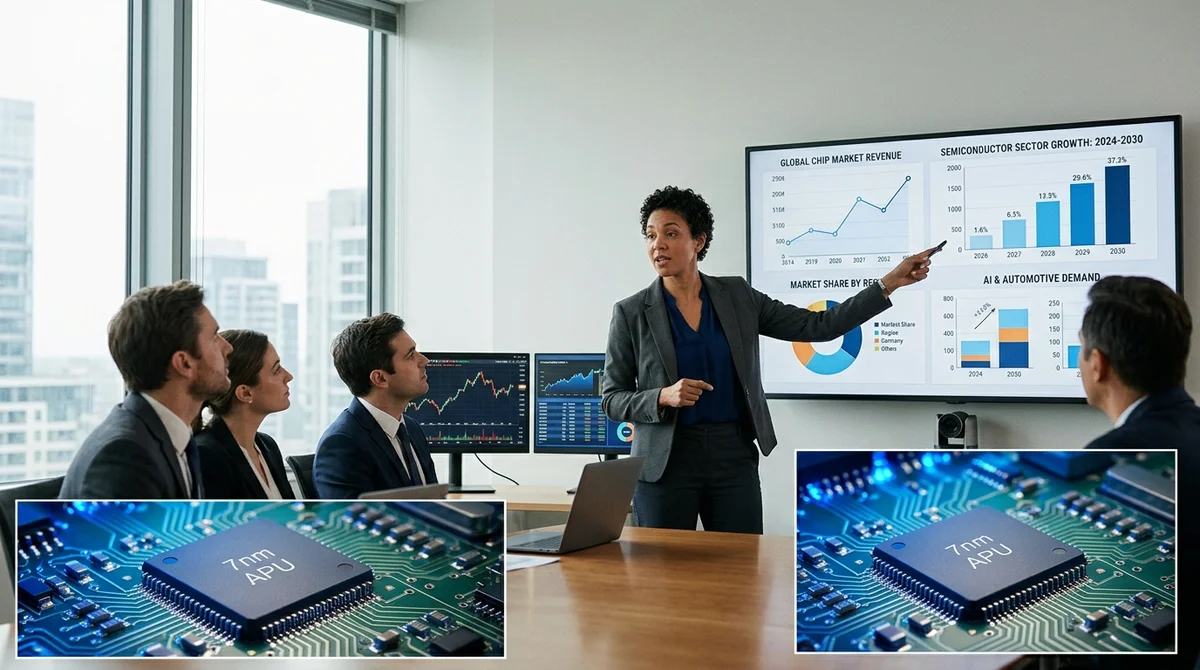
Cameron Dawson, chief investment strategist at NewEdge Wealth, called the current state of the semiconductor industry the "mother of all supercycles": a historically significant growth period that will redefine the investment landscape for years to come.
Why this is a supercycle
In investment parlance, a supercycle is a period of multi-year structural growth in which underlying economic forces, not short-term trends, push demand higher. For semiconductors, such a moment rarely arrives. Dawson believes we are now seeing a unique convergence of several megatrends: the AI revolution requires millions of new chips, cloud providers are upgrading their entire infrastructure, and electric vehicles and IoT devices are opening new demand categories.
This is not just temporary demand for GPUs to run neural networks. It is a structural rebuild of the entire global IT ecosystem around a new computing paradigm. Every major cloud provider — Google, Microsoft, Amazon, Meta — is investing hundreds of billions in data center expansion. Every automaker is moving to electric platforms. Every government is rushing to build local semiconductor production for strategic independence.
"This is not just a cycle, it is a rebuilding of the economy" — in essence, that is what
Dawson implies in his forecast.
Drivers of long-term growth
The reasons Dawson sees a supercycle rather than just a cycle:
- AI and data centers — giant cloud providers are investing in capacity expansion for LLMs and other AI applications
- Energy transition — semiconductors are needed in every electric vehicle, charging station and grid management system
- IoT and edge computing — billions of new sensors require specialized chips at the network edge
- Geopolitical competition — governments are funding local semiconductor production, creating new markets
- Legacy upgrades — old systems are moving to new architectures, requiring complete re-equipping
In the past, each of these factors created a growth cycle of 3–5 years. Together, they set the conditions for decades of growth, which is what makes this the "mother" of all cycles.
Long-term outlook
What sets a supercycle apart from an ordinary cycle is its duration and depth of penetration. Past semiconductor booms (the 1990s with the internet, the 2010s with mobile) usually ended in corrections after a few years and were confined to specific applications. The current supercycle spans everything from cloud computing to transportation, energy and industry.
That means short-term volatility in the sector is noise against a long-term structural trend. Investors with a horizon of several years can treat corrections as buying opportunities rather than signs of a crash.
What this means
If Dawson's forecast is right, semiconductor stocks are at the start of a historic growth period comparable to the adoption of the internet or mobile technology. This is a rebuild of the global economy, not just demand for a single product category. For investors, it means the present moment may be an optimal entry point into the sector for years to come.
*Meta has been designated an extremist organization and is banned in Russia.
- Nov 1, 202616 models tested on 7 search tools: Exa averaged 10.5 out of 14, SearXNG about 3
- Nov 1, 2026Google's StreamVibe video agent beats other models by 10.7% on response timing and quality
- Nov 1, 2026OpenAI Rewrites GPT Behavior Rules: Five Values and a Chain of Command
- Nov 1, 2026Voice bots built on LLMs turn to Jev, a fast classifier, for decisions in 200–500 ms
Key Questions Answered
Why this is a supercycle?
In investment parlance, a supercycle is a period of multi-year structural growth in which underlying economic forces, not short-term trends, push demand higher. For semiconductors, such a moment rarely arrives. Dawson believes we are now seeing a unique convergence of several megatrends: the AI revolution requires millions of new chips, cloud providers are upgrading their entire infrastructure, and electric vehicles and IoT devices are opening new demand categories. This is not just temporary demand for GPUs to run neural networks. It is a structural rebuild of the entire g
What are the key details on Drivers of long-term growth?
The reasons Dawson sees a supercycle rather than just a cycle: AI and data centers — giant cloud providers are investing in capacity expansion for LLMs and other AI applications Energy transition — semiconductors are needed in every electric vehicle, charging station and grid management system IoT and edge computing — billions of new sensors require specialized chips at the network edge Geopolitical competition — governments are funding local semiconductor production, creating new markets Legacy upgrades — old systems are moving to new architectures, requiring complete re-e
What are the key details on Long-term outlook?
What sets a supercycle apart from an ordinary cycle is its duration and depth of penetration. Past semiconductor booms (the 1990s with the internet, the 2010s with mobile) usually ended in corrections after a few years and were confined to specific applications. The current supercycle spans everything from cloud computing to transportation, energy and industry. That means short-term volatility in the sector is noise against a long-term structural trend. Investors with a horizon of several years can treat corrections as buying opportunities rather than signs of a crash.
Test Frontier LLMs & Autonomous Agents in One Workspace
Run Claude Opus 5.5, GPT-6, Gemini 3.1, and DeepSeek side-by-side in Nomad AI (nomadnet.ai) — unified model routing, deep research, and multimodal workflows under one subscription.
The AI world, distilled — once a week
Seven stories that actually mattered, hand-picked. No noise, no reposts, no press releases.
Done! Check your inbox for a confirmation.