Swiss Startup Builds a Four-Armed Robot for Space Stations
Swiss startup Orbit Robotics has unveiled Helios, a four-armed robot built to work inside space stations. In microgravity, the two front arms anchor the robot to the structure while the two rear arms handle the main tasks. An hour of astronaut time on the ISS costs roughly $140,000, so the robot could pay for itself within a few years of regular use.
AI-processed from TNW; edited by Hamidun News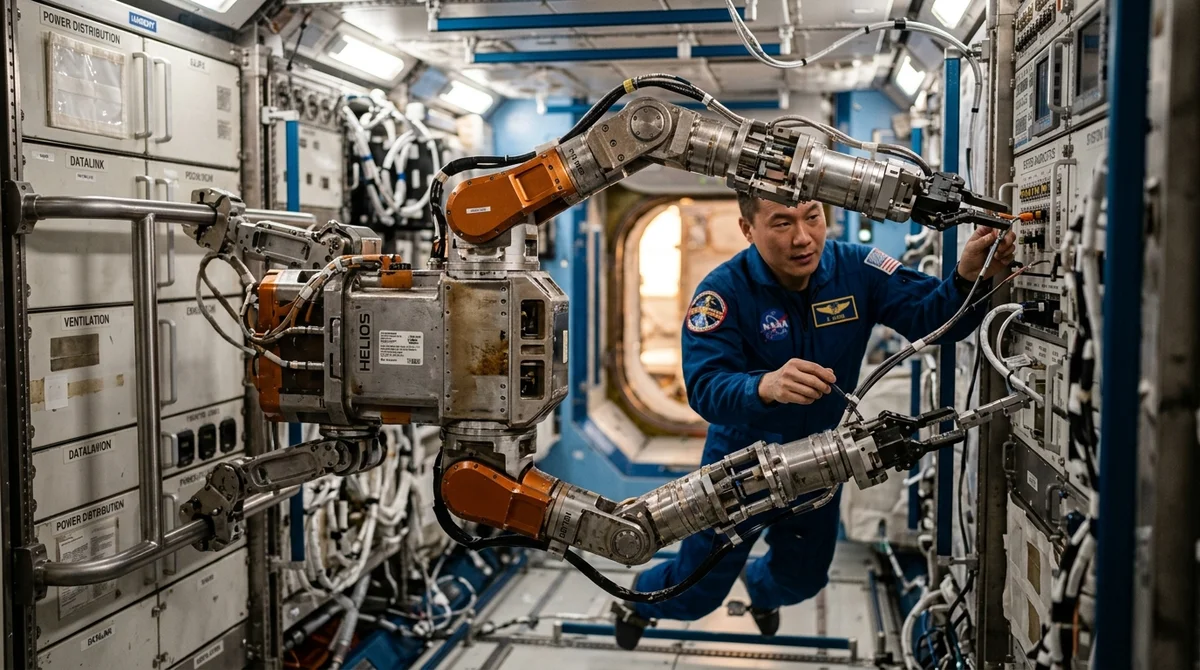
Swiss startup Orbit Robotics has unveiled Helios, a four-armed robot built to work inside space stations. In microgravity, the classic two-legged design simply doesn't work. The engineers took an unusual but logical route, one that could become the standard for orbital robotics.
Four arms versus zero gravity
Astronauts work in bulky spacesuits, tethered to the station by cables and safety lines. Legs are no help in microgravity: there's no "down," and nothing to brace against. Helios tackles the problem differently. Its two front arms anchor to handrails and panels inside the station, leaving the two rear arms free for the main work.
From an engineering standpoint, the design makes sense. Anchoring and task execution happen at the same time. There are no unnecessary legs taking up room in narrow passageways and adding weight at launch. Every kilogram of cargo sent to the ISS costs thousands of dollars to transport.
This approach lets the robot:
- Hold its position in zero gravity without additional anchoring mechanisms
- Perform maintenance with two working arms at once
- Operate in narrow passageways, enclosed modules, and hard-to-reach compartments
- Work without requiring modifications to existing station structures
Helios can be fitted with different tools depending on the task, from monitoring sensors and video cameras to welding modules and mechanical grippers.
The economics of an hour in space
The numbers are striking. Every hour of astronaut work on the ISS costs about $140,000. That figure covers astronaut preparation (months of training), rocket transport, medical insurance, and compensation for health risks.
A robot that takes over routine or hazardous operations cuts those costs directly. Helios can handle equipment diagnostics, preventive system maintenance, component repairs, and cargo organization. If the robot saves even 20 hours a year, its development and delivery costs will pay off within a few seasons. For next-generation commercial space stations, that could be a decisive competitive factor.
"Helios is the first step toward robotizing the interior of space
stations," the developers said in the announcement.
What it still has to prove
Helios faces a harsh proving ground. Microgravity, extreme temperature swings from -70 to +120 degrees Celsius, and cosmic radiation will all test the machine's reliability.
Once the robot reaches the ISS or a commercial station, it will have to work in hazardous zones: repairing solar panels, operating in low-pressure compartments, and handling substances dangerous to humans. The first months of operation will show whether Helios is ready for everyday tasks or needs further work.
What it means
Automation in space is scaling up. If Helios proves reliable, orbit will be populated by a whole fleet of specialized robots: helpers that work around the clock, take no days off, and don't require huge costs to ferry them up and back.
That could reshape the economics of orbital projects for decades to come and open the way to cheap, 100% automated scientific and industrial activity in orbit.
- Nov 1, 2026Pika Labs releases open video model H3 Flex: 6 steps instead of 50
- Nov 1, 2026Google's StreamVibe video agent beats other models by 10.7% on response timing and quality
- Oct 31, 2026AI cartoon series: a 24-second episode built ten ways, the best cost 162 credits
- Oct 31, 2026Anthropic: Fold Subagents Back Into a Single Loop — One Customer's Tasks Ran Twice as Fast
Key Questions Answered
What are the key details on Four arms versus zero gravity?
Astronauts work in bulky spacesuits, tethered to the station by cables and safety lines. Legs are no help in microgravity: there's no "down," and nothing to brace against. Helios tackles the problem differently. Its two front arms anchor to handrails and panels inside the station, leaving the two rear arms free for the main work. From an engineering standpoint, the design makes sense. Anchoring and task execution happen at the same time. There are no unnecessary legs taking up room in narrow passageways and adding weight at launch. Every kilogram of cargo sent to the ISS co
What are the key details on The economics of an hour in space?
The numbers are striking. Every hour of astronaut work on the ISS costs about $140,000. That figure covers astronaut preparation (months of training), rocket transport, medical insurance, and compensation for health risks. A robot that takes over routine or hazardous operations cuts those costs directly. Helios can handle equipment diagnostics, preventive system maintenance, component repairs, and cargo organization. If the robot saves even 20 hours a year, its development and delivery costs will pay off within a few seasons. For next-generation commercial space stations, t
What it still has to prove?
Helios faces a harsh proving ground. Microgravity, extreme temperature swings from -70 to +120 degrees Celsius, and cosmic radiation will all test the machine's reliability. Once the robot reaches the ISS or a commercial station, it will have to work in hazardous zones: repairing solar panels, operating in low-pressure compartments, and handling substances dangerous to humans. The first months of operation will show whether Helios is ready for everyday tasks or needs further work.
Test Frontier LLMs & Autonomous Agents in One Workspace
Run Claude Opus 5.5, GPT-6, Gemini 3.1, and DeepSeek side-by-side in Nomad AI (nomadnet.ai) — unified model routing, deep research, and multimodal workflows under one subscription.
The AI world, distilled — once a week
Seven stories that actually mattered, hand-picked. No noise, no reposts, no press releases.
Done! Check your inbox for a confirmation.