Scotland's 'Green' Data Center Policy Ignores AI Emissions
Scotland's government attracts investors to AI data centers under the banner of environmental responsibility. However, an analysis revealed that the definition of a 'green' center from 2022, before ChatGPT, does not account for emissions from model training, chip production, and supporting infrastructure. Environmental deception wrapped in green rhetoric.
AI-processed from Guardian; edited by Hamidun News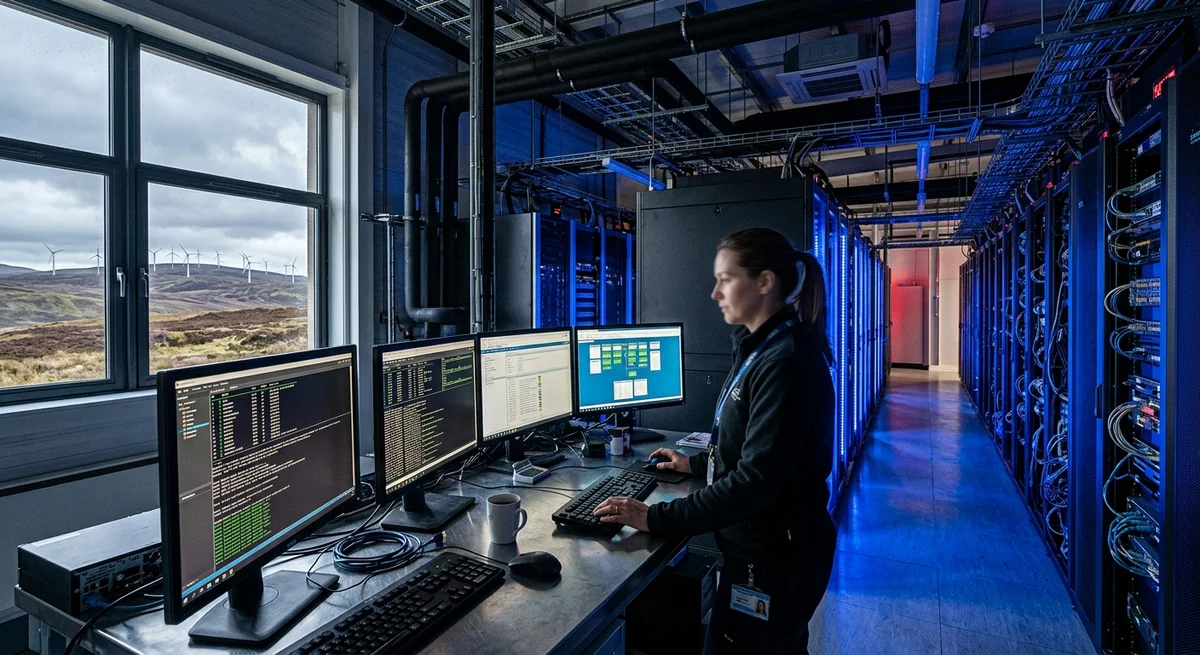
Scotland's government positions its country as an ideal location for building next-generation data centers. Low natural temperatures reduce cooling costs, an abundance of renewable energy (wind farms, hydroelectric plants) aligns with environmental ambitions, and tax incentives attract major AI industry players. This is part of Britain's broader plan to capture a share of the global artificial intelligence market while OpenAI, Google, and other giants are choosing locations for new computing clusters.
However, an analysis by the charity Action to Protect Rural Scotland revealed a critical problem: the policy known as 'green data centers' is based on a definition written in 2022—an era when ChatGPT had not yet changed the world. This definition does not account for the real carbon footprint of modern AI computing, which could lead to environmental deception at the scale of national policy.
What 'Green' Means in Scotland
According to the 2022 definition, a green data center is a facility powered by renewable energy sources and meeting strict energy efficiency standards. Power from wind and water is verified, server cooling capacity is monitored, and cable network architecture is analyzed. Five years ago, this made perfect sense. The primary workload was traditional IT services: websites, cloud storage, corporate databases. Energy consumption was predictable and stable, and computing did not require continuous model training on petabytes of data.
AI Rewrote the Equation
But since 2023, the situation has reversed. Training a large language model requires hundreds of millions of kilowatt-hours. A single query to ChatGPT requires power equivalent to the daily consumption of a small cottage. OpenAI, Anthropic, and other industry leaders speak openly about the problem, but this is not reflected in Scottish policy. Renewable energy powers the servers, but it doesn't change the fundamental fact: AI itself is an energy-intensive machine of wonders, requiring cooling, backup systems, and continuous maintenance. If Scotland attracts two or three major centers for model training, the region's energy consumption could increase by 15-20% without visible benefits beyond tax revenues.
What the Definition Hides
Action to Protect Rural Scotland points to ignored sources of emissions:
- The carbon footprint of chip production—from rare earth mining to lithography plant operations
- Emissions from training AI models at industrial-scale data volumes
- Environmental damage in the data labeling supply chain (often in countries without environmental standards)
- Transportation of equipment thousands of kilometers from the USA, South Korea, and Taiwan
- Indirect emissions from supporting infrastructure—employee offices, office buildings, roads
A paradox emerges that policy exploits: a data center can be powered by 100% renewable energy while generating harm that simply isn't measured in official statistics.
What This Means
Scotland risks becoming the country that attracts petawatts of computing power under the banner of environmental responsibility, yet masks a carbon crisis with green rhetoric. Definitions from four years ago became obsolete in three years. As the AI industry grows at the speed of light, old measurements don't work.
- Oct 28, 2026Keystone removes the model name from code: open-source LLM gateway adds 0.64 ms
- Oct 28, 2026Wired Tested 6 AI Agents in a Day: Dots Leads, Gemini Spark Fails at Lunch
- Oct 28, 2026Anthropic Turns Claude Code Into a Platform: Claude Mods Flip the Agent Harness
- Oct 28, 2026Liquid AI releases LFM2.5-24B-A2B: an agent model with 2B active parameters
Key Questions Answered
What 'Green' Means in Scotland?
According to the 2022 definition, a green data center is a facility powered by renewable energy sources and meeting strict energy efficiency standards. Power from wind and water is verified, server cooling capacity is monitored, and cable network architecture is analyzed. Five years ago, this made perfect sense. The primary workload was traditional IT services: websites, cloud storage, corporate databases. Energy consumption was predictable and stable, and computing did not require continuous model training on petabytes of data.
What are the key details on AI Rewrote the Equation?
But since 2023, the situation has reversed. Training a large language model requires hundreds of millions of kilowatt-hours. A single query to ChatGPT requires power equivalent to the daily consumption of a small cottage. OpenAI, Anthropic, and other industry leaders speak openly about the problem, but this is not reflected in Scottish policy. Renewable energy powers the servers, but it doesn't change the fundamental fact: AI itself is an energy-intensive machine of wonders, requiring cooling, backup systems, and continuous maintenance. If Scotland attracts two or three maj
What the Definition Hides?
Action to Protect Rural Scotland points to ignored sources of emissions: The carbon footprint of chip production—from rare earth mining to lithography plant operations Emissions from training AI models at industrial-scale data volumes Environmental damage in the data labeling supply chain (often in countries without environmental standards) Transportation of equipment thousands of kilometers from the USA, South Korea, and Taiwan Indirect emissions from supporting infrastructure—employee offices, office buildings, roads A paradox emerges that policy exploits: a data center c
Test Frontier LLMs & Autonomous Agents in One Workspace
Run Claude Opus 5.5, GPT-6, Gemini 3.1, and DeepSeek side-by-side in Nomad AI (nomadnet.ai) — unified model routing, deep research, and multimodal workflows under one subscription.
The AI world, distilled — once a week
Seven stories that actually mattered, hand-picked. No noise, no reposts, no press releases.
Done! Check your inbox for a confirmation.