DeepMind forecasts AGI by 2030: Hassabis on AI revolution
Demis Hassabis, head of Google DeepMind, predicted at Google I/O that strong artificial intelligence (AGI) will emerge by 2030. According to him, the technology will revolutionize global computing systems. Hassabis is convinced that AGI will be a turning point not only for the IT sector but for the entire economy, transforming decision-making processes.
AI-processed from 3DNews AI; edited by Hamidun News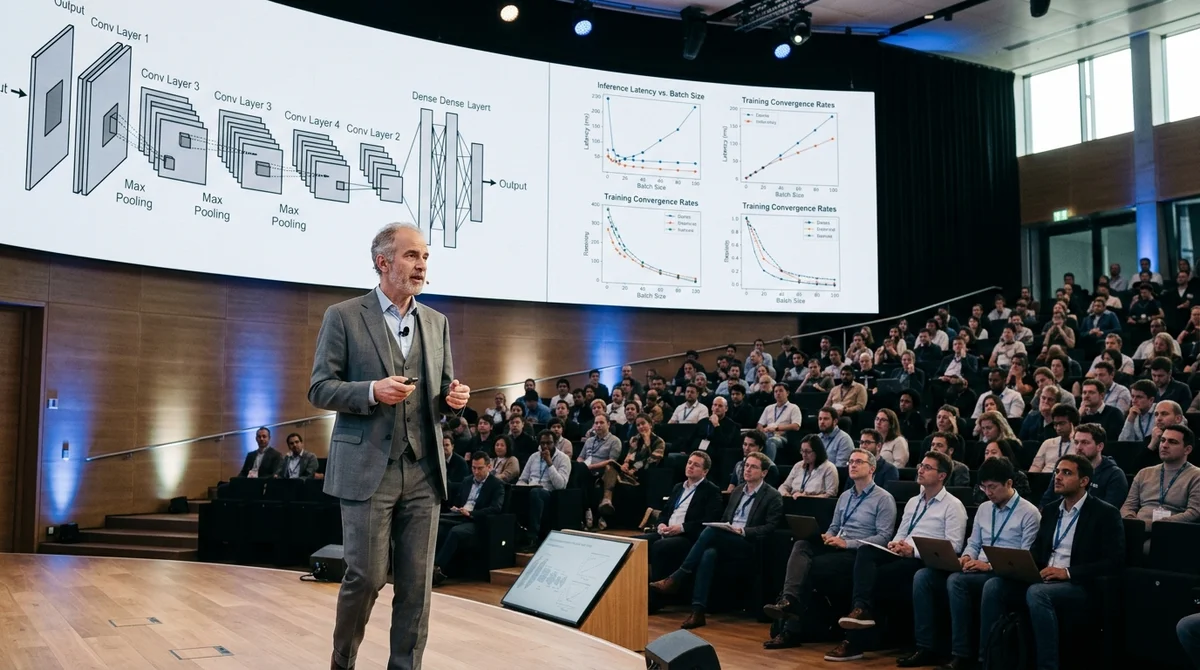
Demis Hassabis, CEO of Google DeepMind, took the stage at Google I/O with a bold forecast: strong artificial general intelligence (AGI) will emerge around 2030. According to him, this technology will fundamentally transform not only global computing systems, but the economy as a whole, rewriting the rules for every industry.
Hassabis's Forecast: AGI Is Already Close
At Google I/O, Hassabis spoke plainly: AGI is no longer a distant fantasy, but a very real future that is approaching faster than many think. He defined AGI as an artificial intelligence system capable of solving tasks at the level of human intelligence across a broad spectrum of complex problems—from scientific discoveries to economic planning. DeepMind is actively moving toward this goal.
Over the past three years, the team has achieved breakthroughs in neural network architectures, model generalization capabilities, and scaling efficiency. Current successes in multimodal systems (working simultaneously with text, images, and video) demonstrate that the fundamental building blocks for AGI are already in place. According to Hassabis, the remaining work is in optimization and overcoming the last fundamental obstacles.
Scale of Change: What Will Be Transformed
If DeepMind's forecast is correct, the consequences will be revolutionary. Here's what the industry should expect:
- Boundless automation—systems solve complex problems independently, without human involvement in the loop
- Explosive growth in scientific discoveries—acceleration of research in biology, medicine, and physics by orders of magnitude
- Reassessment of IT infrastructure—the transition to AGI-optimized architectures will require trillions of dollars
- Economic transformation—new models of production, services, and value distribution
- Urgency of security—control over AGI will become a critical task for states and regulators
Hassabis emphasizes that the transition will be gradual, not explosive, but irreversible. Organizations that are now preparing their systems for the AGI era will gain significant competitive advantage.
Why 2030?
DeepMind is not just throwing a number out there. Trend analysis shows the realism of this timeline. First, computing power is growing exponentially: data center capacity doubles every 1.5–2 years. Second, algorithms are becoming more efficient—less data and computation are needed to achieve the same result. Third, the shift to multimodal models has shown that systems generalize knowledge better when trained on diverse data. However, Hassabis is honest about the uncertainties. Much depends on unexpected breakthroughs in learning theory, solving the energy consumption problem of large models, and the industry's ability to overcome current plateaus in quality improvement. By 2030, significant barriers may remain that require conceptual breakthroughs.
What This Means
Hassabis's forecast is not a warning but a call to action. If AGI truly approaches 2030, then now—in 2026–2029—the foundations are being laid for the safe and effective development of this technology. For investors, startups, and large corporations, this means one thing: betting on AGI-oriented solutions is no longer speculation, but strategic necessity.
Companies that now invest in research and development, train engineers, and transition their systems to AGI-compatible architectures will be ahead of competitors tomorrow. For regulators and policymakers, the challenge is even more urgent: rules need to be developed quickly while AGI is still in the development phase. The absence of international safety standards could result in chaos.
Therefore, Hassabis, alongside his optimism, calls for responsibility: AGI is not only an opportunity but a serious challenge for humanity.
Need AI working inside your business — not just in your newsfeed?
I build production AI for companies — custom CRM, internal tools, autonomous agents, workflow automation. Owned by you, shaped to your process, no per-seat tax. Built by Zhemal Khamidun, CPO of AlpinaGPT (AI platform, 6,000+ users).
The AI world, distilled — once a week
Seven stories that actually mattered, hand-picked. No noise, no reposts, no press releases.
Done! Check your inbox for a confirmation.