Google combines Street View and AI to create virtual training worlds
Google unveiled a new version of Project Genie — an AI that generates fully functional 3D worlds from Google Street View coordinates. Robots can train in a virt
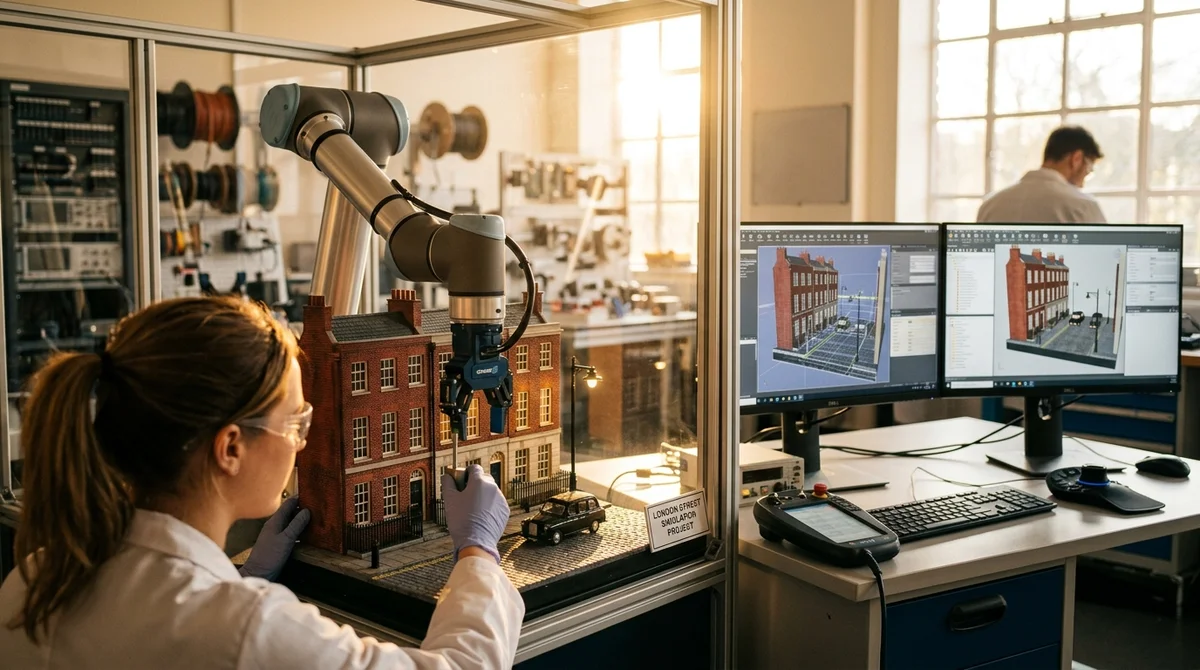
Google presented an update to Project Genie — a generative model that creates fully functional 3D worlds tied to real coordinates from Google Street View. For the first time, AI gained the ability not just to generate video, but to create interactive virtual environments where robots can learn without contact with the physical world.
What are world models
World models differ from ordinary video generation in that they don't just draw a sequence of frames — they build understanding of physics, causality, and the three-dimensional structure of the world. The model learns from video and interaction examples, and then can predict what will happen if a robot performs a specific action. A robot trained on such a model can plan trajectories, avoid obstacles, and practice complex navigation skills in a virtual environment, then apply this knowledge to reality. This is significantly different from video models like Sora, which simply generate plausible video sequences without complete understanding of physics.
Genie 3 and Google Street View
Google integrated Project Genie with its own Google Street View database — millions of street photographs from around the world with known coordinates and three-dimensional geometry. Now you can select a real place (for example, a square in London or a street in New York) and the AI will generate a complete 3D world of that place with correct proportions. Robots can train on routes of real cities without leaving the data center. This is critical for autonomous systems: instead of millions of hours of actual driving, a vehicle learns in an accelerated virtual environment. Waymo is already testing this approach for its autonomous vehicles.
- Binding to real coordinates from Google Street View
- Generation of complete 3D geometry with physics
- Interactive environment where a robot acts and sees results
- Scalability: worlds can be generated for any place on Earth
Production pipeline: Unity and Blender
The most important thing in the new version is integration with tools that developers already use. Google added MCP connectors for Unity and Blender, allowing the generated worlds to be used directly in favorite engines without export and conversion. A developer can select a place in Google Street View, get a ready-made 3D scene, import it into Unity or Blender and add logic, characters, and interactivity. Previously, this process required weeks of manual work by 3D artists. Now the initial scene is generated automatically in minutes.
Why this changes gamedev and robotics
For robotics this is an acceleration of months of development. For gamedev — a reduction in the entry barrier for indie developers who previously either hired expensive artists or used ready-made assets. A city based on a real place is now generated in seconds. Waymo, Boston Dynamics, and other companies have proven that quality simulation is critical for practical AI. Genie 3 makes simulation scalable and tied to reality.
What this means
World models are transitioning from research laboratories to a working tool. The next stage of AI in robotics and gamedev will not be about video generation, but about creating an interactive world in which an agent can act and learn. Google has already shown how this works in practice.