Local Qwen3.6-27B vs. cloud models: why privacy is not the main point
Local Qwen3.6-27B presents a real alternative to cloud-based Claude and GPT. The main advantage of local models is not just privacy — it is full control, no net
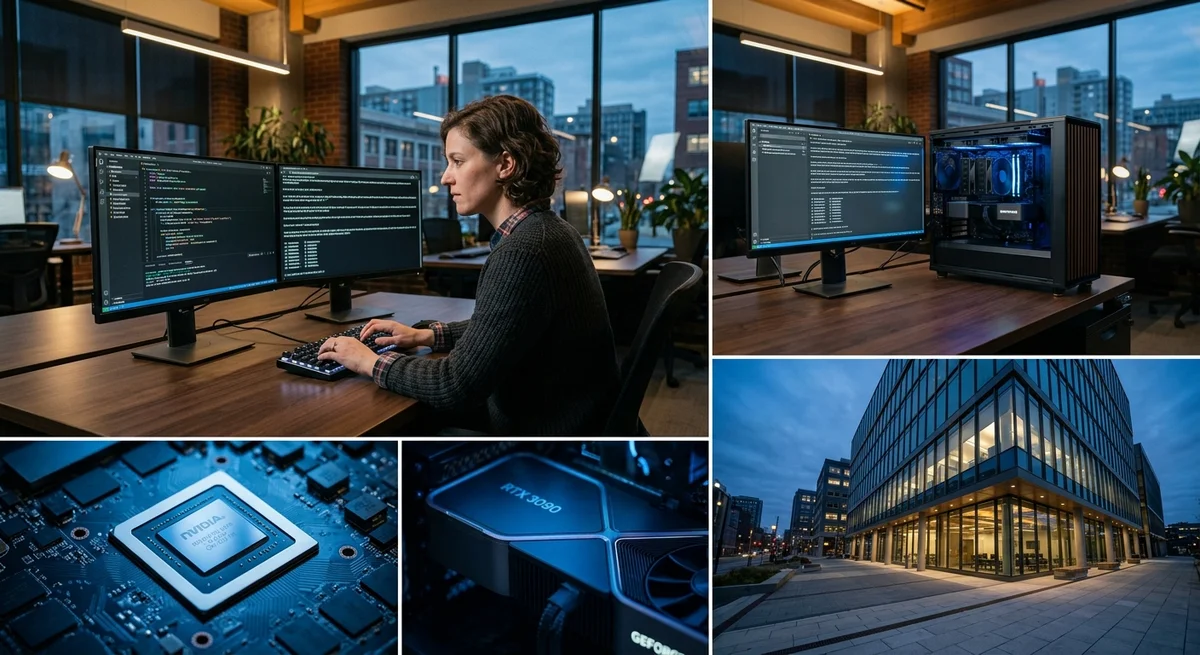
Local Qwen3.6-27B Model vs Cloud Models: Why Privacy Isn't the Main Thing
The local Qwen3.6-27B model challenges the standard answer to the question of how local AI is better than cloud-based Claude or GPT. When the question is raised for the first time, the first answer usually sounds like: privacy. Yes, privacy is critical. But this is only a guarantee, not an advantage.
Privacy as a condition, not as a win
Standard logic: a local model stores all data on your computer, while a cloud solution sends it to Anthropic, OpenAI, or Google servers. This is true, and it's important. But in 2026, guaranteeing that your data doesn't go to the cloud is not an advantage—it's a threshold requirement, a standard of hygiene. The real, practical advantages of local models lie further:
- Network-free inference — the response is generated directly on your GPU in milliseconds
- Unlimited request volume — no API counter, no rate limiting
- Fine-tuning on your data — retrain the model for your specific use cases and language
- Offline operation — the model works without internet at all
- Complete provider independence — when OpenAI goes down, your system doesn't
From Hardware to Control
A cloud API is not just a model; it's a service locked into a business model. OpenAI and Anthropic don't simply provide code; they impose usage policies. Content filters, performance restrictions, geographic limitations, regular API changes—all of these are the provider's decisions. Local Qwen3.6-27B is a tool, not a service. Want to retrain the model on a specialized dataset? Run it in production on your own hardware? Customize tokenization or architecture? It's all in your hands. The model executes your code, not the cloud platform's policies.
"A local model gives you a tool; a cloud API gives you a service—these
are fundamentally different things."
Economics: One Investment Instead of Recurring Payments
OpenAI, Google, and Anthropic earn money on volume. The more tokens processed, the higher the bill. For a startup or company processing millions of documents, this can be a seven-figure annual expense. A local model requires a one-time GPU investment (from $5K to $20K depending on power). After that, you only pay for electricity. If you use the model in production—development, testing, data processing—a local solution pays for itself in 3–6 months of intensive use, then becomes virtually free.
What This Means
Qwen3.6-27B shows that local models have moved beyond the category of "hobbyist experiments" and become a practical alternative for companies. Privacy, control, economics, independence—four reasons to choose a local model over a cloud API. Privacy is only one of them, and often not even the most important.