OpenAI model refuted the central hypothesis of discrete geometry
An OpenAI model solved the 80-year-old unit distance problem, refuting the central hypothesis of discrete geometry. This is a historic milestone: for the first
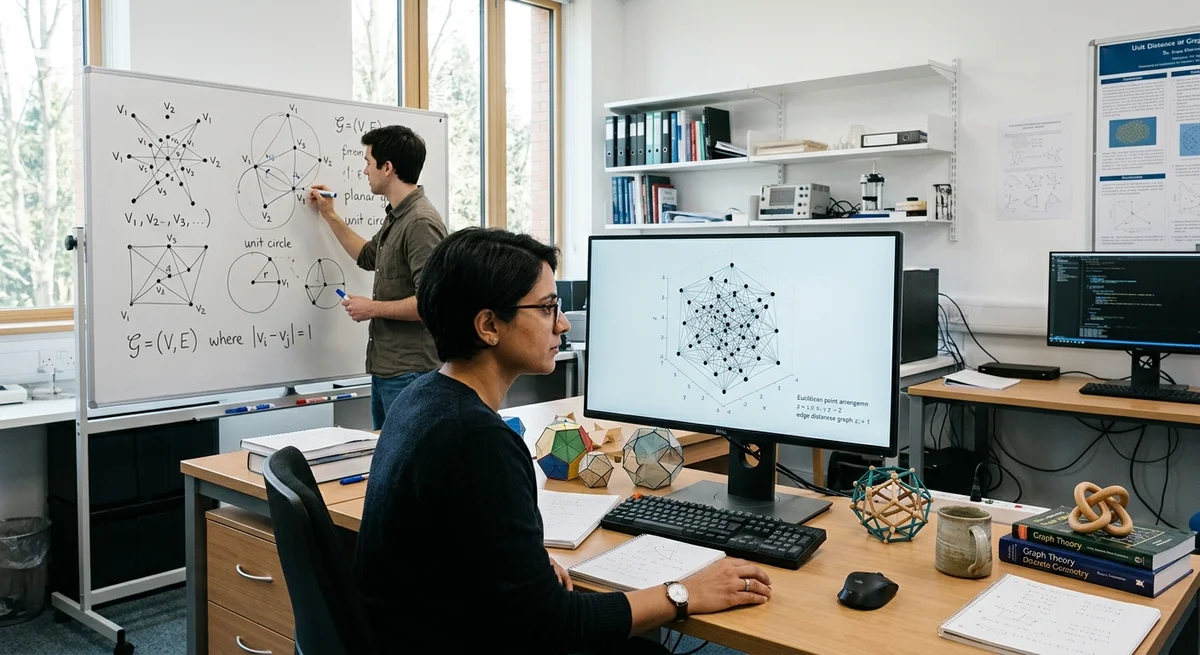
OpenAI model proved what seemed impossible: it refuted a central hypothesis in discrete geometry, solving the 80-year-old unit distance problem — one of the classical unsolved problems of modern mathematics.
What is the unit distance problem
In 1946, Hungarian mathematician Paul Erdős formulated a question that has been captivating researchers ever since: what is the maximum number of points that can be placed in d-dimensional space such that the distance between any two points is exactly one unit?
The question sounds simple, but the answer has proved elusive. In the plane (in 2D), the answer is known — seven points. But in three-dimensional space and beyond, the solution has remained unknown for eight decades. This is not an academic puzzle: the problem touches on fundamental questions about the structure of space and its discrete properties.
The problem belongs to the field of discrete geometry — a branch of mathematics that deals with finite sets of points, lines, polygons, and other geometric objects. Discrete geometry has applications in crystallography, computer graphics, and optimization. Although the unit distance problem is formulated elementarily, its solution requires a deep understanding of combinatorial and geometric structures.
How the neural network refuted the hypothesis
OpenAI trained a model on a representative set of known proofs and results in discrete geometry. The neural network learned to recognize complex patterns in mathematical structures and, critically, to propose counterexamples to existing hypotheses.
As a result of training, the model independently generated a specific configuration of points that refuted one of the central and long-standing hypotheses in discrete geometry. Researchers then formally verified the result and confirmed its mathematical correctness.
This was a historic moment: AI did not simply compute a numerical answer, did not simply help a human, but produced an original, previously unknown mathematical discovery. Human mathematicians subsequently verified the result independently and recognized its validity.
- AI found a counterexample to the hypothesis in less time than a team of analysts would have needed
- The proof underwent rigorous verification and was approved by experts in discrete geometry
- The result was published as a full scientific contribution and can be cited
Why this is a turning point
A proof of impossibility (that is, a refutation of a hypothesis) is one of the most valuable types of results in pure mathematics. Each such refutation revolutionizes the understanding of an entire field of research. If a hypothesis that mathematicians checked for 80 years is false, then all consequences from it, all work built on this assumption, require rethinking.
For AI, this marks a transition from the role of auxiliary tool (human assistant) to the role of independent researcher, capable of making independent discoveries. The model did not simply help a scientist narrow down options or test a hypothesis — it independently formulated and substantiated a result that was not in its training data.
"This demonstrates the potential of AI in fundamental science," emphasize
OpenAI researchers in their report.
What this means for science
The result opens a new path for applying large language models and other AI systems to pure mathematics, theoretical physics, and fundamental sciences. If neural networks can find new proofs, refutations, and counterexamples, they will be able to accelerate research in areas where variant enumeration, combinatorial complexity, and the need to test multiple hypotheses currently slow human progress.
This does not mean that mathematicians will become unnecessary — rather, AI will become a powerful partner, expanding the boundaries of what is possible to investigate.