Google updated Project Genie to create 3D worlds from Street View
Google updated Project Genie with Street View integration. AI can now convert panoramic images of real places into interactive 3D spaces in a matter of seconds.
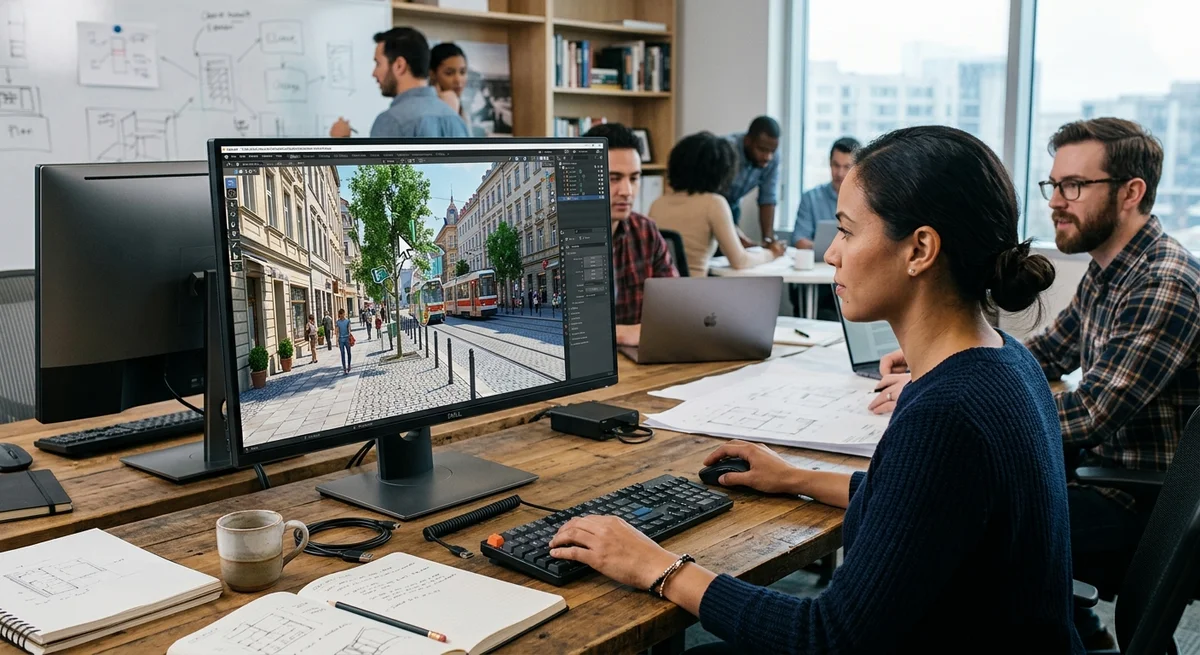
Project Genie — Google's experimental 3D-world generator — received an important update. The company added integration with panoramic Street View images, allowing AI to create interactive 3D spaces directly from real locations.
How Google Expanded Project Genie
The tool, created earlier this year based on Google's models, now works with the Street View archive — decades of accumulated panoramas from around the world. This means that any frame from Street View can be turned into a game-like, interactive 3D space in a matter of seconds.
Previously, Project Genie required uploading a video or photo, which the AI would analyze and transform into a small three-dimensional world. The process was slower, and the result depended on the quality of the source material. Now, integration with Street View has simplified the workflow: you select a panorama — you get a ready-made 3D space.
Street View covers millions of locations, from city streets to remote villages, so the tool's potential has grown dramatically.
How the Technology Works
Project Genie uses a neural network approach to analyze a 2D image and create a 3D model with realistic physics. The AI understands depth, distance between objects, shadows and lighting. Based on this analysis, an interactive space is generated where the user can move the camera, change viewing angles, add elements.
One advantage of Google's approach is that the AI learns from real photographs, so the generated worlds look more natural than simple panorama-to-3D conversions. The quality of details is impressive, especially for street scenes with recognizable architecture.
What the Updated Tool Can Do
Project Genie generates interactive 3D environments where you can interact with the surroundings:
- Control the camera and explore the scene from all angles
- Interact with objects in the environment (open doors, move items)
- Change lighting, weather and time of day in real time
- Add characters and dynamic elements
- Export the result to game engines or 3D applications
The size of the generated world remains compact — it's not a fully functional 3D space, but rather an interactive scene that creates a convincing illusion of depth and volume.
Where This Will Be Useful
Integration with Street View opens up unexpected applications. Architects and designers can quickly prototype changes to real places — add a building, redesign a street, change landscaping.
Game developers get an environment generator that saves weeks of manual modeling. Tourism platforms will be able to offer interactive previews of locations instead of static photos. Instead of a gallery of hotel room or restaurant photos, a visitor will be able to "walk around" a 3D version.
Companies like Google Maps, Airbnb and virtual tour developers are interested in such technologies.
What This Means
Google is moving toward a world where reality and the digital merge automatically. Street View, which previously served simply as navigation, is now becoming raw material for creating interactive 3D worlds.
This trend points to a future where any place on Earth can not only be seen in photos or videos, but also explored in an interactive format without leaving home.