Сделка Nvidia по экспорту H200 в Китай застопорилась на саммите Трампа и Си
Трамп прилетел в Пекин с CEO Nvidia Jensen Huang, встретился с Си Цзиньпином, но переговоры по поставкам чипов H200 не привели к результату. Разрешение на экспо
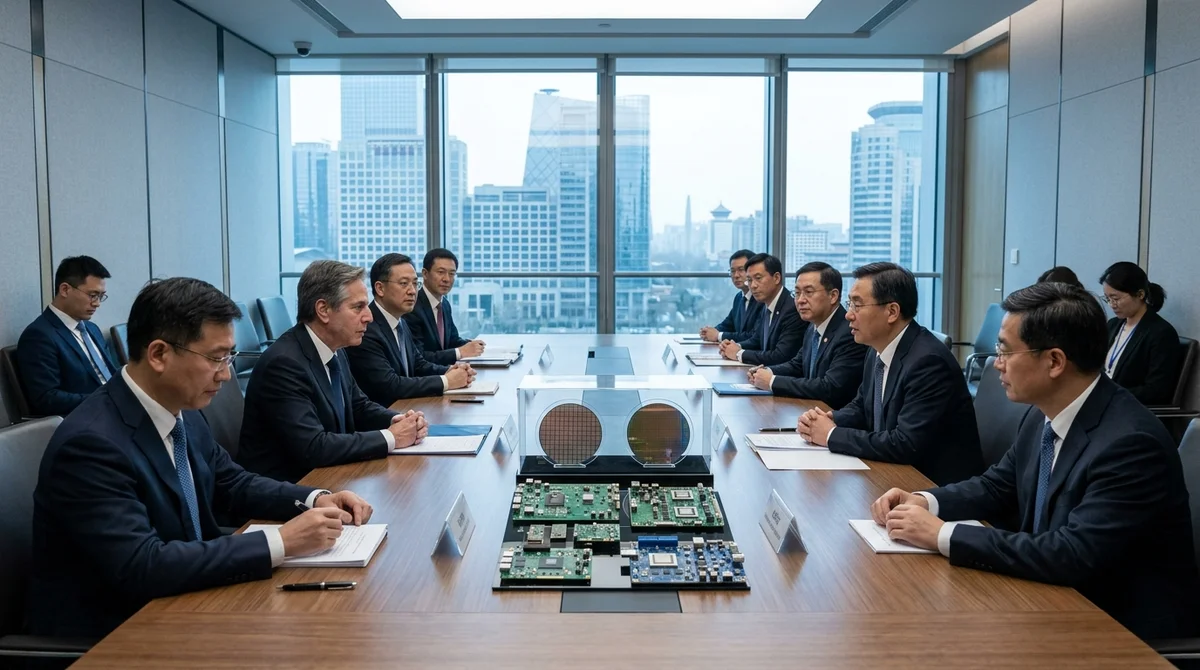
Trump flew to Beijing with Nvidia CEO Jensen Huang and promised journalists changes in high-tech chip trade. However, no real deals happened, and the process came to a standstill — not a single H200 microchip has entered China since the official export permission was granted.
Permission
That Permitted Nothing In December 2025, the Trump administration took a first-ever step — it permitted Nvidia to export H200 chips, designed for AI computing, to China. This was perceived as rare softening after four years of trade wars and large-scale sanctions on AI technology exports. At a personal summit in Beijing, Trump repeated the signal to the world: "something could happen" regarding opening access to semiconductors, adding drama by inviting Jensen Huang as an advisor. But the theatrical nature of the scenario sharply contradicts market reality.
Not a
Single Chip in Six Months Since Permission Over six months since the permission was signed, not a single H200 microchip has been shipped to China. U.S.
Trade Representative Jamieson Greer confirmed to Bloomberg that national semiconductor controls remain in full force and no practical simplifications have occurred. The U.S.
has a multi-level system of local control tools that de facto block real sales despite formal permission: Nvidia subsidiaries in the U.S. must obtain separate permission even after export approval Each individual chip goes through a government licensing system Suppliers and manufacturers fear violating the letter of the law and facing fines Any new presidential executive order can cancel the permission within one day * Penalties for non-compliance reach billions of dollars per corporation ## Political Theater and Real Interests Jensen Huang is not a random summit guest.
He is the CEO of a company that generates the bulk of profits in the global AI industry and holds a critically important position in the AI infrastructure supply chain worldwide. By inviting him to a meeting with Xi Jinping, Trump sent a dual signal to the world: America is ready to trade and actively seeking compromises, but only on its terms and in its interests. However, the signal is drowned out by a stronger political reality.
During the summit, no new trade conditions, simplification mechanisms, or security guarantees appeared on the negotiating table.
Pressure
Strategy Remains Unchanged The Trump administration's strategy includes maintaining political pressure on China through various tools simultaneously. To formally permit — means to get the image of a negotiator on the world stage, but not to actually allow — means not to weaken real restrictions on competitive technologies. For politicians, such an approach is convenient; for corporations like Nvidia, it is a source of constant uncertainty, which is often worse than an outright ban.
What
This Means High-tech chip trade between the U.S. and China remains in a deep deadlock, despite political gestures and high-level visits. For Nvidia, this means losing access to a market of 1.4 billion people and the need to rely exclusively on domestic and allied markets. For China, this means an acute need to accelerate the development of its own H200 alternatives independent of American controls.