Anduril и Meta разрабатывают AR-очки для управления военными дронами
Компания Anduril совместно с Meta разрабатывает боевые AR-очки для операций на передовой. Система позволяет командирам управлять боевыми дронами через отслежива
AI-processed from MIT Technology Review; edited by Hamidun News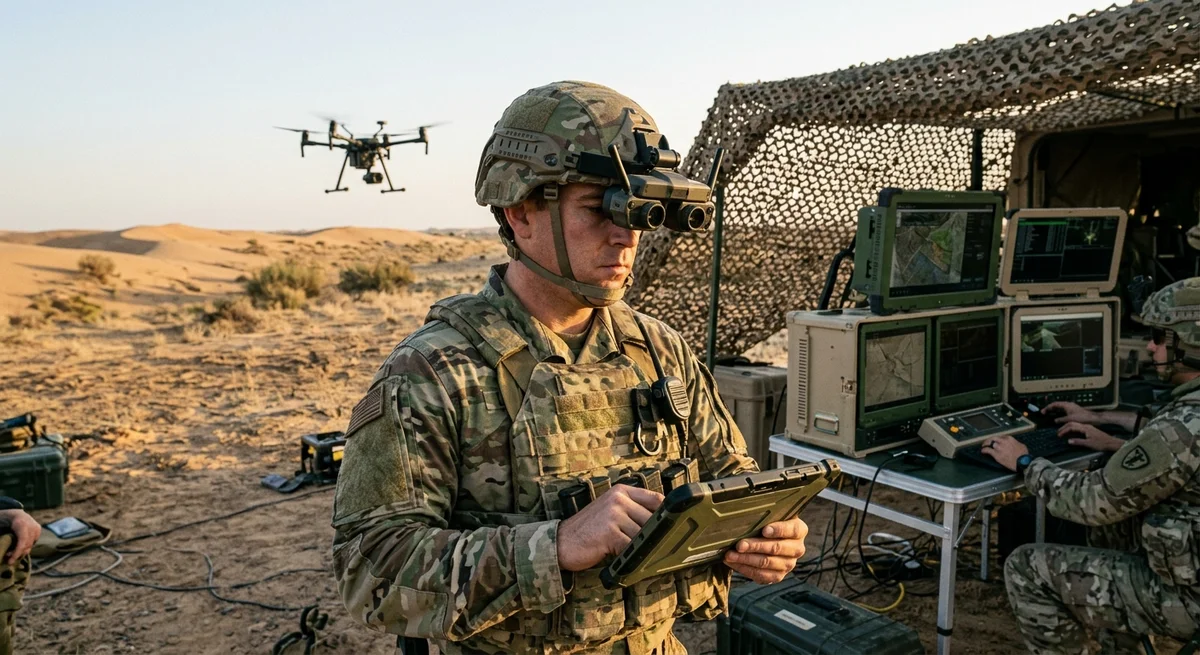
Announcement from Anduril shows how future combat systems are evolving: a commander looks at a wall in a room, blinks — and a combat drone receives an order in a fraction of a second. The company has disclosed detailed information about AR headset development for military use, created jointly with Meta. The device will enable drone control through eye-tracking and voice commands, significantly accelerating decision-making in combat conditions on the front line.
How the glasses will work
Anduril and Meta are jointly developing an AR headset for combat operations. The device tracks eye movements and registers voice commands, converting them into control signals for unmanned aircraft. According to Quay Barnett, Vice President of Anduril and a veteran of Army Special Operations, the system will enable military personnel to issue orders in seconds — something that today requires complex interaction between command levels and consumes precious minutes. Early prototypes are already being tested in field conditions. The system recognizes not just individual commands, but entire sequences of actions: a soldier can select a target with a blink on a field display, and voice input will add operational parameters — altitude, angle of attack, execution time.
What the system can do
Developers have disclosed the main capabilities of the prototype:
- Directing unmanned aircraft at targets in real time with automatic correction for target movement
- Correcting aircraft flight trajectory through operator eye movements
- Issuing combat commands for airstrikes with minimal signal transmission delay
- Synchronizing coordinated actions of multiple aircraft simultaneously
- Exchanging tactical combat data with other systems in a unified command network
Barnett emphasizes that the entire system is designed to operate under extreme and stressful conditions of active combat, when every second determines the outcome of a critical operation. According to him, the AR interface will preserve situational awareness of a soldier who can simultaneously track multiple drones on the battlefield.
Where the potential lies and where the challenges are
The glasses will be particularly effective in dynamic scenarios: reconnaissance of positions, rapid repositioning across territory, operational changes to tactics during combat. Here, the speed of decision-making becomes the decisive advantage. But there are obvious limitations. The system requires clear visibility of targets on the display screen, a stable communication channel with aircraft, and intensive personnel training. In difficult terrain with poor radio signal, the glasses may work less reliably. Additionally, full integration with existing Pentagon weapons will require months of refinement and testing.
What this means
If prototypes successfully pass testing, it will redefine the pace of military operations in the 21st century. Instead of a traditional chain of radio commands — direct and instantaneous transmission of orders from operator's gaze and voice to the combat system. For the military, this means potential reduction of reaction time by a third; for the enemy — significant reduction in time for shelter or countermeasures. The development also shows how traditional AR technologies (which Meta uses in civilian Quest glasses) are beginning to find serious military applications.
Want to stop reading about AI and start using it?
AI News is a curated feed of AI/tech news. Hamidun Academy teaches you to use AI systematically in your work.