Google на третьем месте в гонке AI-моделей: стратегия I/O 2026
Google на I/O 2026 выступает уже не лидером, а третьим игроком в гонке AI-моделей. OpenAI и Anthropic обогнали её с GPT-4o и Claude 3.5. Год назад Google считал
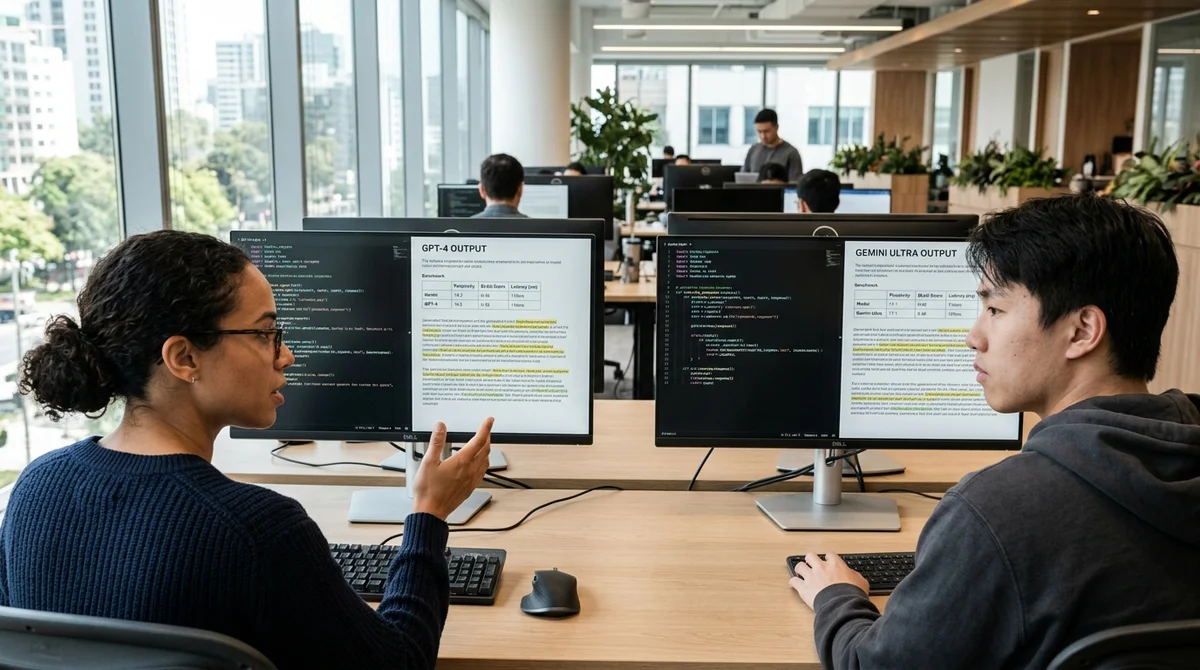
At Google's I/O 2026 conference, which kicks off this week, the company will be in an unusual position for itself — not as a leader, but as the third player in the foundation models race. OpenAI and Anthropic have taken the lead in creating cutting-edge language models. A year ago, such an outcome seemed completely impossible, but Google lost the initiative at a critical moment.
How Google Lost Leadership in Models
When Google unveiled Gemini in late 2023, it seemed the company was ready for a new decade of dominance. Gemini Ultra was positioned as a direct competitor to OpenAI's GPT-4. On paper, the benchmark numbers looked convincing — sometimes even surpassing OpenAI.
But in practice, everything started slower than promised. Deadlines slipped one after another. Meanwhile, more powerful models appeared on the market: OpenAI's GPT-4o proved that closing the gap was entirely possible, and Anthropic's Claude 3.
5 Sonnet showed that you could match and even exceed competitors in developer feedback. Deep organizational disruptions occurred inside Google. Leadership changes in AI divisions, reshuffles between departments, uncertainty about development strategy — all of this drained resources and slowed development.
In parallel, competitors moved with a clear objective. Anthropic attracted serious investment and worked as a compact team focused on a single mission. Google's biggest mistake: it failed to turn its enormous research superiority into a cutting-edge model.
OpenAI and Anthropic managed to create small but effective teams completely concentrated on one goal — to build the best model. Google remained scattered across multiple competing projects and initiatives.
What Google Can Show at I/O
The conference is expected to announce significant improvements to the Gemini family. Better image and video processing, longer context handling, deep integration with Android and Chrome, expanded API access for developers. All of this matters for the ecosystem and could attract enterprise clients. The conference is expected to announce new specialized models for specific industries — for example, for financial analysis, medical diagnosis, or logistics. This is a classic strategic move: instead of trying to win the overall quality war with OpenAI and Anthropic, win in a niche where narrow specialization provides an advantage.
- Improved code handling in Gemini
- Integration of models directly into Android and Chrome
- New tools and APIs for developers
- Specialized models for industries
Why Distribution Can't Compensate for the Lag
What remains for Google is its ecosystem and distribution. Billions of people use Android, Chrome, Search, Gmail every day. Google can embed its models directly into products faster and deeper than any competitor. But even such powerful distribution cannot compensate for a noticeable lag in model quality. If Gemini is noticeably worse than GPT-4o or Claude 3.5, experienced users will notice this very quickly. Now a real strategy is needed: either catch up quickly on quality, or bet on specialized solutions that require depth in a specific field.
"Third place in the models race doesn't mean third place in the AI applications race" — this is the kind of message
Google might try to convey at I/O.
What This Means for the Market
The AI models race has reached an age where even a dominant monopolist can lose its leadership. Three-player dynamics (OpenAI, Anthropic, Google) are objectively better for innovation than a monopoly. Google doesn't completely drop out of the game, but losing leadership is a serious loss of momentum and psychological advantage. The company must urgently show a convincing path to recovery or pivot to specialization. Otherwise, there's a risk of sliding to fourth place, where its ecosystem advantages become less significant.