LEGO Education abandons its own platform and introduces AI and NFC cards
In 2026, LEGO Education is making a 180-degree turn: moving to open platforms, reducing the role of coding, adding AI assistants, and replacing electronic hubs
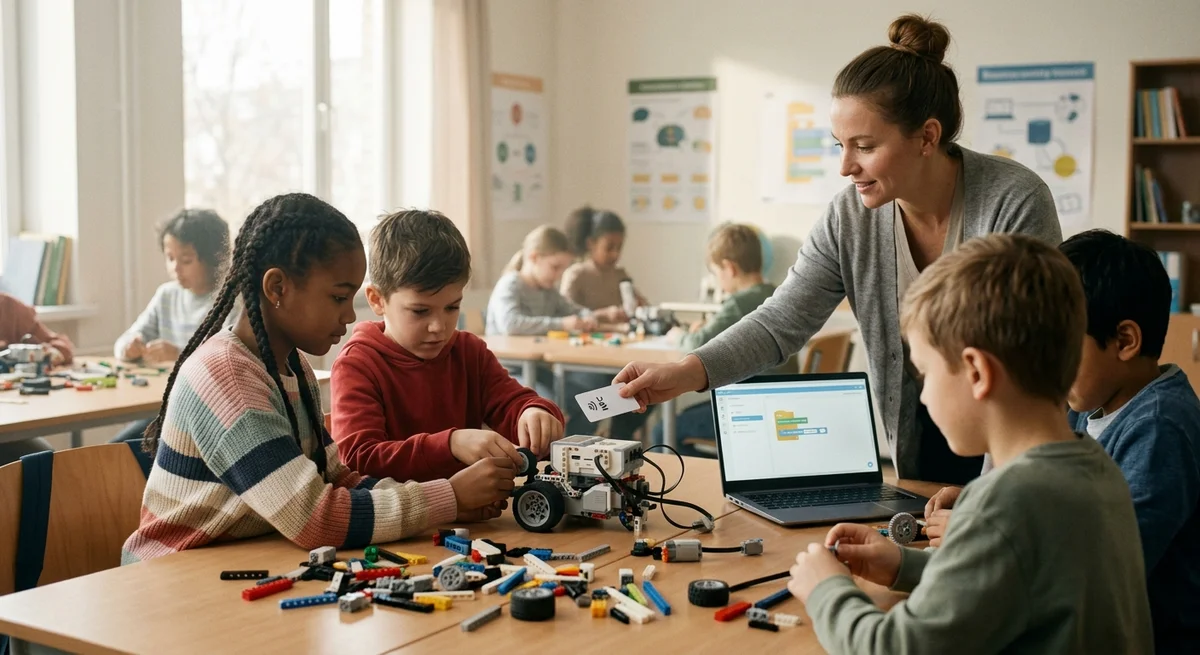
LEGO Education is making a move that seemed unthinkable just a couple of years ago: abandoning its own robotics platform, reconsidering the central role of programming in educational courses, and introducing elements of artificial intelligence. At the same time, the company is changing the architecture of set management, replacing traditional electronic hubs with simple NFC cards. This is not simply a generational hardware upgrade — it is a reformatting of the entire approach to STEM education.
The End of the Proprietary Platform Era
The history of LEGO Education with robots began in the late 1990s, when Mindstorms revolutionized educational sets. Over a quarter century, the company developed, improved, and protected its platforms, creating an ecosystem in which children learned to program on LEGO "hardware." Teachers, schools, and even entire countries chose LEGO precisely because it was a closed, stable, and understandable system. In 2026, this strategy is being turned 180 degrees.
LEGO Education is transitioning to open and universal control systems. This means that the same construction sets will be able to work with different platforms and controllers — whether they are popular Arduino, Raspberry Pi, or their own future developments. This move is dictated by the logic of the modern market: closed ecosystems lose to open ones. For education, this transition has profound significance. Children will no longer be bound to a single platform and will be able to apply their skills in a broader context, transfer knowledge between different systems, and avoid becoming trapped by legacy technologies.
From Coding to Systems Thinking
The second cardinal shift is the reduction of programming's role as the central pillar of STEM education. LEGO Education honestly acknowledges: not every child needs code, and focusing solely on syntax and programming narrows education instead of expanding it. Rather than teaching children to write programs for robots, the company is introducing AI elements directly into courses. AI assistants help students understand the problem, propose solution options, think about consequences — but they don't solve the task for them. This shifts the focus from syntax to logic and creativity.
What specific changes to the curriculum are:
- Reducing time spent on syntax and code debugging, increasing time on problem formulation and analysis
- AI assistants as hints and learning partners, but not as a replacement for teachers
- Interdisciplinary approach: the robot becomes a tool for physics, mathematics, logistics, rather than an end in itself
- Emphasis on meta-skills: critical thinking, collaboration, adaptability
This shift reflects a global transition in education — from hard skills (code, syntax) to meta-skills (how to think, how to learn, how to work in teams).
NFC Cards Instead of Electronics
The third change sounds paradoxical: replacing programmable electronic hubs with simple NFC cards. At first glance, this is a simplification, even a step backwards. In reality, it is a radical rethinking of the learning architecture. Instead of the construction set containing a programmable controller (hub), management will be built on cards that contain instructions. A child places a card on a reader — and the robot receives a set of actions. This may sound primitive, but it has enormous practical advantages: sets become cheaper, simpler to use, do not require batteries in hubs, and most importantly — more accessible to schools with limited budgets.
As one of the developers says: "We moved from complexity for
complexity's sake to simplicity that actually works."
What This Means
LEGO Education in 2026 is not simply updating its product line. It is restructuring the fundamental model of STEM education as the company understood it for decades: from closed platforms to open systems, from programming as the center to systems thinking, from electronics to intelligent solutions. This could either lead to a new generation of creative problem-solvers who are not afraid to experiment, or create a transitional period of confusion for schools that have spent years adapting to the old approach.