AI has learned to build itself: Google DeepMind and OpenAI on the path to self-improvement
GPT-5.3-Codex helps improve itself: it writes its own code, troubleshoots training, and manages deployment. Google DeepMind launched AlphaEvolve — an agent for optimizing neural networks and chip design. Anthropic says Claude Code writes most of its own code. This is not full automation yet — humans set the goals and decide which changes to accept. But AI has already taken a step toward self-improvement.
AI-processed from IEEE Spectrum AI; edited by Hamidun News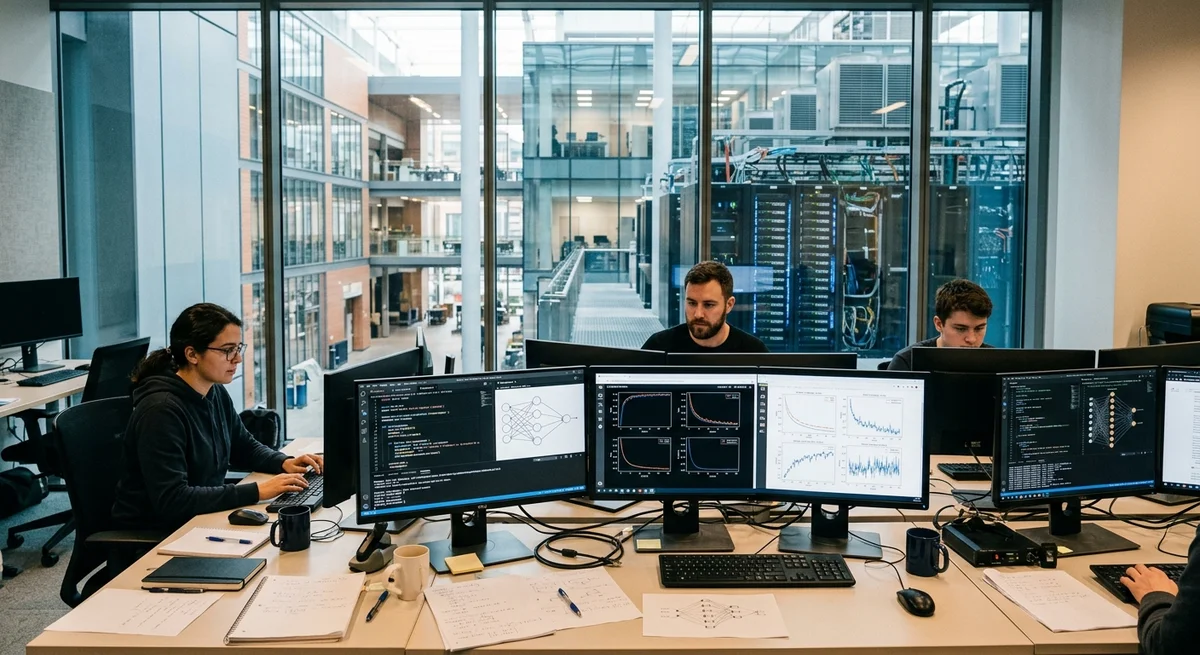
In 1966, mathematician I.J. Good predicted that a superintelligent machine could create even smarter machines, leading to an "intelligence explosion." That science fiction is becoming reality: OpenAI, Google DeepMind, and Anthropic are already using AI to create more advanced versions of themselves.
AI Begins to Write Itself
OpenAI recently reported that GPT-5.3-Codex actively participates in its own improvement. The model writes code for its training, debugs the training process, manages deployment, and analyzes evaluation results. Essentially, it helps itself become better.
Anthhropic has gone further: most of the code for Claude (their primary AI assistant for programming) is now written by Claude itself. This creates a peculiar loop: AI improves itself, but humans remain in the loop, verifying results and making decisions.
Google DeepMind introduced AlphaEvolve—an agent for "scientific and algorithmic discovery." The system can optimize neural network architectures, improve task distribution in data centers, and enhance chip design. Each breakthrough allows scientists to move faster toward the next one.
"Often you look at what the system has discovered and learn from that discovery," says Matey Balog from DeepMind. The system has already surprised its creators by finding optimization algorithms that eluded human intuition.
Two creators of AlphaChip (a chip design system) founded the startup Recursive Intelligence. They promise to reduce chip development cycles from one to two years to days. In the third phase, the company plans to use AI to create chips that better train the next generation of AI.
Why This Hasn't Taken Off Yet
Despite impressive successes, complete AI independence from humans remains far ahead. Researchers note that current systems generate ideas and implement them at a 'good, but not excellent' level. Here's what freezes the process:
- Humans still set goals and decide what counts as success
- Training top models costs billions—no one will release such a system without oversight
- Knowledge in large corporations is distributed among thousands of people (TSMC employs 90,000) and cannot be packed into a single algorithm
- Full automation would require not just code and chips, but also building data centers, power plants, and mining operations
Researchers at Meta propose a different path: instead of full automation, strive for 'co-improvement' of humans and machines. By remaining in the development loop, humans ensure both the speed of progress and its safety.
Can This Go Out of Control?
A survey of 25 leading AI experts showed: 23 of them do not rule out an 'intelligence explosion' with full automation of development. The majority believes companies will keep such models secret, not releasing them to the public.
David Krueger from Montreal, who advocates for a pause in AI development, paints a dark picture:
"This is gambling with everyone's lives."
He proposes stopping AI development when machines start writing 99% of the code. "It seems we are approaching this moment right now," he adds.
What This Means
We stand at the beginning of an era when AI truly begins to accelerate its own development. This could lead to breakthroughs in medicine, science, and technology. But it also demands rigorous oversight—from both international regulators and the companies themselves. History shows: powerful technologies require boundaries.
Want to stop reading about AI and start using it?
AI News is a curated feed of AI/tech news. Hamidun Academy teaches you to use AI systematically in your work.
The AI world, distilled — once a week
Seven stories that actually mattered, hand-picked. No noise, no reposts, no press releases.
Done! Check your inbox for a confirmation.