Waymo vs Tesla: two strategies for mastering autonomous cars
Waymo and Tesla are taking different paths to autonomy. Waymo develops everything in-house, from software to simulators, and is building a safety-critique syste
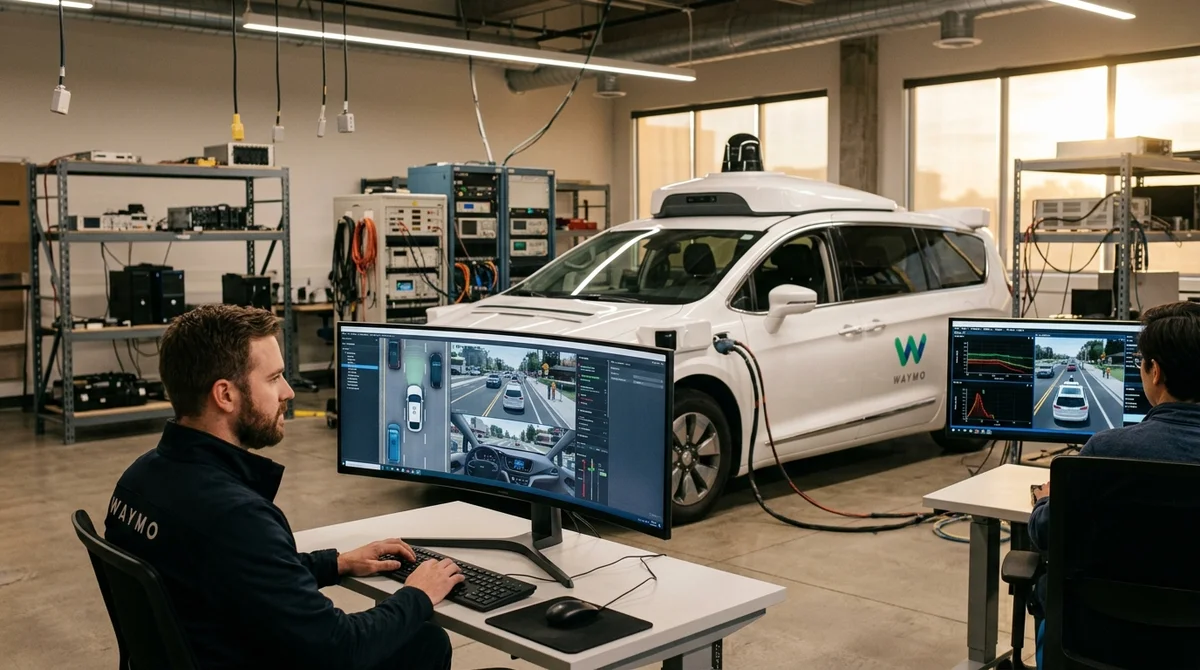
Waymo and Tesla, the two main forces in the race for autonomous vehicles, have chosen radically opposite strategies. Srikanth Thirumalai, vice president of software at Waymo, discussed this in an interview with Bloomberg.
Waymo's Full-Stack Control
Waymo builds autonomy from the ground up. The company develops its own software, its own algorithms, and controls the hardware itself. This is a full stack, with no external dependencies — neither from chip manufacturers nor from third-party perception modules.
The key tool here is its own simulator. Instead of running a car on real roads every time, Waymo tests scenarios in a virtual environment. It's faster, safer, cheaper.
The company can model rare, dangerous situations that occur once in a million kilometers on real roads. But the most important part is the safety-critique system. It's not just code review.
It's a system that critically evaluates the decisions made by the autonomy agent. Before the car executes an action, the system checks whether it's safe. This adds a layer of protection between perception and execution.
- Proprietary software and algorithm development
- Simulation instead of repeated real-world testing
- Safety-critique system as a second line of control
Tesla: Reality as a Teacher
Tesla took a different path. It doesn't try to create perfect software in a lab. Instead, the company released FSD (Full Self-Driving) into the real world, into the hands of hundreds of thousands of drivers.
Every drive is data. Every braking, every turn is a learning signal. Tesla builds on cameras.
No lidars, no radars — only vision, like in humans. This is simpler, cheaper at scale, and the data stream comes constantly from the entire fleet simultaneously. The FSD beta allowed Tesla to collect millions of hours of real-world driving.
This is a huge dataset that Tesla uses to train neural networks. Every bug, every edge case is an improvement for all other cars. Doors failing to open in a snowstorm?
The next update will account for it.
Two Philosophies, Two Speeds
Waymo is slower, but cleaner. It will check a thousand times before releasing to the masses. Tesla is faster, but riskier. It learns from mistakes in real time, and not all of these mistakes are harmless. Waymo has an advantage in safety and control. Tesla has an advantage in scale, iteration speed, and data volume. These are two logics for solving one problem: how to teach a car to drive without a driver.
What This Means
Autonomous vehicles will appear not because of one approach, but because of both. Waymo will show the industry how to do this safely and reliably. Tesla will show how to do it at scale and with profit. The winner is the one who first combines both — the safety of the lab with the data from real roads.