The autonomous driving race: Waymo, Wayve, and others compete for the future of mobility
The autonomous driving race is heating up. Waymo favors a sensor-precision approach, while Wayve is betting everything on mapless end-to-end AI. BYD is developing its own vision, Einride is electrifying trucks and implementing full autonomy, and Vay sees the future in drones for long-haul transport. All major players are fighting for dominance.
AI-processed from Bloomberg Tech; edited by Hamidun News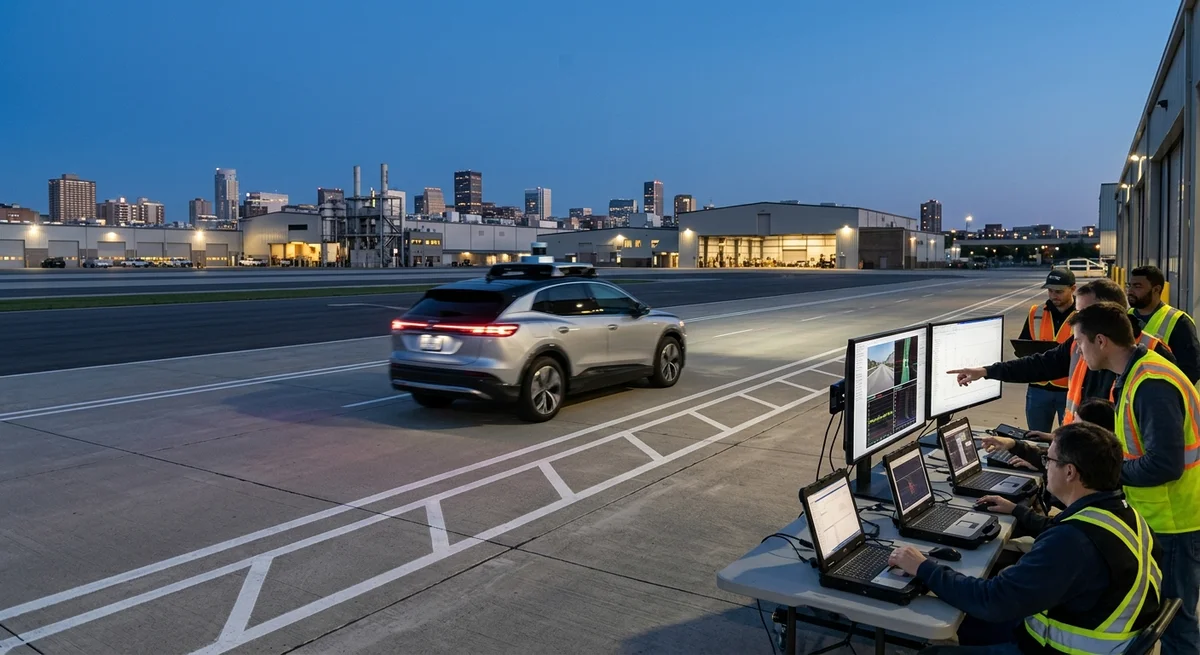
The race for autonomous driving leadership resembles a sprint with an unclear finish line. Each year the technology gets closer to reality, but there are several paths to victory — and each major player is confident in theirs.
Two Opposing Strategies
At the core of the competition lie two fundamentally different approaches to solving one problem: how to make a car drive without a driver?
Waymo chose the path of total control. A fleet of sensors — cameras, lidars, radars — captures every movement on the road. The system knows every centimeter of the route, every traffic light is memorized. This is the path of precision, reliability, and predictability. It requires enormous investments in mapping, but the logic is simple: the road is mapped, sensors see everything, errors are unlikely.
Wayve chose the opposite path. Its end-to-end model learns from video, the way humans learn: sees the road, understands the context, makes decisions. Without preloaded maps, without an excess of sensors. Philosophy: intelligence instead of infrastructure. This is cheaper to deploy, but requires astronomical volumes of data for training.
Five Competitors, Five Visions
Other serious players joined the race, each with their own bet:
- Waymo — leader in sensor accuracy; conducts taxi trials in real cities
- Wayve — betting on end-to-end AI and video-based learning; a more cost-effective path
- BYD — Chinese electric vehicle giant; leverages the scale of its production
- Einride — electric trucks with full autonomy; focused on logistics
- Vay — sees the future in drones for long-distance transport; a radically different segment
Each company bets on its own strengths. BYD has production scale and data from millions of vehicles. Einride has a clear commercial use case — deliveries between points. Waymo offers maximum safety through control. Wayve promises deployment speed. Vay is pushing a new class of transport.
Where the Real Test Lies
On paper, different strategies sound equally convincing. The real test is a city with a million variables: rain, snow, a biker who suddenly swerves from the next lane, a parked car on the sidewalk instead of the road.
Waymo will need maps everywhere it wants to operate. This slows expansion but guarantees reliability on already-mapped territory. Wayve can be deployed faster, but risk remains: an undertrained model in an unforeseen situation. BYD has a formidable advantage — access to billions of real miles of data from its own fleet. This is training material money cannot buy.
What This Means
A clear winner has not yet emerged, because the race is truly just beginning. Safety and regulatory standards have not yet been established globally, insurance remains an open question. Governments have not yet decided who to trust with the streets. But one thing is clear: the autonomous vehicle that wins will be chosen by people not for its technology, but for convenience and price. Which model will deliver this first is a big question. Likely, there will not be one answer: each niche (taxi, delivery, trucking) may find its own winner.
Want to stop reading about AI and start using it?
AI News is a curated feed of AI/tech news. Hamidun Academy teaches you to use AI systematically in your work.
The AI world, distilled — once a week
Seven stories that actually mattered, hand-picked. No noise, no reposts, no press releases.
Done! Check your inbox for a confirmation.