ArXiv to ban authors for a year over unchecked AI content in papers
ArXiv is introducing a one-year suspension for unchecked AI content in preprints. The new policy was announced by Thomas Dietterich, head of the repository’s co
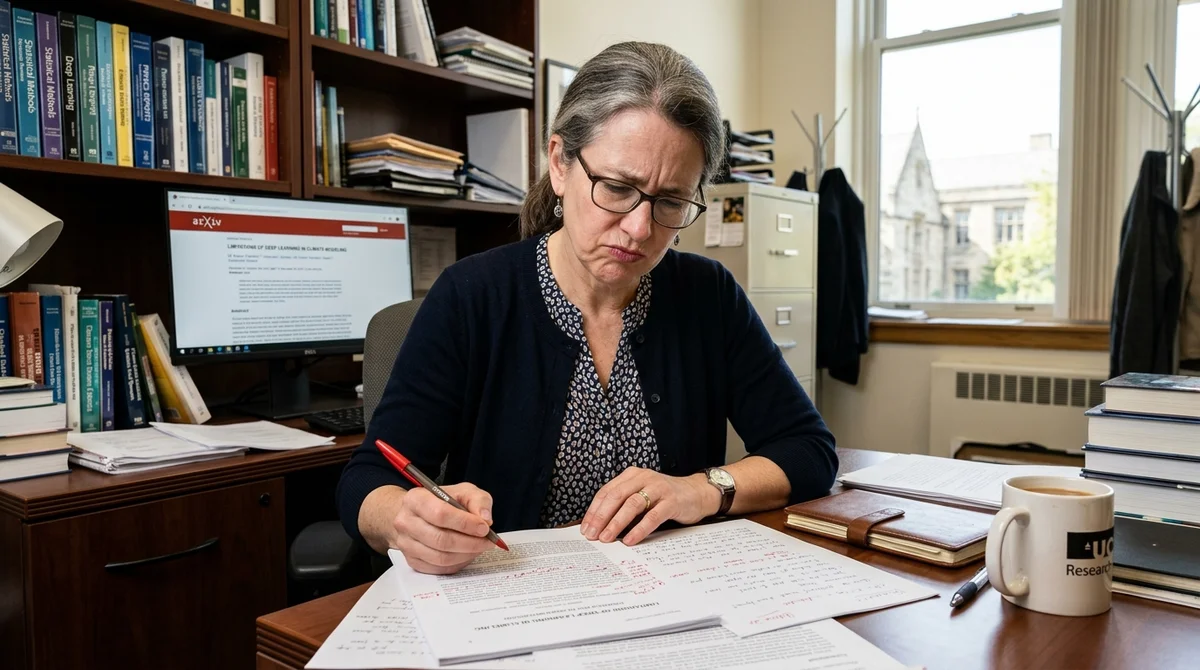
ArXiv, the open preprint repository that has served as the standard for disseminating scientific research in computer science, mathematics, and physics for over three decades, has announced the introduction of a strict policy to combat AI-slop. Authors who submitted articles with clear signs of uncontrolled AI-generated content will receive a one-year ban. The decision was supported by Thomas Dietterich, chair of the computer science section of the repository.
A Wave of AI Garbage in Science
Over the past two years, the scientific community has faced an unprecedented influx of low-quality preprints generated by neural networks without any human review. More than 10,000 preprints are uploaded to ArXiv daily — a number that has grown exponentially since the appearance of accessible AI tools like ChatGPT. The platform's staff moderators cannot keep track of all cases, and the archive itself risks becoming a landfill of automatically generated garbage.
The problem has become so critical that signal degradation in the scientific space is beginning to make it difficult to find truly valuable and innovative research. When the database is full of texts written by garbage models, new works are lost in the noise and do not receive the attention they deserve.
How Slop Harms the Scientific Community
AI-slop violates several key aspects of the scientific process:
- Clogs the search: researchers waste hours reading obvious garbage instead of finding relevant works
- Blurs peer-review: as volume grows, review quality falls — there simply aren't enough reviewers
- Undermines trust: when there is a lot of garbage in the archive, the scientific community begins to have less faith in the authority of the platform
The problem is particularly acute in new areas like LLM applications, where every researcher experiments with GPT and uploads results to the archive.
How Violators Will Be Caught
The new policy focuses on identifying "obvious signs" — clear AI-generation artifacts, syntactic errors, strange recurring patterns, absurd numerical data in tables, or the absence of real experiments. ArXiv deliberately does not use automatic AI detectors because they are unreliable and produce many false positives. Instead, the platform relies on the human judgment of moderators and the scientific community. A one-year ban is a serious enough penalty to discourage authors from uploading weak work. Authors will also be asked to add a note about which AI tools were used in their research.
What This Means
This is a signal that major scientific platforms are beginning to seriously defend themselves against digital garbage. For honest researchers, this is a blessing — valuable work will not be lost in the noise. For authors who hoped for free automatic publishing, the new reality is harsh. ArXiv is making a historically important bet: peer-review and human responsibility remain the foundation of science, despite the AI revolution.