How Allen AI's model learned to discover expert specialization on its own
Allen AI researchers observed an interesting effect: when a large mixture of experts is trained on different documents, each expert chooses its own specializati
AI-processed from Hugging Face Blog; edited by Hamidun News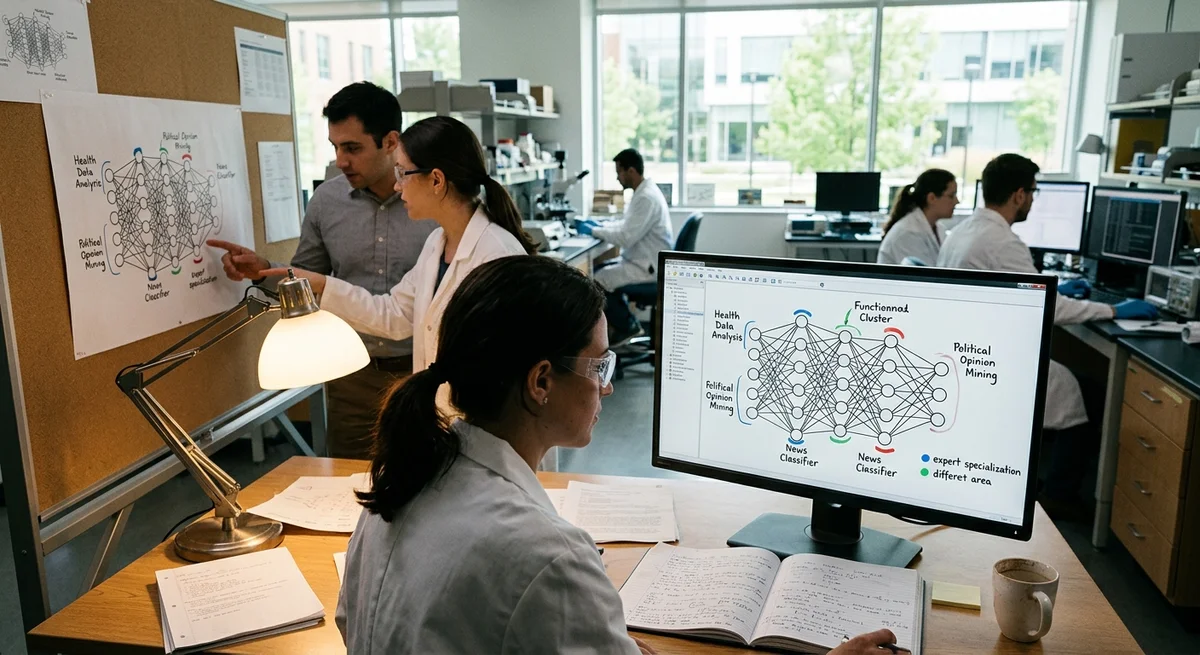
How Neural Networks Find Their Own Specialization
Allen AI published research on the EMO model (Emergent Modularity), which demonstrated unexpected behavior: when trained on a mixture of documents from different domains (medicine, politics, cinema, news), each expert naturally specialized in one of them. No one told the model which domains were important or how to divide them — the model discovered this independently, relying only on the content of the texts.
A Simple Idea with Large Potential
Typically in mixture-of-experts architectures, routing works either randomly or requires explicit data labeling. Allen AI researchers applied a different approach: instead of telling the model which domains are important, they simply observed which expert processes documents of one type most frequently. It turned out that when trained at the document level (when the model selects one expert for an entire text), a structure naturally forms. This works because one expert handles medicine better, another handles politics, a third handles entertainment. The system converges to this division without requiring explicit instruction. As a result, you get an interpretable model: you can open the code and see what each component does.
What Domains Emerged?
Analysis revealed five main patterns:
- Health: medical domain expert that processes medical content
- News: specialization in news materials
- Politics: focus on political content
- Film & Music: entertainment content (film and music)
- Mixed: multi-domain expert for everything else
Interestingly, this specialization emerged completely automatically. The authors did not introduce categories beforehand — they simply looked at the results and saw the structure.
Performance: Almost Free
Here are the key numbers: the model uses only 12.5% of experts per document while losing approximately 3% in quality — a quite acceptable trade-off for such savings. Plus, the model can learn in a few examples to select the right expert for a new task — even if that domain was not encountered during main training.
The most valuable thing: we can open the "black box" of the neural network and actually understand what is happening there.
Instead of an opaque mixture, we get a system with visible, understandable structure.
What Does This Mean for the Future?
EMO results offer a new path to scalable and interpretable models. Instead of building black boxes, we can allow the system to self-organize into understandable components. This simplifies debugging: if the model makes a mistake in medicine, you can look at the Health expert and understand the reason. For practice, this means large language models will become more transparent. Currently, it is difficult to explain to a user why GPT makes a mistake in a specific situation. If you build a model from interpretable pieces, as in EMO, there is a real chance for more honest and explainable AI.
Want to stop reading about AI and start using it?
AI News is a curated feed of AI/tech news. Hamidun Academy teaches you to use AI systematically in your work.