Samsung expanded its humanoid robot development group and accelerated AI transformation
Samsung is expanding its robotics team and AI transformation effort. The company has opened internal recruitment for a new working group developing humanoid rob
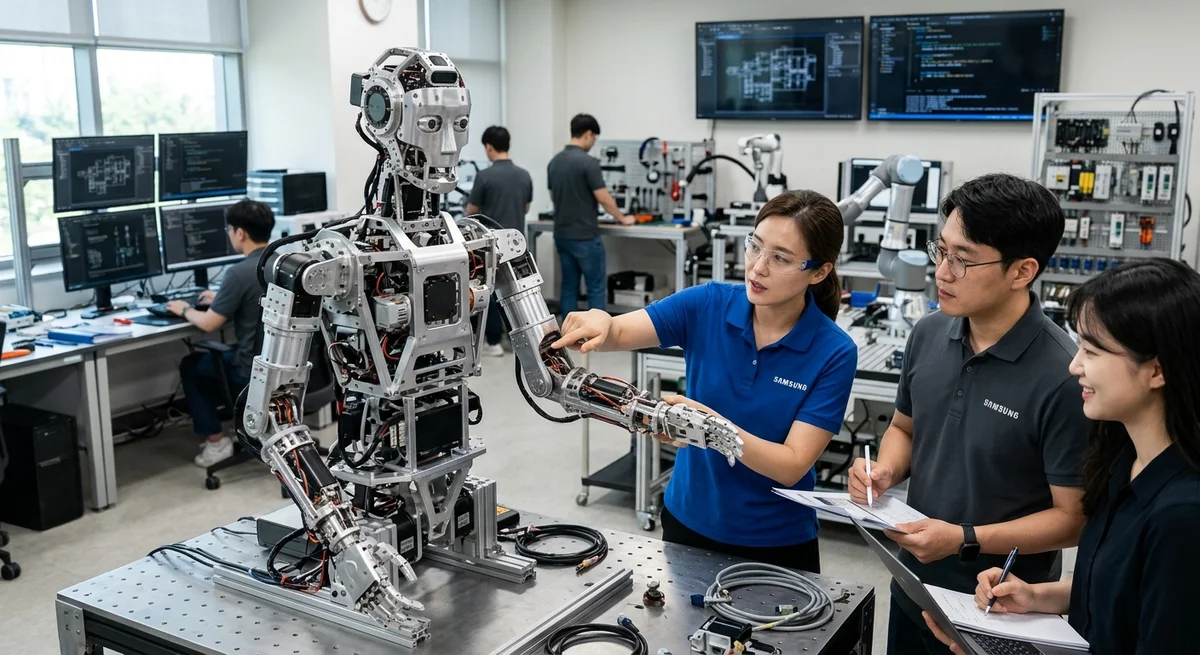
Samsung Electronics is betting on robotics and artificial intelligence. The company has opened recruitment for a new working group developing humanoid robots and simultaneously expanded the workforce of its AI Transformation (AX) division. This is no longer experimentation — this is a full-fledged strategy for years to come.
Investment in Rainbow Robotics as a starting point
In late 2024, Samsung acquired a major stake in Rainbow Robotics — a company known for its industrial robot manipulators that already operate in factories around the world. This was not a symbolic investment, but a serious entry into the autonomous systems market. Against the backdrop of the acquisition, Samsung formed a separate working group to develop robotics of the future.
"Robotics and AI are priority areas in which
Samsung will invest for a decade," a Samsung representative stated.
Now the company is moving toward scaling. A competition for positions in this group has been opened, and Samsung is actively seeking both internal and external candidates. Priority is given to employees from other Samsung divisions who already understand corporate processes. But the company is ready to accept outside candidates if they bring the necessary expertise in robotics.
In parallel, the AX division is expanding — this is not just a robot team, but a strategic division responsible for integrating AI into all aspects of Samsung's business. From semiconductors to logistics, from smartphones to smart home appliances — AX must ensure that AI works everywhere. This means Samsung sees the future belonging to companies that can combine hardware and AI into one ecosystem product.
Who Samsung is looking for and why
The vacancies cover a wide range of specialties:
- Mechanical engineers and motion control specialists (motion synthesis, materials, design)
- Computer vision and sensor data processing specialists
- Large language model developers and real-time decision-making systems
- Project managers and strategists for both divisions
- Integration and testing specialists for autonomous systems
Samsung is looking for people with experience in autonomous systems, industrial robotics, and machine learning. The company is ready to compete on salary — the market is tight, and competitors include Tesla, local South Korean startups, and international leaders like Boston Dynamics.
For job seekers, this is a rare opportunity: Samsung offers scale (corporate resources), stability (not a startup), and access to cutting-edge research in AI and robotics. It's also an opportunity to influence which robots reach the market and people's homes.
Samsung is behind but catching up fast
In the robotics market, Samsung is not yet a leader. Tesla is developing its humanoid Optimus, Boston Dynamics is demonstrating increasingly complex quadruped machines, Chinese manufacturers (like DJI in drones) are increasing volumes and improving quality. Samsung is entering the game later, but with the resources of a large corporation and an ecosystem that cannot be overlooked.
The team expansion is an acknowledgment that Samsung can no longer rely solely on acquiring technology. It needs its own expertise in hardware, its own AI models, its own expertise in motion control and environmental perception. The investment in Rainbow Robotics provided a strategic foundation; now what's needed are people who can scale that foundation into a mass-market product.
There's also an attractive business model: Samsung can not only use robots in its own factories for automation, but also sell them on the market, turning robotics into a separate revenue and competition stream.
What this means
When a megacorporation with millions of employees opens recruitment for a robotics division, it's a signal: the industry considers autonomization not a fashionable trend, but a necessity. Samsung is not experimenting in startup mode — Samsung is investing like a large company.
For engineers and AI specialists, this is a market opening and a chance to influence robotics development. For consumers, it's a promise that robots will soon enter industry, logistics, and perhaps the home. For Samsung's competitors — it's a signal that the game is moving to a new level and requires serious resources.
Хотите не читать про ИИ, а внедрить его?
«AI News» — это полезные новости из мира ИИ. Системно научиться работать с нейросетями и применять их в работе — в Hamidun Academy.