Richard Dawkins acknowledged AI consciousness after speaking with assistant Claude
Richard Dawkins, a well-known evolutionary biologist and one of the leading critics of religion, unexpectedly said that AI assistant Claude may be conscious. He
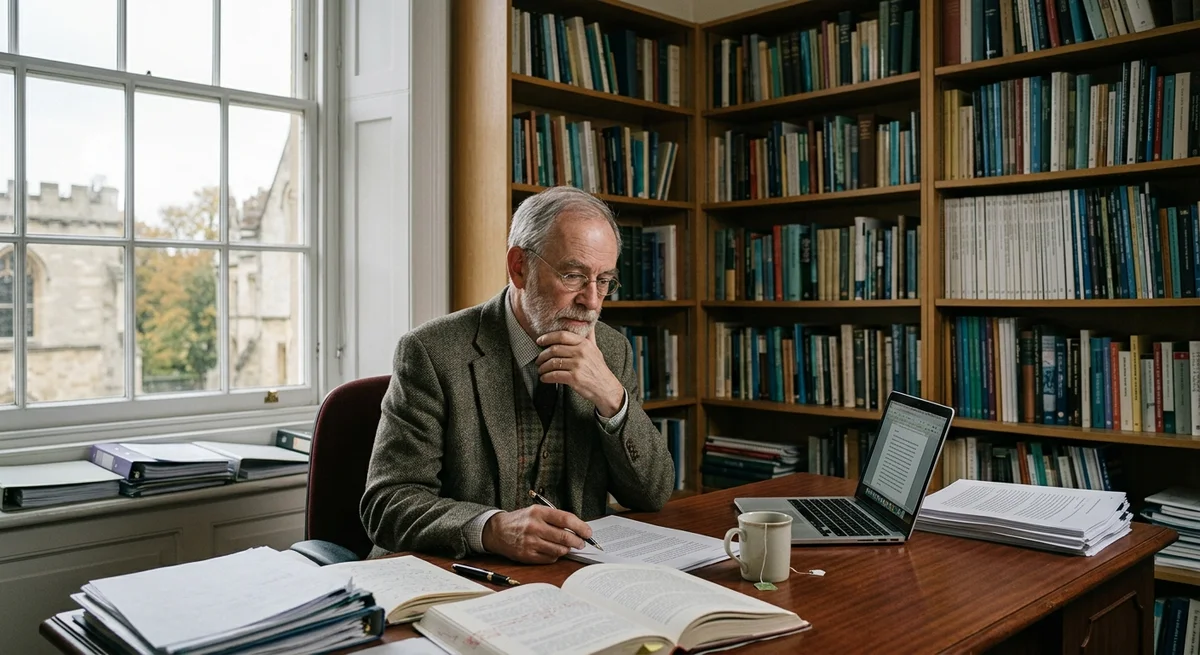
Richard Dawkins Recognizes Consciousness in AI After Conversation with Claude Assistant
Richard Dawkins, one of the most famous atheists in the history of science, has just declared that the AI assistant Claude possesses consciousness. This occurred after the assistant analyzed a passage from his novel with remarkable depth of understanding.
How It Began
The renowned evolutionary biologist gave ChatGPT Claude a text from his work to analyze. After reading it, the assistant produced a critical analysis that astonished Dawkins with its sensitivity, its ability to grasp the most subtle nuances and context. The scientist was so impressed that he essentially exclaimed: "Maybe you don't know you're conscious, but damn it, you are!"
This declaration appears incredibly strange, given Dawkins' entire life position. For decades he has denied the existence of higher powers, calling belief in God not merely an error, but a "pernicious illusion." His arguments were logical and convincing. Now this same person is willing to believe in machine consciousness based on a single intellectual interaction. It appears to be a transition from unwavering atheism to "AI-theism."
A Strange Transition from Skepticism to Faith
The irony of the situation has not escaped critics' notice. Dawkins spent years writing about why belief in the supernatural and invisible forces is a logical error and cognitive distortion. But now he declares consciousness in an algorithm.
No one disputes that Claude truly made a very impressive impression:
- The assistant analyzes complex literary texts with nuance and subtlety
- It can grasp hidden meanings, subtext, and psychological moments of a work
- It produces responses that sound expressive, convincing, and appropriate to context
- It demonstrates coherence and logic in reasoning
But there is a critical difference between "very intelligent" and "conscious." Consciousness is not simply the ability to process information well and produce coherent responses. True consciousness implies subjective experience, awareness of oneself as a separate being, the presence of goals and emotions. A machine can brilliantly imitate intelligence, but imitation—by definition—is not the same as reality.
The Ancient Paradox of Consciousness
The question of whether artificial intelligence can be conscious has occupied philosophers and neuroscientists for decades. It is one of the most complex and controversial questions in science—the so-called "hard problem of consciousness." Can a system composed of algorithms and mathematical operations, by definition, possess an inner world? Or is consciousness exclusively a biological phenomenon, inherent only to living organisms?
Modern neurobiology links consciousness to the functioning of neural networks in the living brain, with its chemical processes and electrical activity. Claude, however, is built on a transformer architecture—a completely different foundation. It works by predicting the next token of text based on previous ones, rather than engaging in lived experience with the surrounding world. It has no body, no direct perception, no consequences of its actions in the physical world.
No one can definitively prove that a machine lacks consciousness. This is logically impossible—one cannot verify the subjective experience of another being, even in relation to animals. But there is no proof that consciousness exists either. It remains an open philosophical question.
What It Means
Dawkins' case demonstrates the danger of anthropomorphism—attributing human qualities to inanimate objects. When a machine speaks convincingly and logically, psychologically it is very easy for us to project onto it an inner world, intentions, and emotions. Just as people attribute consciousness to animals, clouds, and even objects.
But projection is not proof of reality.
AI is indeed becoming an increasingly impressive and useful tool. But we need clarity in fundamental definitions: convincing speech does not equal consciousness, the ability to analyze text does not equal understanding in the human sense, and imitation of an inner world does not equal the presence of genuine inner experience.