Humanoid to deploy humanoid robots at Schaeffler factories
British company Humanoid has signed a major contract with German industrial manufacturer Schaeffler to deploy 1000–2000 humanoid robots across its global produc
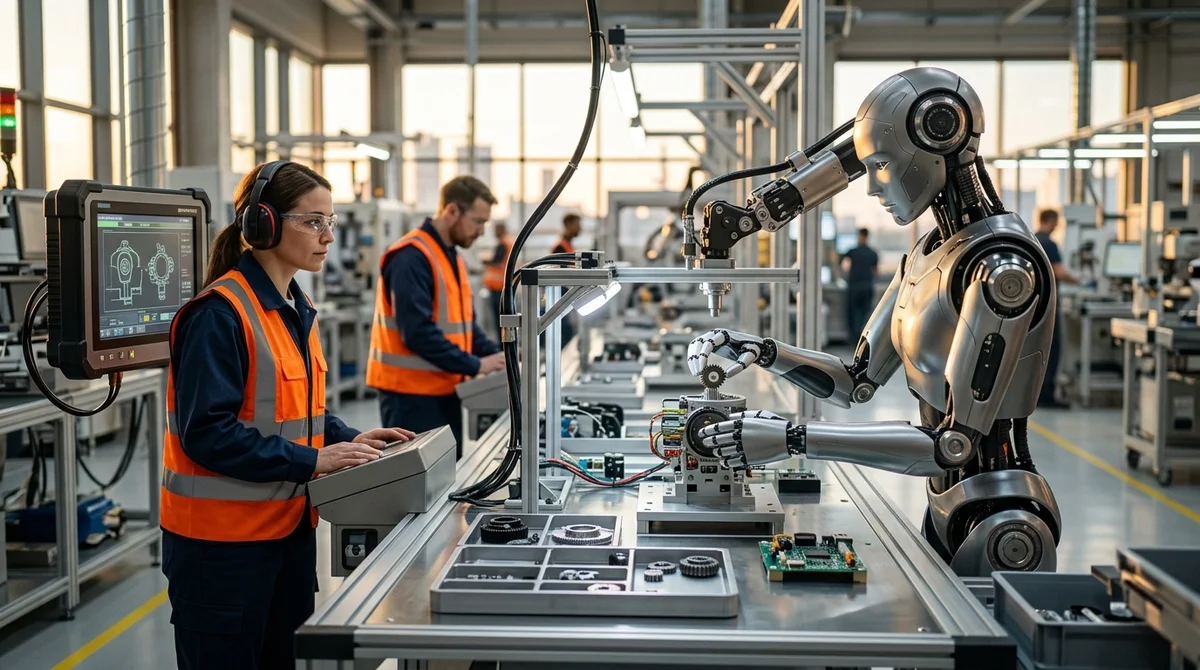
Humanoid Deploys Humanoid Robots at Schaeffler Factories
Humanoid has signed a major contract with German industrial manufacturer Schaeffler to deploy humanoid robots at its factories worldwide. According to the plan, between 1,000 and 2,000 robots will be deployed at Schaeffler's global manufacturing sites by 2032.
About the Contract and Parties
Humanoid is a British company developing humanoid robots, specializing in solutions for industrial applications. Its robots are designed to automate assembly, logistics, and other physical work in factories. Schaeffler is one of the world's largest suppliers of industrial components and systems, with dozens of manufacturing plants globally. The company serves the automotive industry, mechanical engineering, energy, and other critical sectors. With such a client base, Schaeffler understands well the demands placed on reliability and precision of production systems.
The new contract covers the deployment of Humanoid's humanoid robots at multiple manufacturing facilities of Schaeffler in different countries. Neither company disclosed the value of the deal, but the scale — 1,000–2,000 units by 2032 — indicates an ambitious modernization program. This is one of the largest orders for humanoid robots for manufacturing in the history of the industry.
Until now, humanoid robots were discussed in the context of experiments and pilot projects; now the conversation is about industrial-scale deployment.
How Implementation Will Proceed
The first deployment is planned for the coming months — likely for 2025–2026. Humanoid will begin with one or several Schaeffler factories, where robots will be tested in real conditions, productivity data will be collected, bottlenecks and problems will be identified. After a successful pilot, both companies will gradually increase the number of robots at different facilities, reaching the full volume of 1,000–2,000 machines by 2032.
The seven-year deployment timeline indicates a cautious and well-thought-out approach. The companies will not rush; they will:
- Learn from experience with the first batches and capture lessons learned
- Optimize the process of integrating robots with existing equipment
- Resolve emerging technical problems before scaling up
- Adapt robot configuration to the specifics of each factory
- Train production personnel to interact with humanoid systems
This approach minimizes the risk of large-scale failures and allows for optimization of the return on investment of each deployment.
A Turning Point for Physical AI
The Humanoid-Schaeffler contract is a pivotal moment for the Physical AI industry (humanoid robots for physical labor). This contract shows that humanoid robots are moving out of laboratories and pilot projects into real mass production at major global players.
For Humanoid, this is validation of the technology and proof of demand for its robots among industrial giants. For Schaeffler, this is a strategic opportunity to automate routine, monotonous, and dangerous operations — component assembly, mechanical processing, material handling — at its manufacturing plants worldwide.
The scale of the contract is particularly significant. 1,000–2,000 units is not an experimental quantity. It is a signal to the market that humanoid robotics is no longer exotic, but is becoming economically viable for major industrialists. It is also a signal to other companies and investors: if Schaeffler, one of the world's industrial leaders, is ready to deploy humanoid robots on a large scale, then other companies will soon follow.
A wave of similar deals is expected in other industries — energy, logistics, construction, resource extraction, agriculture. Every manufacturing sector with physical labor, monotonous or dangerous operations becomes a potential market for Humanoid and its competitors.
What This Means for the Future of Manufacturing
The success of this project will determine the next decade of automation in industry. If the deployment of humanoid robots proves successful — if they increase productivity, reduce costs, prove reliable in operation and easy to maintain — there will be an accelerated spread of such technologies throughout the world. This, in turn, will transform the global labor market, manufacturers' competitive advantage, international supply chains, and the very model of the modern factory.