New quantum algorithm solves a problem impossible for supercomputers
Researchers developed a quantum algorithm that solves extremely complex problems in seconds instead of years of continuous computation on supercomputers. The al
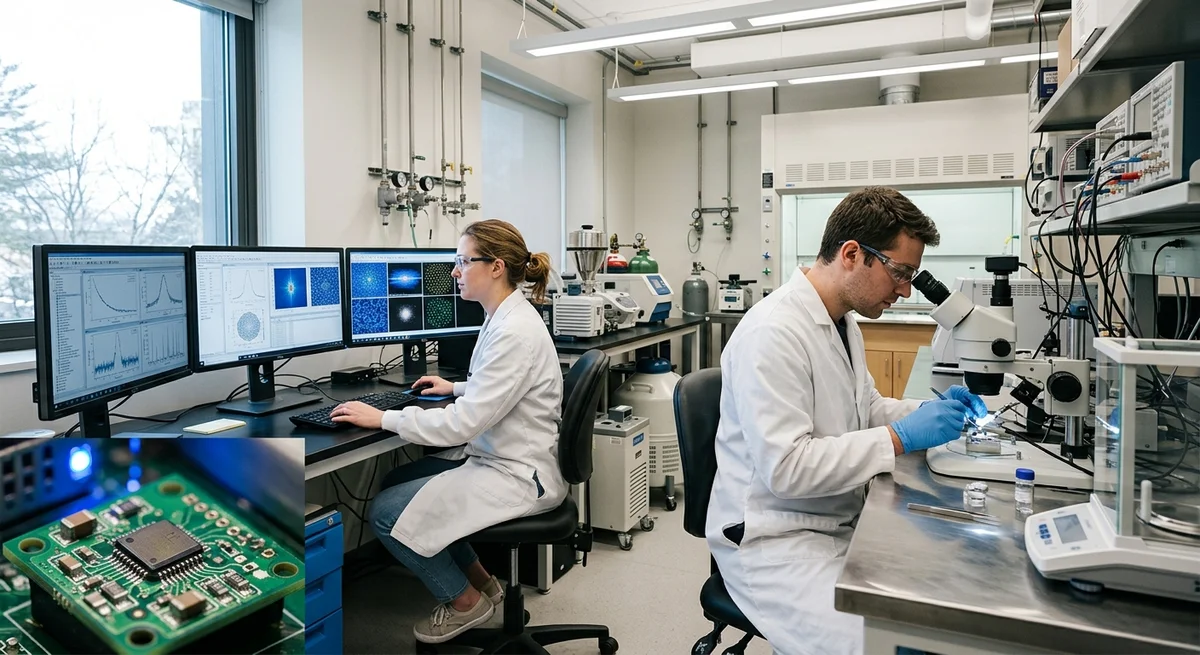
Researchers have developed a new quantum algorithm that solves problems inaccessible even to the most powerful supercomputers. The development enables modeling of the most complex quantum materials and paves a direct path toward creating truly full-featured quantum computers.
Breakthrough in Materials Modeling
Scientists have developed a quantum algorithm capable of handling tasks that traditional supercomputers would solve over years of continuous computation. This involves modeling quasicrystals — exotic materials with unusual structures that don't follow standard laws of crystallography. Quasicrystals have a regular arrangement of atoms but don't form a repeating lattice, making their analysis extremely difficult.
Imagine a brick pattern that looks ordered but never fully repeats itself — this is a simplified explanation of a quasicrystal. Studying such materials requires considering billions of quantum states simultaneously. The new algorithm processes this information in seconds, opening possibilities for research that previously seemed impossible.
This is not merely an acceleration of computation — it is a qualitative leap in scientists' ability to work with quantum systems in principle.
Path to New Quantum Devices
The results are already finding application in the design of topological qubits — a special type of qubit that possesses natural error protection thanks to its physical properties. Topological qubits are considered one of the most promising approaches to creating stable, functional quantum computers. The problem with traditional qubits is that they are extremely sensitive to external interference — even microscopic changes in temperature or electromagnetic field can cause an error. Topological qubits bypass this problem by encoding information in the topological properties of the material, which are less vulnerable to perturbations. The algorithm helps scientists understand which materials are best suited for creating such qubits, and design devices with the necessary properties:
- Real-time modeling of quasicrystals
- Design of topologically protected qubits
- Search for materials for high-temperature superconductors
- Development of ultraefficient next-generation electronics
- Creation of materials for quantum sensors and metrology
Scale of the Problem
The complexity of modeling quasicrystals lies in the fact that their quantum properties cannot be predicted using simple approximations and formulas. Full calculations are needed, accounting for the interaction of an enormous number of particles — literally billions of electrons interacting according to complex quantum mechanical laws. Classical computers handle this task extremely inefficiently — computational complexity grows exponentially as system size increases.
This means that adding just a few more atoms can increase computation time a million-fold. The quantum algorithm circumvents this problem by using principles of quantum mechanics for the modeling itself. Instead of simulating a quantum system on a classical computer, the algorithm works directly with its quantum description.
This allows handling tasks that fundamentally exceed the capabilities of traditional computation.
What This Means
The development represents an important step in the practical application of quantum computing. Previously, quantum computers were primarily theoretical research objects; now they are beginning to deliver concrete results in materials science and engineering. If this research is successfully scaled and integrated into standard materials science tools, it could accelerate the emergence of fully functional quantum computers by a decade or more. Quantum computers, in turn, will be able to solve numerous tasks in cryptography, chemistry, optimization, and artificial intelligence that currently remain inaccessible.