AI image generators aren't creative: why and what to do
AI image generators exist, but there's a problem: they produce banal illustrations. Even powerful models are hard to make creative. The solution? Describe as pr
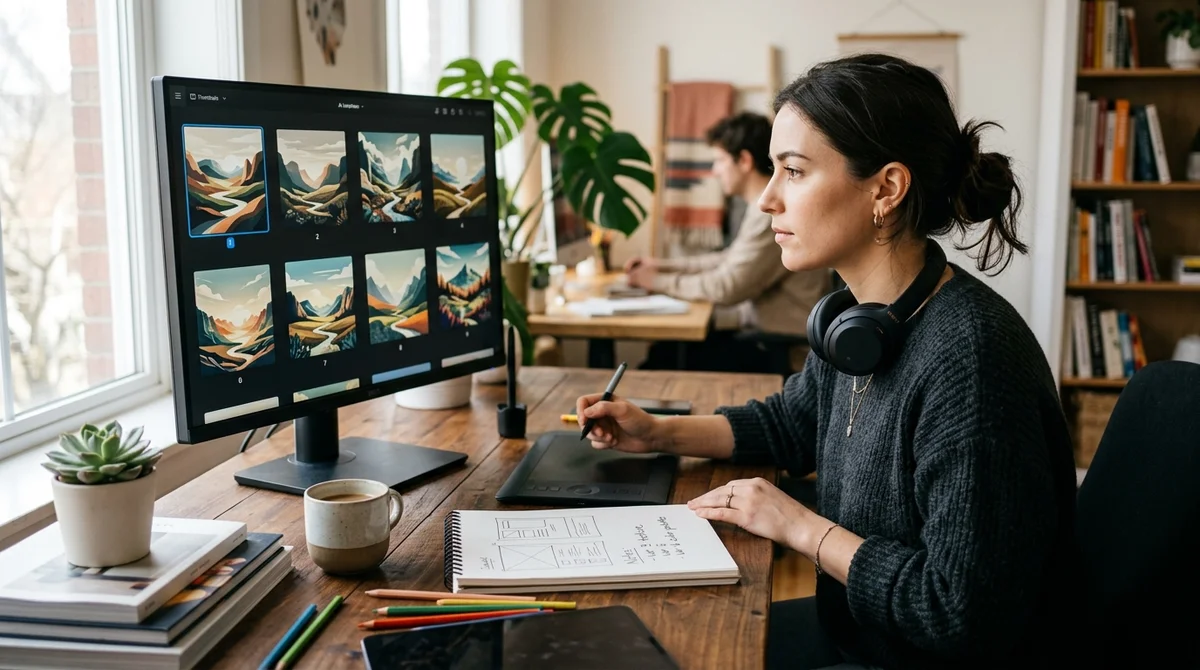
Illustrations for text can be generated in a couple of minutes. But why does the result often look faceless and uninteresting?
The
Generator Exists, Creativity Doesn't AI models for creating images have indeed given an enormous tool to editors, marketers, and web developers. Text description → neural network → ready-made illustration that doesn't need to be commissioned from a designer. It seemed like the problem with visual content was solved once and for all.
But in practice, it doesn't work out that way. Even the most powerful models (DALL-E, Midjourney, Flux) are all too eager to produce banal, mundane images. Secondary compositions.
Faces without character. Scenes you've seen thousands of times. The problem isn't that the image doesn't match the website's style.
Wrong style can be fixed. The real problem is different: with a standard prompt, the neural network simply doesn't create. It produces what's reliable.
What's known. What's already been generated a million times.
Why
Models Fear Experimenting Here's the root of the problem: AI is trained on millions of examples from the internet. And what's the share of truly original, creative images? Negligibly small. Most content is repetition. Variations on one theme. When you give a brief description, the model gravitates toward the averaged, statistically likely result. Moreover, neural networks tend toward compromise. If you write "programmer in an office," the model will pick something average between thousands of office photos from Pinterest and Adobe Stock. The result is safe, professional, but boring.
- The model relies on statistics from training data, where banal images appear more frequently Brief, imprecise prompts lead to averaged results Neural networks avoid experimentation without explicit instructions Standard descriptions almost guarantee standard images Requires very precise formulation to extract something interesting ## How to Make the Neural Network Creative There's no magic button. But there is a strategy: formulate as precisely as possible what you want. Simply "office" won't do—you need "open-plan 1980s office with glass partitions, yellow light from fluorescent lamps, muted palette." Simply "robot" won't do—you need "robotic arm with hydraulics, close-up on mechanism details, cold metal, industrial lighting." The more specifically you describe visual details, aesthetics, lighting, era, mood, texture—the less likely the neural network will switch into statistical compromise mode. Sometimes helpful is specifying a visual style or source of inspiration: "in the style of a 1960s scientific poster," "Tarkovsky's cinematic vision," "National Geographic photography."
What This Means Image generators really do work, but they require skill.
It's not just pressing a button. It's more of a craft: the ability to precisely visualize an image and describe it so the neural network doesn't slide into statistical compromise mode. For content teams, this means demand for a new specialist—somewhere between copywriter and designer, who masters both prompt engineering and visual language simultaneously.