How Creatures (1996) created the first true computer creatures
Creatures (1996) was the first mass-market artificial life simulator. Steve Grand did not program Norn behavior — he wrote the rules of life: DNA with 16 gene t
Creatures is not a video game in the ordinary sense. Released in 1996, it became the first artificial life simulator for the mass market, where each Norn was a complete organism: learning, reproducing, dying, like an animal.
Where Did the Idea Come From
It all started with a book. In 1986, science fiction writer Clifford Pickover published "The Planiverse" — about a two-dimensional universe where every physical law is simulated from scratch. Grand read it and understood: to create life, you don't need to program every action. You need to write mechanisms from which life emerges. Before Creatures, he made a series of games: Robin Hood (1990) and Rome AD92 (1991). But that was routine. In 1992, he began experimenting with artificial organisms. Seven years of obstacles ahead.
Seven Years of Obstacles
When Grand brought the idea to market, publishers understood nothing. Maxis supported the project in 1994, then canceled it. Millennium Interactive gave five months for refinement. Then Warner Interactive founded a special Cyberlife R&D division. Finally, in 1996, Creatures was released.
How a Norn Is Structured
A Norn is three systems working simultaneously. First: Genome. 16 types of genes controlled neurology, biochemistry, appearance. Genes were inherited, mutated, crossed like real DNA. Second: Biochemistry. Emotions were modeled by chemistry. Hunger, fear, pleasure — these are concentrations of virtual molecules in the Norn's body. One molecule affected hundreds of reactions, and everything was connected. If a Norn was hungry and frightened at the same time, its behavior was unpredictable. Third: Neural. 952 neurons in 9 functional lobes — vision, hearing, motors, decision-making. The Norn learned through reinforcement: good actions strengthened synapses, bad ones weakened them. Synapses changed during sleep. This was machine learning before the boom, embedded in real-time in every creature.
Dioramas Instead of Pixels
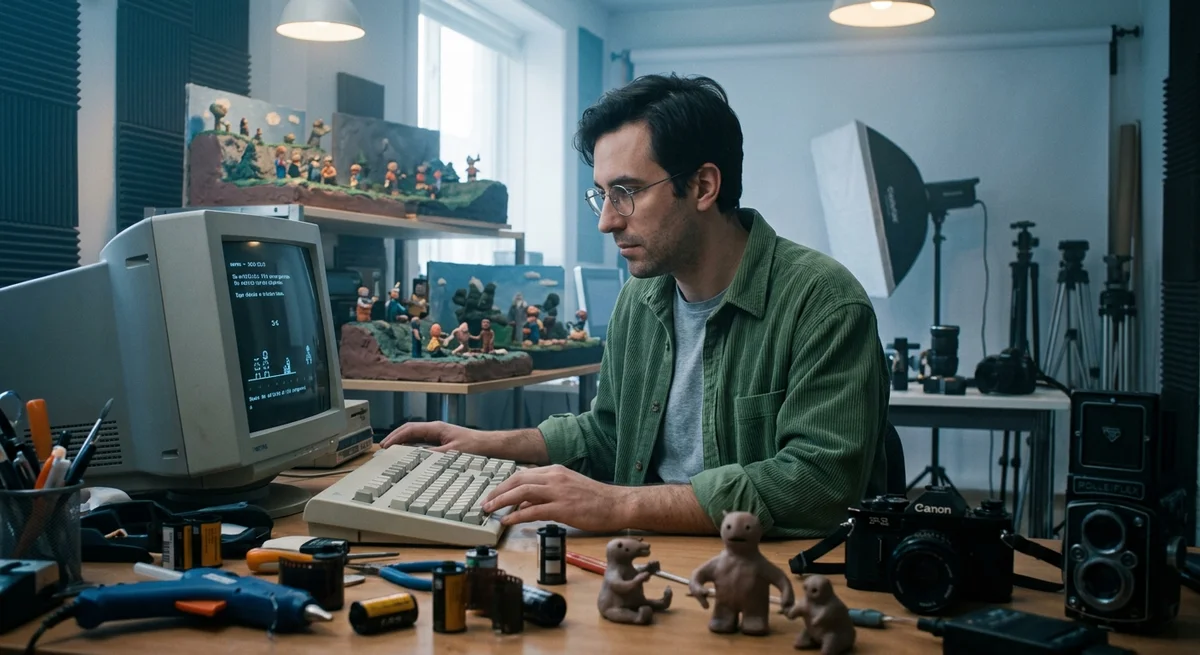
Creatures' graphics did not look like a typical game. Instead of polygons, Grand used physical museum dioramas. His team built plasticine landscapes, photographed them with professional precision, and then digitally retouched them into a game world. The result was hyperrealistic, almost three-dimensional without modern 3D engines. Norns lived in a world that looked real.
Cultural Phenomenon
Creatures sold half a million copies. People didn't just play — they cared for Norns. In the community, shelters for sick creatures emerged. Players debated ethics: is it possible to kill a Norn? Does it have feelings? Cyberpunk seemed abstract fiction, but Creatures made people ask for the first time what it means to be alive.
What This Means
Grand rejected the illusion of control. Instead of scripts and pre-written behavior, he wrote rules of life: genetics, chemistry, neurology. Then he let the Norns live. Some thrived, others went extinct, still others did unexpected things. It was the first time computer creatures seemed not like automatons, but organisms. Almost 30 years later, when discussing agential AI and emergent behavior, Creatures reminds us: there's no need for complex "intelligence." The right mechanisms are enough. Life is what emerges from them.