Automakers Bet on AI: How LLMs Will Change the Car Development Process
Developing a new car requires five years or more of work. Over that time, consumer tastes, the political climate, and fuel prices can change dramatically. Autom
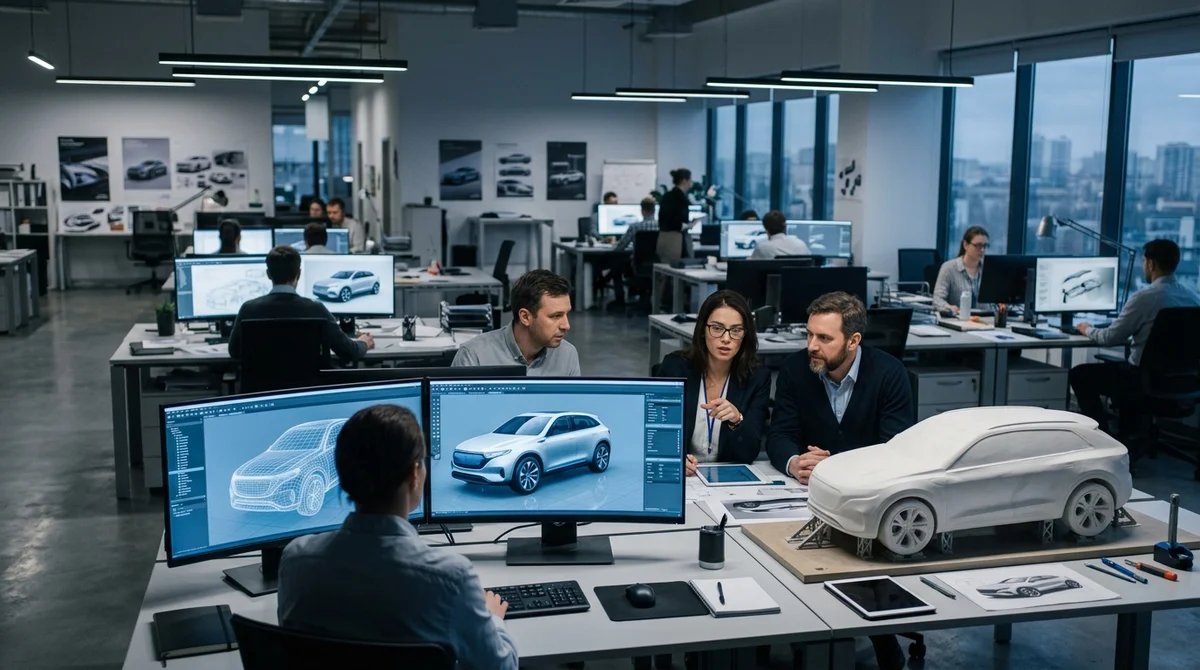
The cars we see on roads today were designed five years ago — when there were different tastes, different fuel prices, and a completely different economic situation. In that time, the market can change radically, but the blueprints cannot be redrawn. This is why automakers are actively searching for ways to speed up the development process, and why they are increasingly turning their attention to artificial intelligence.
Why the five-year cycle is becoming dangerous
Creating a new car is, essentially, a marathon. From the first sketch to the start of production can take five, sometimes even seven years. Designers draw concepts, engineers model them in 3D, then test them dozens of times in a wind tunnel, rework parts, test again. Each cycle requires time, money, and people. But here's the problem: in these years, the market changes radically faster than the car itself. Customers expect new features, competitors have gotten ahead with batteries or design, rules about emissions and safety have changed. The car that was being developed as cutting-edge five years ago, by the time it launches, becomes a compromise.
The electric vehicle revolution has aggravated this problem. Startups like Tesla have shown that you can react to the market faster and roll out updates every year. Traditional manufacturers (GM, Nissan, BMW) see how they are losing market share and are looking for ways to speed up.
How AI will reshape design
This is where artificial intelligence enters the scene. LLM and specialized neural networks are already beginning to help at several key stages of development:
- Analysis and design — AI studies market trends, social media, competitors' past projects and suggests options that will certainly appeal to the target audience
- Virtual modeling — neural networks calculate thousands of construction variants, aerodynamics and material strength in hours instead of weeks of manual design
- Early problem detection — AI finds bottlenecks in the design at the 3D model stage, before expensive physical tests and rework
- Manufacturing optimization — models help design parts so they are easier and cheaper to manufacture on existing production lines
GM and Nissan are already publicly experimenting with AI design. The results are impressive: the full development cycle is reduced from five years to two to three, and sometimes faster. This is not magic — it's just that the machine takes on the routine, and people can focus on what they do well: creative solutions and strategic choices. Even more importantly, AI allows you to quickly test different ideas without building physical prototypes. Instead of one clay model, designers get hundreds of digital variants. This reduces costs and time for refinement.
What this means
The cars of the future will be more relevant and competitive at the time of release. There will no longer be yesterday's ideas in a new body. AI will not only speed up development — it will allow traditional manufacturers to react faster to market demands. They will be able to compete with electric vehicle startups, which are designed from scratch rather than reworked from generation to generation. In the long run, this could rewrite the entire map of the automobile industry.