Cowboy Space raises $275 million for data centers in space
Demand for AI compute outstrips rocket supply. Cowboy Space has raised $275 million to launch data centers into space. There is a problem: rockets are scarce, e
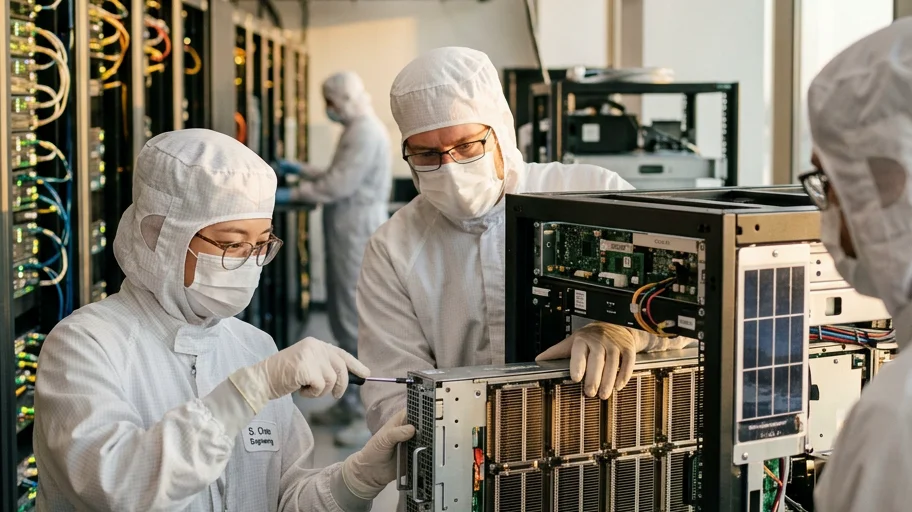
The demand for computational power to train large language models is growing exponentially. Data centers around the world are operating at their limits, and building new terrestrial facilities is time-consuming, expensive, and requires enormous amounts of electricity. Companies compete for available sites, electrical power, and cooling capacity. Some entrepreneurs have come to a radical conclusion: it's time to launch data centers into space.
Cowboy Space Goes to Space
Cowboy Space, a startup specializing in commercial space launches, has just closed a Series B funding round of $275 million. The company plans to use these investments to develop, manufacture, and launch specialized satellite data centers into orbit. The idea sounds fantastical, but it has solid logic behind it. In space, there is a vacuum and cold, which is ideal for cooling servers. Energy can be generated by solar panels without interference from weather conditions. Geolocation ceases to be a critical factor — data is transmitted at the speed of light regardless of how many kilometers separate the server from the end user.
Previously, such projects seemed like pure science fiction. But when demand for AI computing skyrocketed and land plots for data centers began to run out, investors reconsidered their views. In 2024-2025, serious money began flowing into this area.
The Main Obstacle: Shortage of Rockets
Here's an interesting paradox that Cowboy Space has encountered: to send data centers into space, you need rockets. But rockets are in short supply — all commercial operators (SpaceX, Blue Origin, Rocket Lab, and others) are working at maximum capacity. Each launch costs enormous sums of money. Launching a data center into orbit is not a small satellite worth a few million, but an object weighing tens of tons. The cost of a single launch can be $100-300 million, depending on the rocket's payload capacity and its current price.
This means that the return on investment depends on stable and long-term demand for orbital computing. Companies need guarantees that their data will be processed reliably and on time. And orbital infrastructure is completely new territory.
The Technology is Not Simple Either
Cooling servers in space requires fundamentally new approaches. On Earth, data centers use liquid cooling and huge fans powered by electricity. In a vacuum, this approach doesn't work. Equipment reliability must be close to absolute. On Earth, if a server breaks down, a technician comes and replaces it. In orbit, this won't happen. Either the equipment works perfectly for 10 years, or $100 million in investments are lost.
Every kilogram has a cost — launching a cubic meter of material into space costs tens of thousands of dollars. Therefore, engineers must maximize the optimization of weight and size of the data center without losing performance.
- Extreme reliability requirements — no opportunity for repairs in orbit
- Revolutionary cooling systems in a vacuum
- Maximum minimization of structural weight
- Solar panels as the only source of energy
- Highest risks and underdeveloped ecosystem
What This Means
If Cowboy Space and other startups in this field can overcome the technical and financial barriers, this could indeed change the architecture of cloud computing. But in the next 5-10 years, orbital data centers will remain a niche solution — a supplement, not a replacement for terrestrial centers.
The real problem of insufficient computational power for AI will be solved primarily on Earth: through the construction of new data centers, optimization of energy, and more efficient processor architectures. Space is for the future.