DHS to test autonomous drones with 5G on the US-Canada border in November 2026
DHS is preparing a cross-border test of autonomous drones and ground vehicles with 5G on the US-Canada border for November 2026. The main goal is not “smart” na
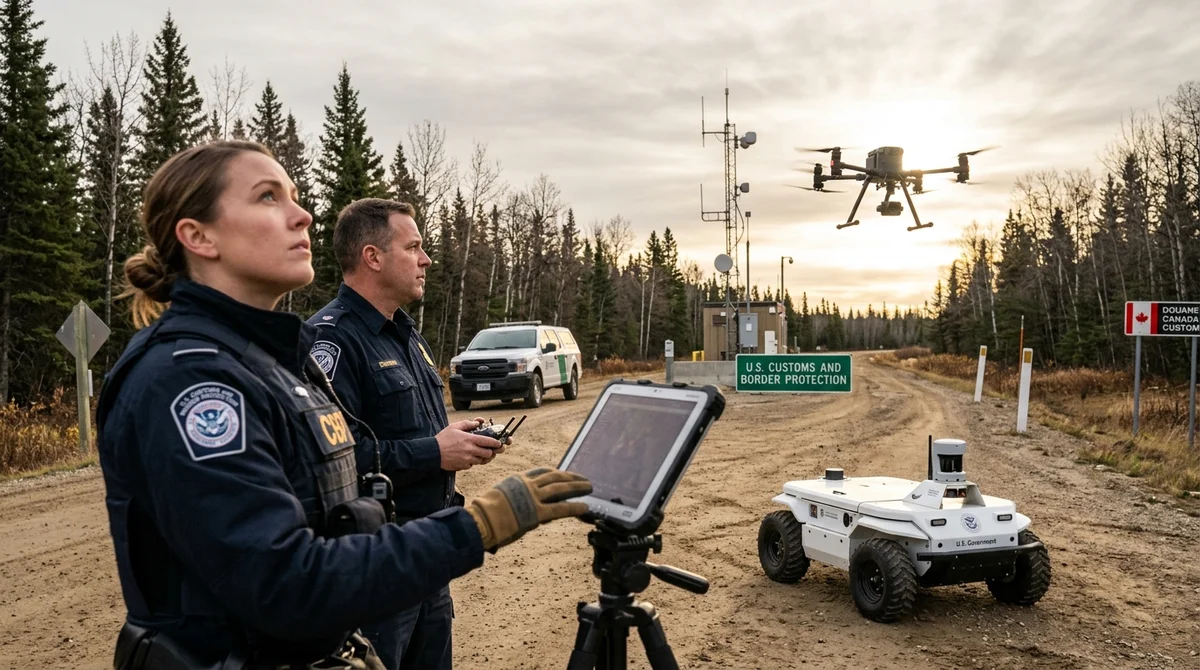
The U.S. Department of Homeland Security is preparing an unusual border test for November 2026: autonomous drones and ground vehicles are to cross the US-Canada line and transmit video and sensor data seamlessly across commercial 5G networks. Formally, this concerns an emergency response scenario, but the language of the documents is noticeably closer to military intelligence than to routine emergency responder communications.
How the Test Will Proceed
The experiment is called ACE-CASPER — Advanced Communications Experiment – Cross-border Autonomous Vehicle Session Persistence Experiment and Research. It is planned to take place in November 2026 as a multi-day exercise on a section of the US-Canada border. According to the scenario, drones and ground autonomous platforms will transmit video and sensor data in real time to a bilateral command and control center while crossing the border and switching between the networks of both countries.
This will be the first joint US-Canada technology experiment of this type in nearly a decade. From 2011 to 2017, Washington and Ottawa already conducted a series of border exercises called CAUSE, where they tested radio, video, and data exchange between services on both sides of the line. The new stage differs in that the focus is no longer simply on communications channel compatibility, but on autonomous platforms that must operate while in motion and not lose connection at critical moments.
What DHS is Looking At
The key emphasis here is not on giving drones complete freedom of action. In the published DHS request, it is directly stated that autonomous decision-making and AI navigation are not the main objectives of the test. The priority is different: to demonstrate that 5G connectivity will remain stable during the transfer of control, video, and telemetry across the border infrastructure of the United States and Canada.
The main goal is to demonstrate "stable and continuous 5G connectivity" when crossing the border.
Participants are expected to provide solutions that are already sufficiently mature, not laboratory prototypes.
Among the requirements described in the documents:
- vertical take-off and landing drones with 5G modems compliant with 3GPP Release 18+ standard
- operating range up to 5 km and flights beyond direct line of sight of the operator
- ceiling around 100 meters and at least 30 minutes of flight time
- streaming HD video and real-time telemetry
- similar requirements for ground autonomous or semi-autonomous vehicles
Technically, the most complex part is not the flight itself, but seamless session transfer between the networks and services of the two countries. For an ordinary consumer drone, losing signal for a few seconds is inconvenient. For a border scenario where video, apparatus control, and a common operational picture for two teams are simultaneously required, such a loss makes the system nearly useless. Therefore, DHS and the Canadian agency DRDC are testing connectivity stability rather than impressive autonomy in a demo video.
Politics and Market
The experiment is taking place against the backdrop of increasingly strict U.S. policy on drones.
Following the White House executive order of June 6, 2025, federal agencies are more actively promoting the national unmanned aircraft industry and tools for detecting foreign devices. For the market, this is an important signal: if ACE-CASPER succeeds, DHS will have a practical template for future procurement in border monitoring, counter-drone systems, and secure mobile communications. At the same time, the current stage is not yet a supply contract.
DHS is recruiting participants through RFI, not promising monetary compensation, and offering selected companies the LP-CRADA format—that is, joint testing without direct government funding. All participation costs fall to the vendors themselves. In return, winners get a rare opportunity to demonstrate their technology in a real cross-border scenario involving U.
S. and Canadian services, and this is almost a ready-made showcase for subsequent tenders.
What This Means
ACE-CASPER shows where the autonomous systems market is shifting: value now lies not only in the drone itself, but in how reliably it integrates into a network, transmits data, and operates across agencies and jurisdictions. If the November test proceeds without incident, the next step could be not just demonstrations, but regular procurement of such systems for border, emergency response, and law enforcement operations.