Britain's government urged to protect authors from free use of books for AI training
British writers brought the AI and copyright dispute to the London Book Fair. They are labeling books with the Human Authored logo and handing out an empty…
AI-processed from Guardian; edited by Hamidun News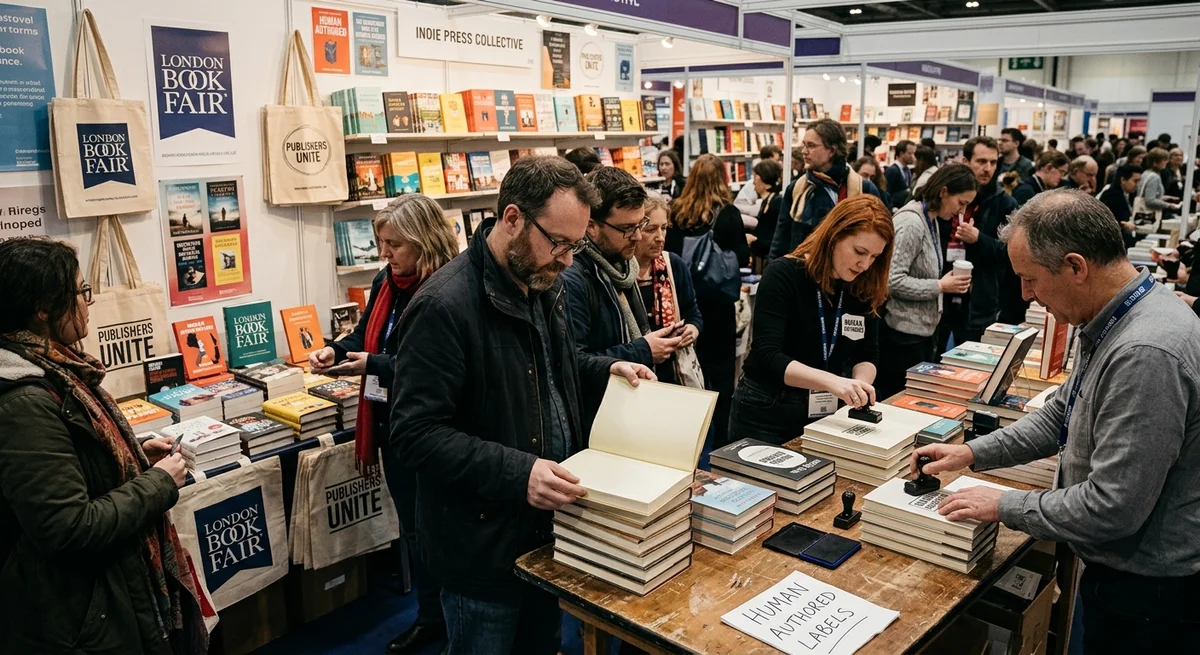
At the London Book Fair, British writers turned the dispute over AI and copyright into a public action. They demand that the government not soften the rules in favor of tech companies and not turn books into free raw material for training models.
Book Fair as Protest
One of the most notable scenes at the fair was the labeling of books with the Human Authored logo. The Society of Authors launched this scheme as a temporary protection and a way to remind the market that human creativity is now forced to mark itself separately alongside AI-generated content. The sticker itself does not solve the legal problem, but it perfectly demonstrates the mood of the industry: writers are no longer willing to silently watch their texts turn into training data for generative systems.
The second symbol of the campaign was the anthology Don't Steal This Book, which was distributed to visitors. The project involved around 10 thousand authors, including Kazuo Ishiguro, Malorie Blackman, Jeanette Winterson, and Richard Osman. But inside this book are empty pages. The gesture is extremely direct: if the state allows books to be used to train models without proper consent and payment, for authors it will look like simple theft, only legalized under the banner of technological progress.
Dispute Over Rules
The campaign came at a particularly sensitive moment. The next week, the British government was supposed to publish a report on the progress of work on AI and copyright. Writers' anger was sparked by last year's proposals to soften existing rules through an opt-out model: not the company should get permission in advance, but the author is offered to refuse the use of their work themselves. For many writers, such logic looks like an inverted system of protection, where the obligation to monitor violations is shifted to the weaker party.
Four things are critical for authors in this story:
- use of books and articles to train models only with clear consent;
- fair payment if the work is included in datasets;
- transparency — which texts were used and how exactly;
- rejection of a scheme where the author must independently "put up a sign" and ask not to take their content.
The outrage is backed up by numbers. According to a Cambridge University study last autumn, nearly 60% of published authors believe their works have already been used to train large language models without consent and without compensation. Nearly 40% said their income has already declined due to generative AI or machine-generated novels.
Against this backdrop, the words of writer Philippa Gregory that opt-out is like a sign on a door asking robbers to pass by no longer sound like a metaphor, but as a description of a real imbalance of power.
Why the Dispute Became Broader
In an editorial column in the Guardian, it was specifically noted that non-fiction and factual books look particularly vulnerable to ChatGPT. Sales of such literature in Great Britain in 2025 fell by 6% compared to 2024 and dropped to a minimum since 2014. Meanwhile, it was painfully personal books that performed better than the market, where value is built on the author's genuine experience and voice. This once again shows that the reader is looking not just for information in a convenient form, but for genuine human testimony.
"AI can faster imitate words, but it has not bled on the page."
This thought was expressed by writer Sarah Hall, who earlier asked to put a Human Written stamp on her novel Helm. The argument here is not romantic, but economic. British creative industries brought £124 billion to the economy in 2023, with £11 billion coming from the publishing sector. The Society of Authors does not ask for a ban on AI, but for basic things: consent, fair payment, and transparency. And the report published last week by the House of Lords directly describes two scenarios: either Britain becomes a home for responsible and legal AI, or slides into silent acceptance of massive unlicensed use of creative content.
What This Means
The story of an empty book and Human Authored logos shows that the main conflict around generative AI is shifting from model quality to rights over source material. If authorities try to accelerate the AI sector at the expense of weakening author protections, resistance from writers, publishers, and the entire creative industry will only intensify.
Want to stop reading about AI and start using it?
AI News is a curated feed of AI/tech news. Hamidun Academy teaches you to use AI systematically in your work.