Uber, Wayve, and Nissan prepare Tokyo robotaxi pilot — Uber’s first autonomous project in Japan
Uber is entering Japan’s autonomous ride market with Wayve and Nissan. The companies are preparing a robotaxi pilot in Tokyo by the end of 2026: Nissan LEAF…
AI-processed from TNW; edited by Hamidun News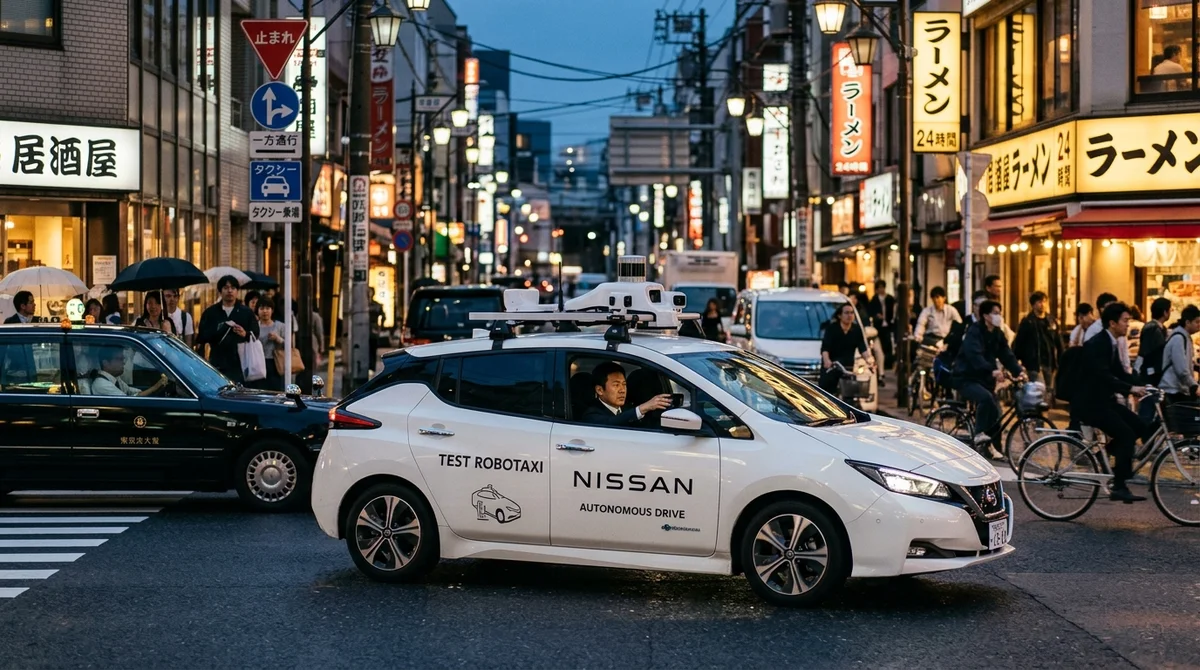
Uber, Wayve, and Nissan have agreed to launch a robotaxi pilot in Tokyo. If regulators give the green light, the first rides booked via Uber are set to begin by the end of 2026 — and it will be the company’s first autonomous project in Japan.
Why Tokyo
The agreement was signed on March 12, 2026. Formally, it is still a memorandum of understanding, but the goals are specific: prepare the pilot, put the vehicles on Tokyo’s roads, and integrate the service into Uber’s familiar interface.
For the market, this is an important signal: instead of a quiet suburb, the companies chose a megacity long considered one of the hardest places to drive. If the system can handle it here, it will have a strong argument for further scaling in other countries as well.
Tokyo tests autonomous vehicles not through promotional demos, but through everyday reality. Dense intersections, narrow lanes, complex signage, heavy traffic, and very low tolerance for mistakes make the city a stress test for any autonomous system.
In that context, the launch cannot be seen as just another PR announcement. It is more an attempt to prove that robotaxis can be adapted not only to wide American roads, but also to a far more demanding urban environment.
How the service will launch
The pilot will be based on Nissan LEAF electric vehicles equipped with the Wayve AI Driver system. Uber will handle ride booking and routing: the user will order a trip the same way as a regular taxi, except the car will be driven by an autonomous system.
At the first stage, there will be no fully unoccupied mode. A trained safety operator will remain in the cabin, and the service itself is expected to launch through a licensed Japanese taxi partner that Uber is still selecting.
This is a more cautious scenario than immediately putting cars on the road without a person in the vehicle.
Wayve’s key feature is its bet on an end-to-end AI system that learns from real road data and does not require a mandatory HD map for every new district. The company has been testing the technology in Japan since early 2025, and that experience is expected to help adapt the service to Tokyo’s streets.
For Wayve, this is also a way to show that the same model can transfer between different cities faster than traditional autonomous stacks.
At this stage, the partners have disclosed these basic pilot parameters:
- launch preparation with an end-of-2026 target
- Nissan LEAF as the base platform for the service
- Wayve AI Driver as the autonomous driving system
- ride booking through the Uber app
“Tokyo is an important step toward bringing autonomous driving to one of the most challenging mobility markets,” said
Wayve co-founder Alex Kendall.
Why the companies are doing this
For Uber, this deal is not an isolated experiment, but part of a broader strategy. The company is already building a global network of partnerships with autonomous transport developers and linking them through its own app.
Japan was an obvious gap: it is a large market, urban transport is mature, and a driver shortage is gradually becoming a real problem. In its official statement, Uber directly called the country a critically important market and linked the project to the future of urban transportation.
If the Tokyo pilot shows an acceptable level of safety and convenience, Uber will gain a strong case for further expansion in Asia. Wayve gets a showcase for its technology in an environment where mistakes are visible immediately, while Nissan gets a chance to turn its work on AI systems for regular cars into a full-fledged mobility service.
For the British startup, this is also a continuation of its global rollout with Uber: the companies have already announced plans for more than ten cities, including London.
For Nissan, the project is valuable because it uses the production LEAF platform rather than a distant concept. In other words, this is not just a lab demonstration, but an attempt to assemble a working chain: vehicle, AI driver, app, operator, and local partner.
What it means
The robotaxi market is increasingly moving away from polished prototypes toward concrete urban pilots. Tokyo is a tough test: here, companies need to prove not just that the technology works, but that it can fit into complex rules, dense traffic, and the everyday rhythm of a megacity. Projects like this show who is ready to move from promises to real urban deployment.
Want to stop reading about AI and start using it?
AI News is a curated feed of AI/tech news. Hamidun Academy teaches you to use AI systematically in your work.