Sunday valued at $1.15 billion after $165 million round for home robot Memo
Sunday has become the latest unicorn in home robotics, raising $165 million at a $1.15 billion valuation. The company is building Memo, a robot for household…
AI-processed from Bloomberg Tech; edited by Hamidun News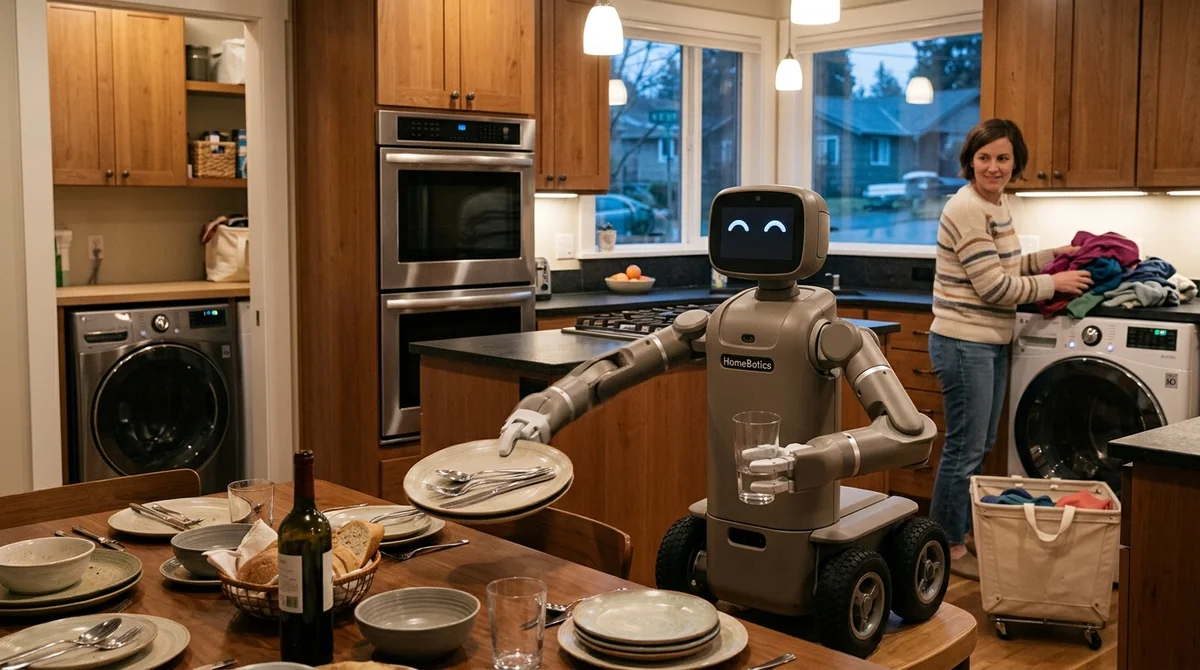
Sunday raised $165 million in a Series B round and received a $1.15 billion valuation. The company is building a home robot Memo, which is designed to take over household chores — from clearing dishes off the table to loading the dishwasher and handling laundry.
The Round and Plans
The round was led by Coatue Management. The deal also involved Bain Capital Ventures, Fidelity, Tiger Global, Benchmark, Conviction, and Xtal Ventures. For the market, this is yet another signal that investors are ready to bet not only on industrial robots for warehouses and factories, but also on the riskier segment — home assistants, where there are many promises but few working products so far.
Sunday plans to direct the new funds toward scaling research and launching the first real-world deployments of Memo in actual homes. The company is essentially transitioning the project from the mode of impressive videos and controlled demonstrations into field testing: beta deliveries, according to the plan, will start as early as 2026.
"We raised
Series B to stop doing demos and focus completely on deployment," said Sunday CEO Tony Zhao.
What Memo Can Do
Memo is conceived as a robot for long household scenarios, not just a single trick. It needs not just to pick up an object, but to understand the room's context, carefully grasp items of different shapes and fragility, move them, and complete a chain of actions without constant human help. According to Sunday's description, the robot targets the most annoying and repetitive household tasks:
- clear plates, glasses, and utensils after dinner
- load the dishwasher and put items in their places
- transport and sort laundry
- tidy up the kitchen, living room, and storage areas
Unlike bipedal concepts, Memo is designed specifically for apartments: with an emphasis on stability, safe movement between furniture, and a friendlier appearance that doesn't look like an industrial machine that accidentally ended up at home. This is an important accent: the company is selling not a "robot in general," but specific time savings on routine tasks. This approach is closer to how the mass market accepts new devices: not because of technological wow-factor, but because of clear utility in daily scenarios.
A Bet on Data
The main problem with home robotics is not the mechanics themselves, but the data. In an apartment everything is too unpredictable: plates differ in size, towels get wrinkled, glasses are fragile, items don't lie where they were yesterday. This is why many impressive robot demos don't survive contact with a real kitchen or laundry room.
Sunday is betting on its own training pipeline. According to the company, Memo trains on household routines collected from more than 500 real homes, with the key tool being the Skill Capture Glove — a glove that records human movements during ordinary activities. These recordings become datasets for models responsible for object grasping, scene recognition, and action sequences. This approach became the main argument for investors.
Sunday promises that the robot will learn not in a sterile laboratory, but on real household mess. If the company truly brings Memo to stable operation in apartments, it will be one of the first serious cases where embodied AI moves from prototypes to a consumer product.
What This Means
The $1.15 billion valuation shows that the market is ready to believe in home robots again — but now the bet is on data, reliability, and household utility rather than impressive movements. For the entire industry this is a test: can an AI robot finally become ordinary home technology rather than just another viral demo.
Want to stop reading about AI and start using it?
AI News is a curated feed of AI/tech news. Hamidun Academy teaches you to use AI systematically in your work.