Deel: Joe Kauffman explains how AI and labor market shifts are accelerating business growth
Deel President and CFO Joe Kauffman said labor market shifts driven by AI are already meaningfully supporting the company's growth. Employers are adapting…
AI-processed from Bloomberg Tech; edited by Hamidun News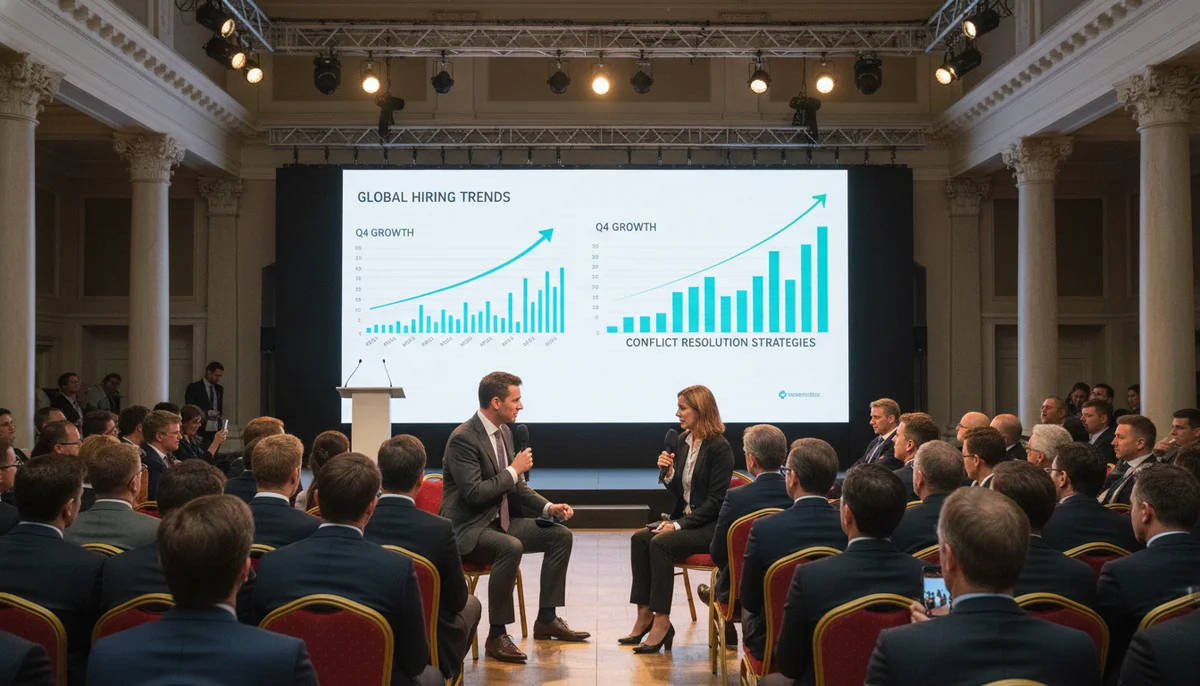
Deel: Joe Kaufman Explained How AI and Labor Market Shifts Accelerate Business Growth
Deel's President and CFO Joe Kaufman stated that changes in the labor market caused by AI development are already helping the company's business "truly deeply." His thesis is important not only for HR-tech: it shows that generative AI is changing not just a set of tools, but the very logic of hiring and managing distributed teams.
What Deel Said
At the DisrupTech conference in London, Kaufman spoke about Deel's growth and how shifts related to artificial intelligence are reflected in customer demand. His position sounds quite down-to-earth: it's not about a distant future and not about laboratory experiments, but about quite practical changes in how companies look for people, assemble teams, and launch new processes. Companies are faster at testing hypotheses and differently evaluate the value of individual roles.
For Deel, such a turn is especially important because the company operates at the intersection of hiring, payments, and formalization of international teams. When business reviews role structure, mixes employees, contractors, and external specialists, and then wants to quickly bring all of this into working mode, the value of infrastructure that removes legal and operational burden grows. It is at this point that AI starts helping Deel not directly, but through changing employer behavior.
How Hiring is Changing
The main meaning of Kaufman's statement is that AI changes not only individual functions within a company, but also the very rhythm of the labor market. Teams try to test ideas faster, launch new directions with smaller teams, and more accurately select people for a specific result. Against this backdrop, the classical long hiring cycle begins to lose to more flexible models, especially if the required expertise is in another country or is needed only for a certain project stage.
- Companies more often assemble distributed teams for specific tasks
- Demand is growing for specialists who can work alongside AI tools
- Projects launch faster, so long hiring cycles get in the way
- The combination of "staff + contractors + external experts" becomes more practical
- Payroll, contracts, and compliance transform from back-office to working infrastructure
For platforms like Deel, this means growing strategic significance. If previously such services were often perceived as an administrative layer, now they are becoming an operational layer for a business that constantly changes team configuration. AI accelerates product and management cycles, which means all the surrounding hiring infrastructure must also work faster, more transparently, and across more jurisdictions simultaneously. This is no longer just an accounting service, but a speed tool for global business.
Why This Helps Deel
The statement that AI "truly deeply" helps business is also remarkable because it comes not from the founder of an AI startup, but from a leader responsible for finance and operational stability. For a CFO, what matters is not beautiful demonstrations, but where real demand actually arises, what companies are willing to pay for, and which processes stop working the old way. In this sense, Kaufman's words can be read as a signal: changes in the labor market are already converting into revenue for those who help business quickly restructure.
"AI truly deeply helps business," is how
Joe Kaufman described the effect of current changes.
The practical takeaway extends beyond Deel itself. The AI boom benefits not only model developers, chip manufacturers, or cloud providers. There is also a layer of services that helps companies assemble a new working model: whom to hire, where to formalize, how to pay, and how to reduce regulatory risks. The more actively business reconfigures organizational structures and distributes tasks between people and AI, the more important platforms become that make such restructuring manageable.
What This Means
AI creates demand not only for automation, but also for more flexible labor architecture. Companies that can quickly assemble international teams and legally support their work gain an advantage. Especially where growth depends on access to rare expertise. For HR-tech, this opens a new stage of growth: such platforms increasingly become not auxiliary software, but a basic operating system for work in the AI era.
Want to stop reading about AI and start using it?
AI News is a curated feed of AI/tech news. Hamidun Academy teaches you to use AI systematically in your work.