Why automakers still don’t warn about black ice: the role of data and machine vision
A routine drive on a dry highway ended in a rollover because of a thin patch of black ice in the shadow of a line of trees, and the case clearly shows a weak…
AI-processed from Habr AI; edited by Hamidun News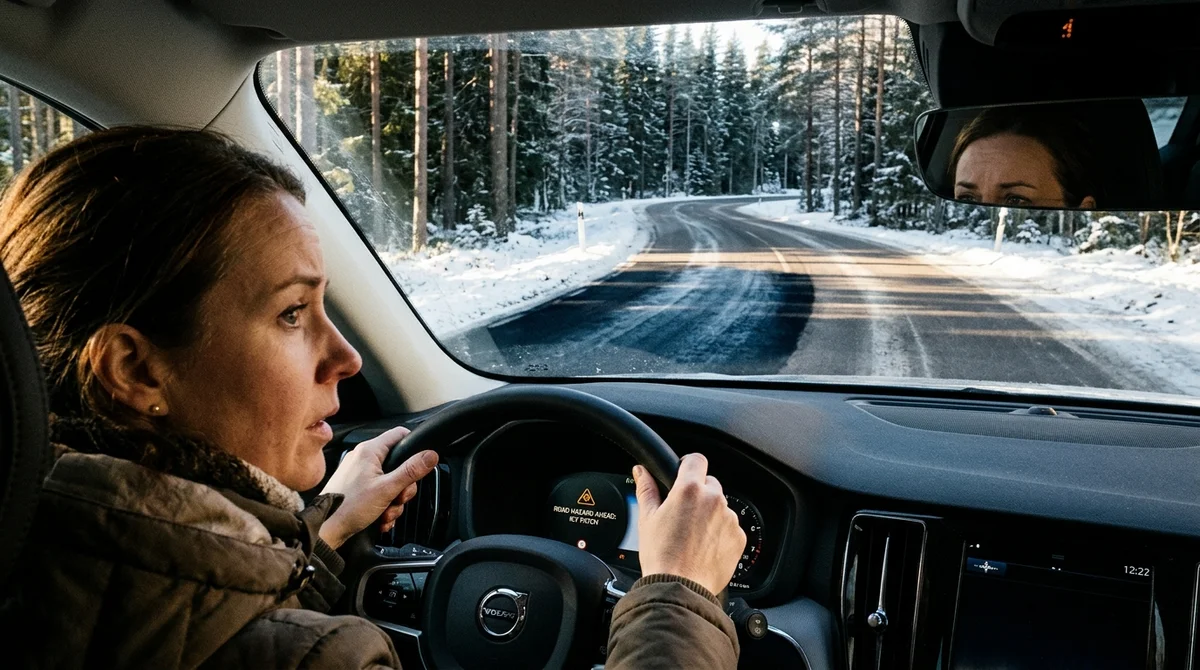
A car flipped on hidden black ice is a good example of how far the automotive industry has advanced in electronics and how little that electronics knows how to act proactively. The driver had normal speed, dry asphalt and a sunny stretch of road, but the system did not piece together the shadow of a forest belt, local cold and risk of losing traction.
Why the car was silent
Most modern cars are indeed saturated with sensors, cameras and electronic assistants, but these components usually work as a set of separate reactive systems. ABS, ESP and traction control intervene only after the wheels have started to slide or the body is in a skid. Even advanced driver assistance systems more often monitor lane, distance and obstacles ahead than the microclimate of a particular turn or shaded section of road. As a result, the car sees many signals but does not turn them into an early warning about black ice.
"Why doesn't a modern car stuffed with electronics warn about this trap?"
The problem is that thin transparent black ice is barely visible to the human eye and poorly detected by simple logic of onboard systems. Before entering the shadow, everything looked safe: dry asphalt, sun, familiar speed around 80 km/h. But within the forest belt, the combination of moisture, low surface temperature and lack of direct light sharply changes traction. For a driver it's fractions of a second, for a machine without a contextual model — just another stretch of road. When data on weather, map, tires and road surface are not connected to each other, electronics respond too late.
What data is needed
To warn about such an accident in advance, a car needs not just one "smart camera," but a combination of big data, computer vision and predictive analytics. The idea is not magic, but probability assessment: the system should notice that ahead is a shadow zone, moisture accumulates there more often, surface temperature is near zero, and similar vehicles have already detected slipping on this stretch. Then the warning appears before the skid, not after the stability system engages.
- Air temperature, humidity and road surface temperature data
- Map of hazardous locations: forest belts, bridges, low-lying areas, shaded turns
- Cameras that look for ice gloss, wet spots and changes in road surface texture
- Anonymous telemetry from other vehicles: wheel slip, ESP activation, sharp corrections
- A risk model that preemptively lowers the warning threshold and suggests reducing speed
Essentially this is the same principle that has long worked in logistics, bank scoring and industrial maintenance: the system looks not for one symptom, but for a combination of signs after which an event becomes probable. In a car, such a model could take into account tire type, drivetrain, vehicle weight, driving style and even time of day. The more accumulated cases on a particular road, the more accurate the forecast. This is where the value of predictive analytics appears, not just a pretty term from presentations.
What's preventing it today
The main barrier is not the absence of individual technologies, but their disconnection. The automaker is responsible for the vehicle, the mapping service for road geometry, road services for road surface condition, weather providers for meteorological data, and the cloud platform for telemetry processing. Bringing this together into a single chain is technically difficult, organizationally expensive and legally risky. If the system stays silent and a person has an accident, the question of responsibility arises. If it alerts too often, the driver will quickly stop trusting it.
There are also practical limitations. Not every car has a set of sensors of the required class, not every road has stable connectivity, and models need to be trained on large arrays of local data, not on averaged statistics across the country. In addition, the warning must be extremely clear: not an abstract icon, but a specific signal like "black ice is likely ahead, reduce speed." For now, the industry focuses more on high-profile features and autonomous driving than on precise prediction of rare but critical scenarios.
What this means
The rollover story shows a simple conclusion: the next stage of automotive AI is not only autopilot and voice assistant, but contextual prediction of road risk. When data from cameras, maps, weather and telemetry begin to work as a unified system, cars will be able to warn about such traps seconds before physics can no longer be stopped.
Want to stop reading about AI and start using it?
AI News is a curated feed of AI/tech news. Hamidun Academy teaches you to use AI systematically in your work.