Project Gravity and the AI boom: how data centers divided Archbald, Pennsylvania
The AI boom in the US is hitting not only power grids, but small towns too. In Archbald, Pennsylvania, six data center campuses will take up 14% of the area…
AI-processed from Habr AI; edited by Hamidun News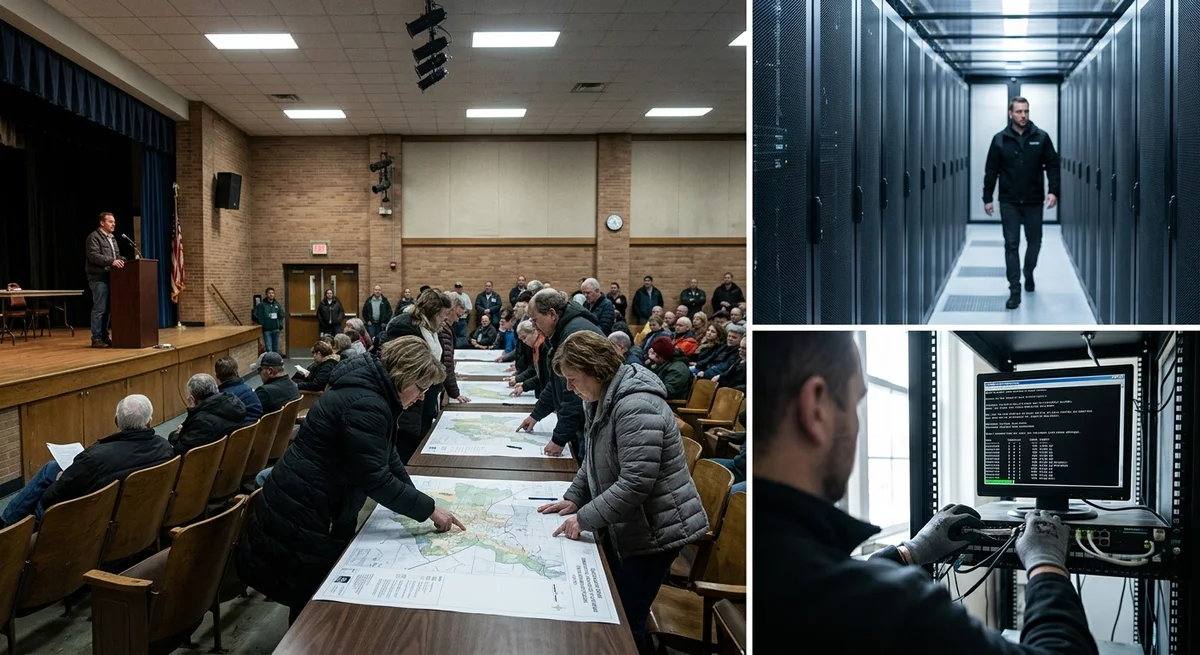
Archbold, a small city in Pennsylvania, found itself at the forefront of AI infrastructure: six data center campuses are planned here, which will occupy 14% of the municipality's territory. For authorities, this is a chance to gain new taxes; for residents, it carries the risk of evictions, pressure on the power grid, and a prolonged conflict over the right to decide what their city will look like.
Why the conflict erupted
Archbold is a town of roughly 7,500 residents in the Lackawanna Valley. This is where one of the densest waves of data center construction for AI in Pennsylvania has arrived: more than 50 campuses are being developed across the state, 11 of them in Lackawanna County alone, and six campuses and 51 large buildings are planned in Archbold itself. According to local media estimates, one of the facilities will consume more electricity than the region's largest power plant can produce. For a small municipality, this is no longer ordinary construction, but an infrastructural overhaul of the entire territory.
Developers were attracted by several factors: a high-voltage Susquehanna-Roseland transmission line worth $1.4 billion, cheap land, fiber optics, proximity to gas pipelines, and lenient zoning rules. In early 2025, data centers in local regulations were effectively in the same category as office buildings, and the updated ordinance adopted in November 2025 did not fully move them to industrial zones. Residents had been pushing for exactly that, but in the end, construction can still proceed next to homes, schools, and senior living complexes.
What worries residents
The most painful episode involves Valley View Estates, a trailer park whose land was agreed to be sold for the Gravity project. Residents are scheduled to be evicted on April 15, 2026. For many, this is more than just a move: some families live on low incomes, care for relatives with disabilities, and have no vehicles. Mobile homes in reality can rarely simply be relocated, and social housing in the county is occupied at approximately 98%, while waiting for an appropriate apartment can take anywhere from one to five years.
Residents speak of several direct consequences:
- six campuses will occupy approximately 14% of Archbold's territory
- facilities are being built next to residential neighborhoods, schools, and senior homes
- Project Gravity could consume up to 1.4 million liters of water per day, and Wildcat Ridge up to 12.5 million liters
- backup diesel generators will add noise and emissions if centers frequently switch to autonomous power
"I don't think anyone in their right mind wants to see a world covered in data centers," said district manager
Dan Marki.
Behind the debate about AI, there are very concrete fears: forest clearing, strain on the private water supply system, rising electricity bills, air pollution, and ground subsidence over old coal mines. The problem is also that residents don't know who will ultimately become the tenants of the future campuses. Developers speak vaguely, and without the name of a specific technology company, it's impossible to assess what cooling systems, energy reserves, and water protection measures will actually be used there.
Money versus trust
Supporters of the projects have a strong argument: money. According to developers' representatives, data centers could bring Archbold approximately $20 million in property tax per year, Lackawanna County $50 million, and the Valley View school district another approximately $100 million. For local authorities and schools, this sounds like salvation: the school district's attorney directly said that the account has barely enough money for salaries and basic expenses. But residents have a different question: how many real jobs will actually remain in the city if the campuses themselves require relatively little personnel?
Distrust is heightened by closed meetings and a sense that rules were written for the developers. Documents published in March 2026 showed that developers participated in discussions about the parameters of the new zoning, and the proposed buffer zone between data centers and neighboring parcels was reduced from approximately 900 to 274 meters. Against this backdrop, a group of project opponents grew to thousands of participants, a lawsuit was filed against the updated zoning, and the Pennsylvania legislature is already discussing stricter rules and even a three-year moratorium on new data centers.
What this means
The Archbold story shows that the AI boom quickly ceases to be a conversation about models and computations and turns into a dispute over land, water, networks, and people's right to influence their surroundings. If states don't learn to set strict rules for such infrastructure in advance and share benefits with local communities, similar conflicts will repeat everywhere tech companies find cheap energy and weak resident protections.
Want to stop reading about AI and start using it?
AI News is a curated feed of AI/tech news. Hamidun Academy teaches you to use AI systematically in your work.