Habr AI: ontologies could become memory for LLMs, robots, and enterprise assistants
Ontological memory is a bet on the next stage of AI systems after RAG. Instead of storing long logs, the article proposes a world model made up of entities, relations, and states. This is especially useful for educational bots, enterprise assistants, robotics, and local LLMs that need stable context without constant recaps. An added benefit is that this layer makes responses easier to understand: the system can be checked through nodes and relations, not just polished text.
AI-processed from Habr AI; edited by Hamidun News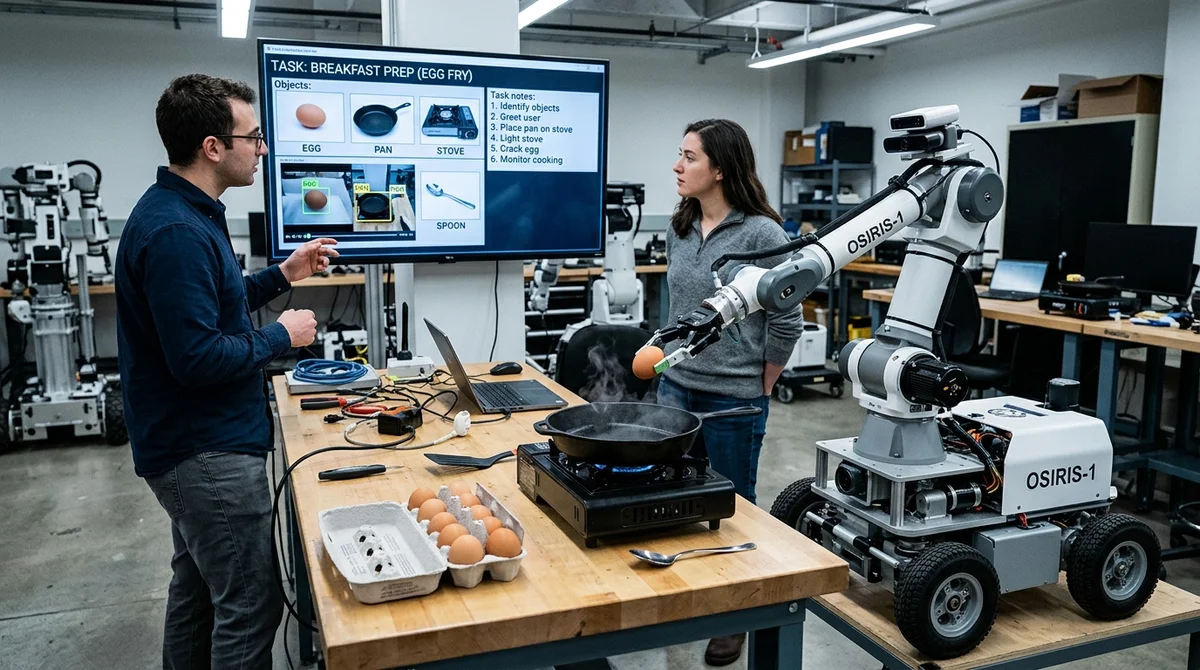
Ontologies are increasingly discussed not as a knowledge base format, but as a separate memory layer for AI systems. The idea is simple: if a model needs to remember a user, the state of an environment, and the history of decisions, plain text context alone is no longer enough.
Why RAG Isn't Enough
Large language models perform confidently as long as the task fits within the current context window. But once interactions stretch across weeks or months, typical failures emerge: the model loses details, reconstructs facts based on indirect clues, re-asks already resolved questions, and accounts less for the user's individual characteristics. Storing everything as long logs is inconvenient, and constant retellings through a summarization pipeline inevitably discard important connections. For an agent meant to guide a person, process, or device over time, this is no longer a minor error margin—it's an architectural limitation.
"RAG gave language models access to data.
Ontologies can give them memory."
Instead of another layer of text summaries, the author proposes storing knowledge as a structure of entities, events, relationships, and state changes. In this approach, the system remembers not just words from past conversations, but a model of what's happening: who it's dealing with, what's already been done, which decisions were made, what constraints are currently in effect, and what has changed since the last session. This transforms memory from archive mode into operational world map mode—something the model can consult with every new action.
Where It Works
The clearest example is an educational bot. If it's been talking with a student for months, remembering conversation fragments isn't enough. You need a cumulative picture of progress: which topics are already mastered, where mistakes repeat, which explanations worked, and which didn't. The same logic applies to customer support and corporate assistants, where interaction history quickly becomes too long even for a human, let alone a model that starts nearly from scratch each time.
- User profile and goals
- Mastered topics, knowledge gaps, and persistent mistakes
- Agreements, statuses, and past decisions
- Successful explanation or response methods
- Connections between objects, rules, risks, and actions
This is even more evident in robotics. A robot can't just "guess" from statistics that eggs, a frying pan, and a stove are connected to a cooking scenario. That's fine for a demo, but not for a real environment. It needs a learnable world model where each object is described by function, properties, valid scenarios, and constraints. When a robot enters a new warehouse, factory, or apartment, such memory helps it not just recognize objects, but understand how they can and cannot be interacted with.
Why It Matters for Business
The idea is especially important for companies wanting to use AI within a closed loop. Banks, industrial enterprises, engineering teams, and any organizations with sensitive data aren't always ready to hand information over to external cloud models. Meanwhile, local LLMs are often weaker than top-tier services. The ontological layer works here as a booster: some of the "intelligence" shifts from the model's weights to an external knowledge structure, and even a compact on-premises system starts to respond more accurately, reliably, and with accumulated context in mind.
There's a second practical benefit—explainability. In the classic LLM stack, explanation often boils down to beautiful text or a source link. An ontology provides more verifiable mechanics: you can show through which entities and relationships the system reached its conclusion. For corporate scenarios, this is as critical as accuracy.
Such a layer gradually begins to function as an operating system for knowledge: through it you can connect documents, tables, images, events, and even sensor data into one operational world map.
What This Means
The article's main conclusion is straightforward: the next step for applied AI is not just improving document search, but changing the unit of knowledge. The shift from text fragment to fact, from archive to world model, and from context to memory makes agents, assistants, and robots noticeably more useful. For the market, this signals that hybrid architectures with LLM and an ontological layer look less and less like an academic idea and increasingly like a practical engineering direction.
Want to stop reading about AI and start using it?
AI News is a curated feed of AI/tech news. Hamidun Academy teaches you to use AI systematically in your work.
The AI world, distilled — once a week
Seven stories that actually mattered, hand-picked. No noise, no reposts, no press releases.
Done! Check your inbox for a confirmation.