Why Microsoft and Alphabet Are Driving Up Global Demand for Copper and Aluminum for AI
AI is changing not only software but also the raw materials market. The growth of data centers is doubling the load on power grids and, with it, demand for…
AI-processed from Habr AI; edited by Hamidun News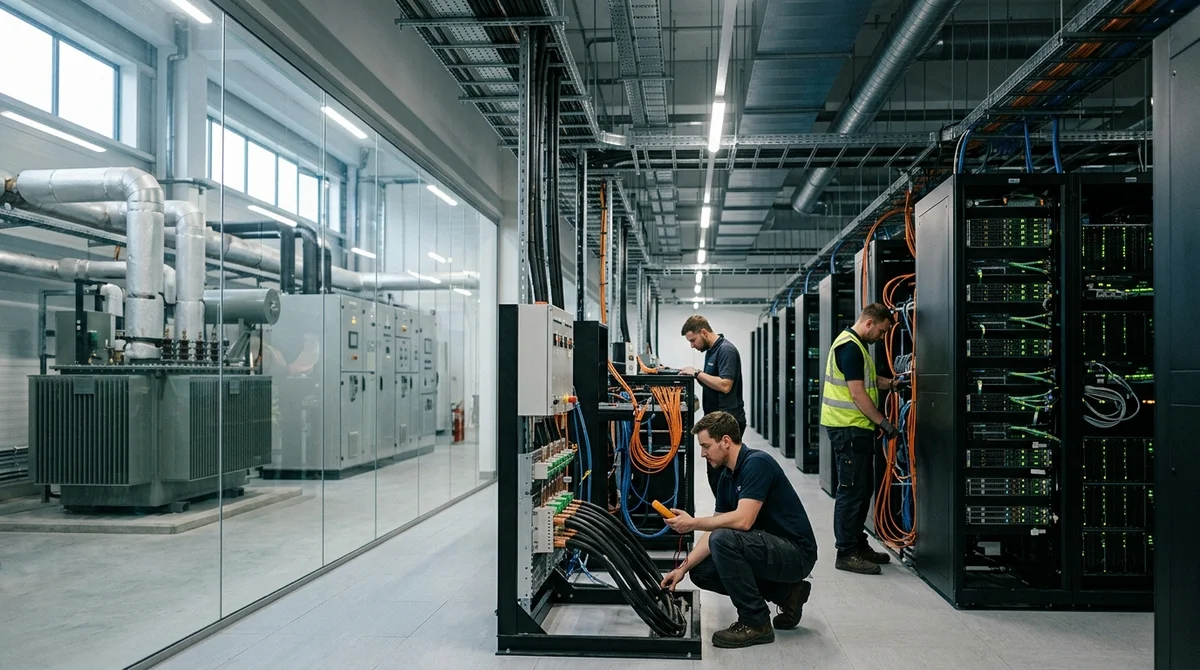
The AI boom is reshaping not only the software market, but the entire industrial ecosystem around computing. Data centers, substations, and power transmission lines are turning copper and aluminum into fundamental materials of the new AI infrastructure.
Energy for AI
According to the IEA, data center energy consumption will grow from 415 TWh in 2024 to 945 TWh by 2030. Separately, AI servers in the baseline scenario add approximately 30% annually. This is not just more server racks in data centers: alongside computational clusters, substations need to be built, cables laid, transformers upgraded, and cooling systems expanded.
This is why the conversation about AI is increasingly less about models and more about electricity, land, construction, and metals. In developed countries, data centers could contribute more than 20% of electricity demand growth through the end of the decade. In the US, the effect is already visible in investment statistics: according to S&P Global, in the first half of 2025, about 80% of domestic private demand growth came from data center-related spending and supporting infrastructure.
In other words, AI is already functioning as a separate industrial cycle, pulling along energy, construction, and equipment suppliers alongside model developers and cloud service providers.
Metals Under Pressure
The main winning metal is copper. It is needed at almost every point in the new chain: in cables, distribution networks, transformers, and power systems. Bloomberg estimated in 2024 that data center expansion alone could add about 2 million tons of copper to global demand by 2030, with more than half of this increase coming in the US. S&P Global goes further and expects total demand growth from 28 million tons in 2025 to 42 million by 2040. If mining and processing don't accelerate, the market deficit could reach 10 million tons.
- Up to 27 tons of copper per 1 MW of capacity according to Microsoft data center estimates in Chicago
- Global data center capacity in the medium term could approach 80 GW
- Asia and the EMEA region could add another 800,000 to 1.3 million tons of copper demand to the market by 2030
- Average copper price rose from $8,351 per ton in January 2024 to $12,987 in January 2026
Aluminum is growing less dramatically, but its role is equally important: it is the material for high-voltage lines and network infrastructure without which new computing clusters simply cannot be connected. The Aluminum Association notes that aluminum is present throughout the US high-voltage network, and data centers' and AI's share of the country's energy consumption could grow from 4.4% to 8.8% by 2030. At the same time, the aluminum sector itself is already competing with data centers for cheap electricity. The metal's price rose from $2,202 to $3,134 per ton from January 2024 to January 2026.
Who Can Deliver Faster
The problem is not just the volume of demand, but the speed of supply response. A data center can be financed and construction started within a few quarters. A new mine, ore processing, and launching metallurgical capacity—these are years of negotiations, geology, infrastructure work, and political risks.
The IEA estimates the global mining industry's need for new capital investments at $500 billion by 2040 in the baseline scenario and around $600 billion in a more accelerated scenario. In other words, the raw material base for the AI phase of the global economy will essentially have to be rebuilt from scratch. Meanwhile, funding on the demand side is already mobilized.
According to S&P Global, leading technology companies spent more than $400 billion in CAPEX in 2025, and cumulative investments in AI and cloud infrastructure could exceed $2.5 trillion by 2030. Microsoft officially planned about $80 billion for data centers in fiscal year 2025, Alphabet raised its annual CAPEX forecast to approximately $85 billion, and Goldman Sachs estimated consensus among the largest AI market players for 2026 at $527 billion.
This creates a gap: demand is accelerating now, raw material supply—noticeably later.
What It Means
AI infrastructure is becoming a new competitor for traditional industry in the battle for metals and electricity. For the market, this means a prolonged period of expensive copper, a more strained aluminum market, and growing importance of energy in technology strategy. For the companies themselves, the conclusion is simple: model scaling now depends not only on chips and software, but on how quickly the world manages to build the physical foundation for this demand.
Want to stop reading about AI and start using it?
AI News is a curated feed of AI/tech news. Hamidun Academy teaches you to use AI systematically in your work.