John McNeill: AI will accelerate IT hiring through demand for infrastructure and architecture
Former Tesla president John McNeill believes AI will not trigger a "job apocalypse" in IT. According to him, the strongest demand will shift to…
AI-processed from ZDNet AI; edited by Hamidun News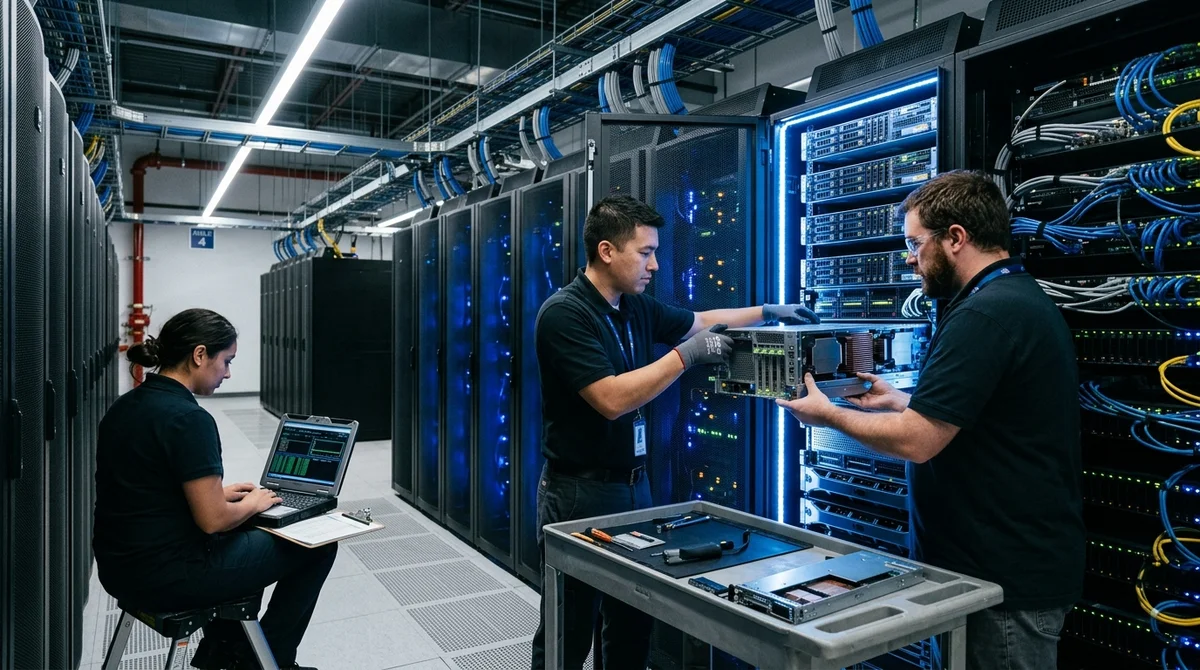
AI won't destroy tech jobs, but reshape them. John MacNeill, former Tesla president and head of DVx Ventures, believes that as AI systems scale, companies will need more people who know how to keep infrastructure, networks, and multilayered product architecture running.
Demand for Infrastructure
MacNeill's main argument is straightforward: AI quickly runs into constraints not just in models, but in the physical and network complexity around them. The more companies launch training and inference, the higher the demand for compute, servers, GPU clusters, node synchronization, and network maintenance. This is no longer a story about a single laptop with an API. It's about server farms where every failure is costly, and system resilience depends on people who understand how hardware, network software, and high-bandwidth memory work together.
According to MacNeill, this is especially pronounced in infrastructure teams. GPUs fail and must be replaced, resynchronized, and integrated back into running clusters. In parallel, demand for inference grows—constant model execution in production, not just training. This means a long tail of work for engineers: server maintenance, network tuning, monitoring, fault tolerance, updates, and performance control. For the labor market, this is expansion rather than contraction.
Architecture Over Routine
For developers, the picture is more complex. MacNeill acknowledges that basic code writing is increasingly automated: agents already help with template generation, QA, checks, and deployment. But this doesn't eliminate the engineer's role—it just shifts it higher. When a product is built from multiple models, search indexes, rules, small specialized models, and large LLMs, someone must decide which layer does what and where AI is actually needed versus cheaper tools.
This design level remains a human task for now. Essentially, value shifts from the zone of "write a function" to "assemble a working system." The wider the stack, the more critical the ability to break down the problem into layers and choose the right tool for each. Not every part of a product needs to be solved with tokens and large models: sometimes search is more efficient, sometimes classical ML, sometimes a combination of multiple agents under engineer control.
Against this backdrop, roles will grow connected to:
- designing multilayered AI architecture
- choosing between search, ML, small models, and large LLMs
- orchestrating agents and synchronizing their work
- QA/QC and deploying AI components in production
- optimizing inference costs and compute resources
Automate Last
Separately, MacNeill repeats a principle he learned from Tesla: automate last—automation should come last, not first. He recalls how early production automation slowed car output instead of speeding it up. The team had to literally return to manual assembly on the timeline to see process bottlenecks and only then decide what to automate.
The same logic, in his view, applies to AI projects: if you cover a raw process with expensive software too early, the system becomes rigid, costly, and hard to change.
"If code is written before the system is simplified and optimized,
changing it becomes too difficult."
This leads to an uncomfortable but useful conclusion for tech teams: not every task requires an expensive AI layer. Sometimes management wants "something with AI," though the problem is solved by regular search, a set of rules, or a small ML component. MacNeill advises pushing back on such requests and first defining the desired process outcome. Only then does it make sense to choose tools, clean data, and build an implementation chain. Otherwise, companies get beautiful demos instead of sustainable products.
What This Means
MacNeill's forecast matters because it shifts the conversation from the slogan "AI will replace programmers" to a more grounded level. Yes, some routine coding and operations will go to agents. But the deeper AI embeds itself in business, the more people are needed who can design architecture, keep infrastructure running, and tell real automation from expensive imitation. For IT, this isn't the end of professions, but growing demands for thinking and systems engineering.
Want to stop reading about AI and start using it?
AI News is a curated feed of AI/tech news. Hamidun Academy teaches you to use AI systematically in your work.