Silicon Valley faces an AI PR crisis amid growing distrust in the US
The AI industry in the US is facing not a technical but a political and social barrier: more and more people see the technology as a threat to jobs…
AI-processed from Bloomberg Tech; edited by Hamidun News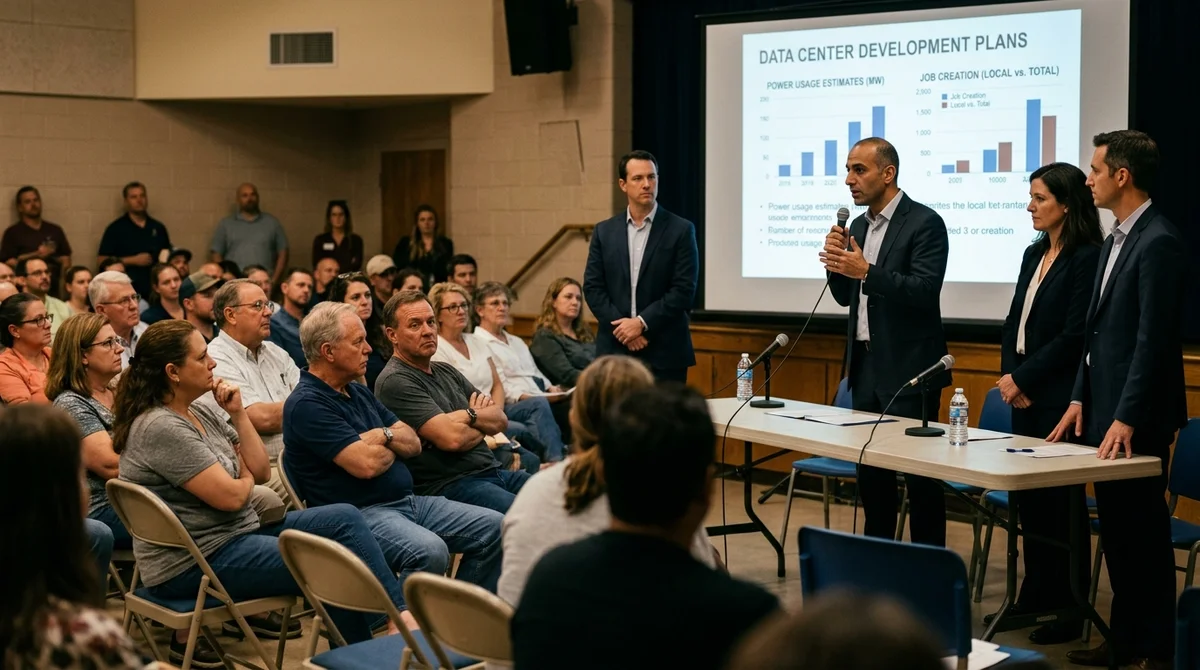
Silicon Valley faced an unexpectedly grounded problem: AI companies must sell the public not only new models, but the very idea that AI is useful, not dangerous. In the US, more and more people associate the technology not with a breakthrough, but with the risk to jobs, rising electricity bills, and a sense that decisions are being made without them.
Where the Skepticism Came From
Within the AI industry, AI still looks like an engine of productivity: code generation, automation of office routine, search, data analysis, new interfaces. Outside, the picture is different. For many users, AI is a black box that writes school essays, gets facts wrong, trains on others' content, and increasingly appears in spheres where the price of error is high: in education, hiring, medicine, and government services.
This very gap between developers' enthusiasm and ordinary people's irritation became the main PR challenge for the industry. Skepticism is visible in surveys too. Pew Research previously found that Americans are noticeably more likely than AI experts to fear job loss and weakening of human contact.
In another Pew study, 59% of respondents said they do not trust much or do not trust at all American companies on the issue of responsible AI development and use. That is, the problem is no longer whether people know about the technology. The problem is whether they believe those who promote it.
Jobs and Bills
The most understandable fear is the labor market. In February 2025, Pew reported that 52% of workers in the US are worried about the future impact of AI on work, and 32% expect a reduction in their own career opportunities in the long term. By March 2026, anxiety only intensified: according to a Quinnipiac survey, 70% of Americans believe that AI development will reduce the number of jobs. At the same time, people use AI tools increasingly actively, but trust them weakly: only 21% said they can trust AI results most of the time or almost always.
People are clearly implementing AI with deep caution, not deep trust.
Distrust is fueled by several things:
- fear of mass layoffs and skill devaluation
- a sense of opacity: companies rarely clearly explain where AI actually works and how it makes decisions
- growing concerns around data centers, which require more and more electricity and water
- a demand for regulation: many Americans believe that business and government are not keeping up with the scale of implementation
A separate headache for the industry is infrastructure. The AI boom turned data centers from inconspicuous objects of the backend economy into a politically toxic issue. According to a March Pew study, Americans more often assess their impact as negative for the environment, household electricity bills, and quality of life near such facilities than as positive. And at the end of March, Quinnipiac recorded an even harsher signal: 65% of US residents opposed the construction of an AI data center in their community.
How Rhetoric is Changing
The industry has already begun adapting its language to this reality. If previously companies sold AI as an inevitable technological future, now they have to speak in the language of utility bills, jobs, and local benefits. A telling moment occurred on March 5, 2026, when Google, Microsoft, Meta, Amazon, OpenAI, Oracle, and xAI supported an agreement at the White House that the new demand for electricity for data centers should not be passed on to households.
The very fact of such a step shows: the problem of perception has gone far beyond the tech scene. But PR is not cured here by slogans. People are not satisfied just hearing that AI will "help humanity" or "accelerate innovation."
They want to understand where the boundary of automation lies, who is responsible for model errors, how data is protected, and why the economic benefits of AI should not be paid for by jobs or rising tariffs. For Silicon Valley, this is an uncomfortable turn: instead of the familiar strategy of "launch first, explain later," it now has to convince first, and then scale.
What This Means
In 2026, for AI companies, it turned out to be not enough to simply be technologically ahead. If the industry does not learn to speak with society honestly—about layoffs, infrastructure, control, and real limitations of models—its main competitor will not be another startup, but public distrust.
Want to stop reading about AI and start using it?
AI News is a curated feed of AI/tech news. Hamidun Academy teaches you to use AI systematically in your work.