Anduril starts production of Fury unmanned fighter jets at new Ohio plant
Anduril has started production of Fury unmanned fighter jets at its new Arsenal-1 plant in Ohio. The company expects the first aircraft as early as summer…
AI-processed from Bloomberg Tech; edited by Hamidun News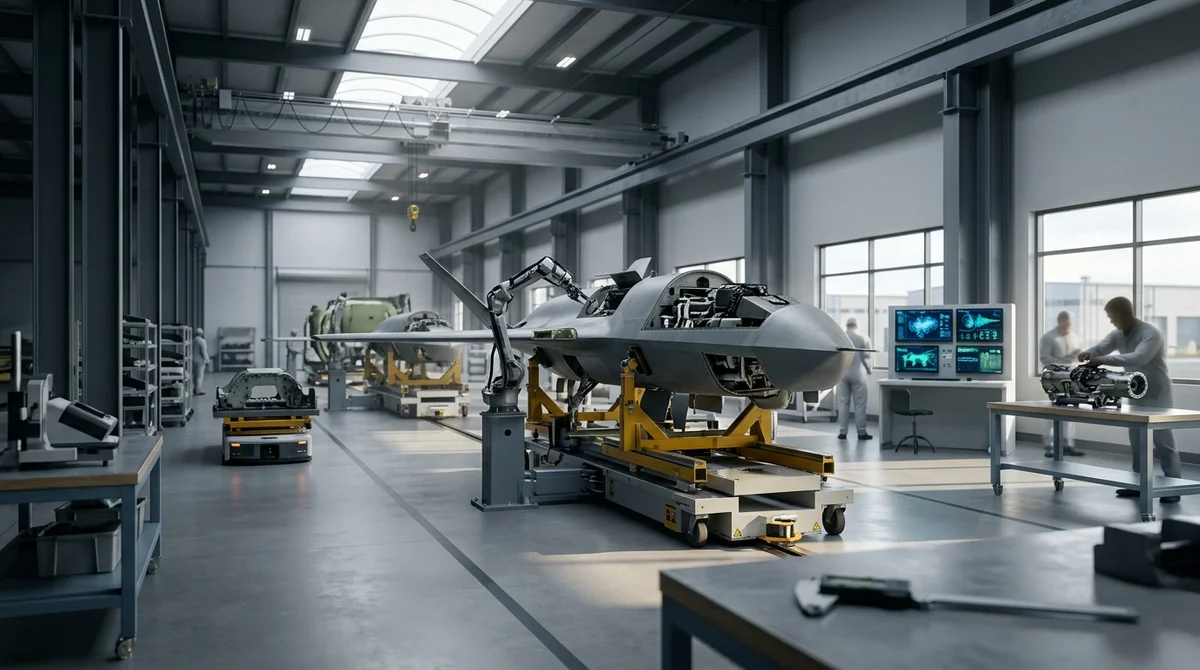
On March 24, 2026, it became known that Anduril launched assembly of the Fury unmanned fighter at the new Arsenal-1 facility in Ohio. The company expects the first aircraft to come off the production line by summer 2026 — a significant step for the Collaborative Combat Aircraft program, where the U.S. Air Force is seeking affordable and mass-produced combat drones to work in pairs with manned fighters.
What's Being Launched
Fury, designated YFQ-44A by the U.S. Air Force, is an unmanned jet aircraft designed to fly alongside manned aircraft, assume some risks, carry sensors and weapons, and expand the capabilities of the combat group. Its counterpart under the CCA program is General Atomics' YFQ-42A, with the Air Force's decision on the next phase of procurement expected by summer 2026.
For Anduril, this is not simply another product but a test of its entire business model. Previously, the company manufactured small batches in California, but now it is relocating assembly to a separate large facility near Columbus. Arsenal-1 is designed as a factory where different systems can be quickly switched and production scaled up without lengthy facility reconfiguration.
How Fury Is Assembled
Anduril's main focus is not on a "smart" factory with heavy automation, but on flexible hand-assembly with a minimal amount of fixed equipment. Inside the first building, 22 work stations have been set up: the airframe is assembled first, followed by hydraulics, fuel systems, and avionics installation, with final stages including landing gear, wings, engine installation, and testing.
"We intentionally start without complex equipment and without a proliferation of robots," explained
Anduril's manufacturing director John Malone.
What is already known about the Ohio production line:
- The company expects the first units by summer 2026
- Initial target is approximately 50 aircraft per year
- At full capacity and operating three shifts, production can reach up to 150 per year
- Approximately 30 employees have already been trained to launch the line
- By the end of 2026, the facility aims to have around 250 employees
Another important detail — Anduril designed Fury for scalable production from the start. The company says it uses many commercially available components, aluminum instead of more complex materials where possible, and a standard business jet engine with an established supply chain. According to Air & Space Forces Magazine, 94% of the aircraft's components are commercially available.
Why the U.S. Air Force Needs This
The Air Force needs Fury not as a replacement for manned fighters, but as a "wingman" in the human-machine teaming concept. Such aircraft should extend operational range, assume dangerous tasks, and provide greater combat mass without needing to build aircraft as expensive as F-35s or F-22s. This is why the Pentagon carefully examines not just flight characteristics but how quickly such systems can be produced in large quantities.
The program has moved beyond impressive renderings. In February 2026, the U.S. Air Force announced that YFQ-44A is participating in semi-autonomous flight tests under the open architecture A-GRA framework, and has since progressed to the next phase — weapons integration checks with inert munitions. The Air Force separately emphasizes that the decision to employ weapons remains with humans in any case, even if the aircraft itself performs parts of the mission autonomously.
If Anduril can demonstrate that its flexible assembly approach truly works, the company will gain a strong argument in competing for major production contracts. At the same facility, by the end of 2026, it plans to manufacture not only Fury but also the Roadrunner interceptor, Barracuda cruise missiles, and another classified system. In other words, Arsenal-1 is being built from the start as a multi-product military factory, not as a line for a single aircraft.
What This Means
The launch of Fury in Ohio shows that the military AI systems market is shifting from prototypes to industrial production. For Anduril, this is a chance to become not just a prominent defense tech startup but a real weapons manufacturer at scale; for the U.S. Air Force, it is a test of whether a new generation of unmanned "wingman" fighters can be rapidly and relatively inexpensively deployed.
Want to stop reading about AI and start using it?
AI News is a curated feed of AI/tech news. Hamidun Academy teaches you to use AI systematically in your work.