U.S. universities are bringing back oral exams as students increasingly rely on AI
American universities are once again betting on oral exams. The reason is simple: AI is increasingly writing homework and essays, while in a live…
AI-processed from 3DNews AI; edited by Hamidun News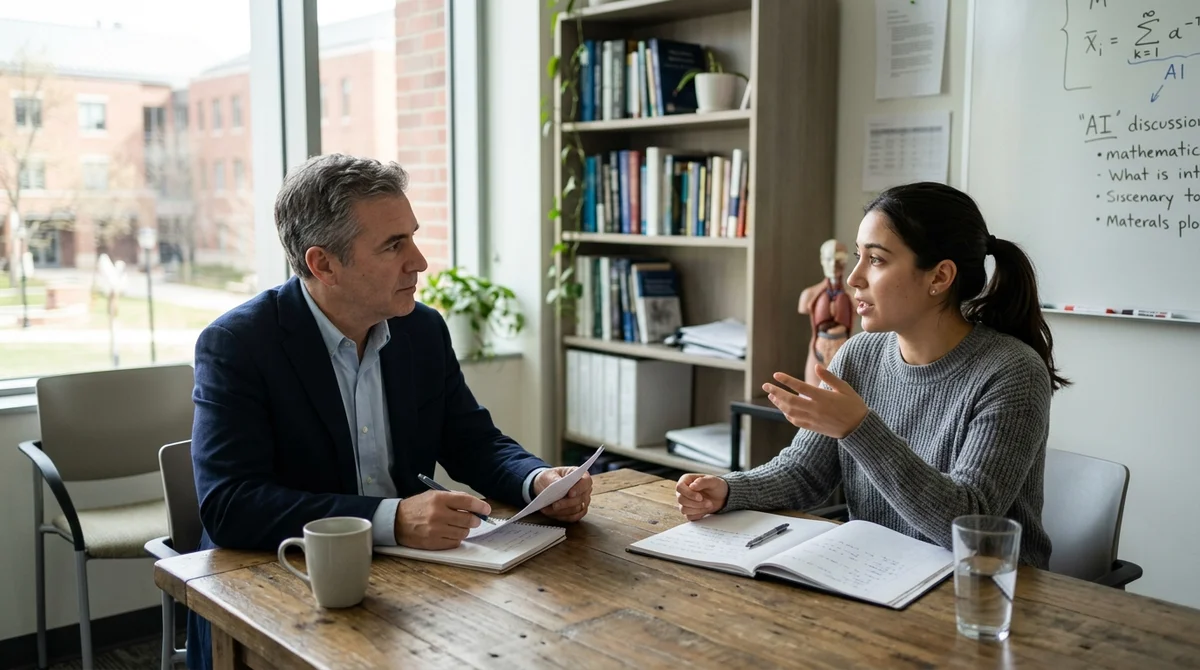
Oral exams are making a comeback in American universities. Professors are returning to a format that leaves students little opportunity to discreetly offload their thinking to a chatbot and instead tests whether a person actually understands the material in live conversation. For universities, this is no longer nostalgia for the old school—it's a practical response to a new educational reality.
Why the format returned
The spread of generative AI has drastically reduced the value of many conventional ways of assessing knowledge. Previously, essays, homework, or short written answers at least partially showed how a student reasoned independently. Now, much of this work can be generated in minutes by any chatbot. The problem isn't just plagiarism. Professors increasingly encounter texts that look confident and well-written but don't reflect actual understanding of the material and sometimes hide gaps in basic knowledge.
An oral exam addresses a different task: it tests not just the final answer but the thought process. When a professor asks clarifying questions, requests an example, asks the student to defend a conclusion, or explain why a particular approach was chosen, relying on a pre-made template becomes much harder. In this format, it quickly becomes clear where a student truly understands the subject and where they're simply reproducing carefully assembled text. This is precisely why the old academic tool has become relevant again in the new technological reality.
How the assessment works
In practice, this isn't always a classical exam before a department. Often it involves short individual defenses of work, mini-interviews after a written assignment, or oral components embedded directly within a semester course. This format can be integrated into almost any discipline: from humanities to mathematics, programming, and law. The key difference is that the professor assesses not only the content of the answer but also the ability to quickly navigate the question without external digital support.
- explain the solution in your own words without reading from paper
- identify an error in your own answer and propose a correction
- compare two approaches and choose the stronger one
- apply theory to a new example not included in the assignment
This is where the oral format gives the professor something that ordinary text lacks: the ability to verify depth of understanding in real time. If a student knows the subject superficially, this becomes apparent by the second or third clarifying question. If the material is truly mastered, the conversation usually becomes flexible and substantive. For strong students, this is even more advantageous, because they can demonstrate their logic rather than just deliver a final answer in limited written form.
What are the drawbacks
Returning to oral exams doesn't mean the problem is solved without costs. This format doesn't scale as well, requires more time from professors, and depends more heavily on the quality of assessment criteria. Additionally, oral examination increases stress for students, especially those who feel more uncomfortable in live conversation than in written work. Universities will need to find balance: in some cases, using oral elements as selective assessment; in others, combining them with projects; and in still others, completely reconsidering their approach to academic integrity and evaluation of actual skills.
There's also an organizational question: to prevent this format from becoming a subjective chat, universities need clear rubrics, consistent rules, and faculty training. Otherwise, one student gets a substantive conversation on the merits while another gets a random set of questions based on mood. Therefore, oral exams will likely not completely replace written assignments but could very well become a mandatory complement where it's important to verify understanding rather than the quality of a polished final text.
What this means
The era of generative AI is changing not only the tools of learning but the very rules of knowledge assessment. Universities are gradually moving away from evaluating finished text toward evaluating thinking, and the oral exam becomes once again a way to understand who truly mastered the subject and who has simply learned to phrase requests for AI correctly.
Want to stop reading about AI and start using it?
AI News is a curated feed of AI/tech news. Hamidun Academy teaches you to use AI systematically in your work.