NiCE Cognigy showed how AI agents and humans will manage customer service together
At Nexus 2026, NiCE Cognigy showed that the customer service market is moving away from standalone bots toward a unified orchestration layer. The company is…
AI-processed from ZDNet AI; edited by Hamidun News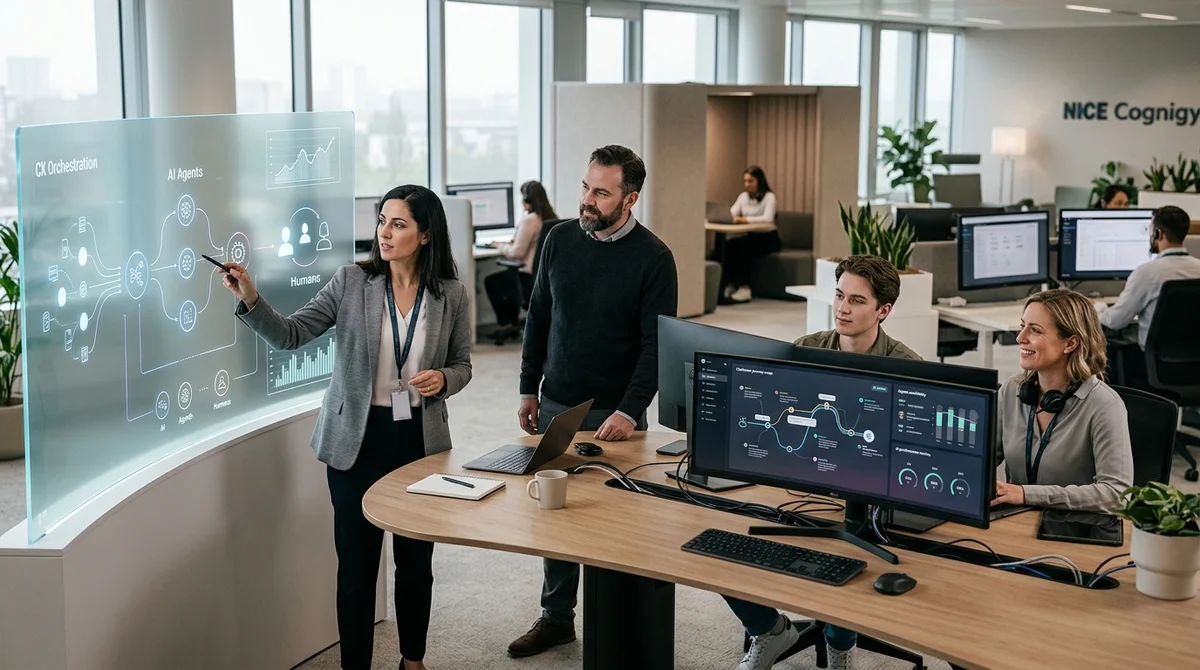
NiCE Cognigy at the Nexus 2026 conference showed not just a set of new AI-functions for contact centers, but a larger shift: the company wants to become the operating layer for the entire customer experience. In this model, AI-agents, live operators, and AI-assistants work in a single loop, not in fragmented systems.
From Contact Center to CX
Nexus 2026 took place in Munich on March 11-12, 2026, and was the first major joint event since NiCE closed the deal to acquire Cognigy on September 8, 2025. For the market, this was an important test: would Cognigy maintain independence for customers on non-NiCE CCaaS platforms, or would it quickly dissolve within CXone? Based on the event outcome, the answer looks quite clear.
Cognigy remains a separate product for companies that do not operate on the NiCE stack, but at the same time integrates more deeply into CXone for existing and new group customers. This move matters not only commercially. It shows that NiCE no longer wants to be perceived as a contact center infrastructure provider, where the main value is routing, workforce management, and quality control.
The company is advancing a different frame: CX AI platform as an orchestration layer that connects channels, knowledge, workflows, analytics, and different types of performers—from AI-agents to people. In other words, it is no longer about a bot next to an operator, but about a unified system that guides the customer through the entire journey from first contact to final resolution.
"AI is no longer a function on top of software—it becomes the
intelligence that manages that software."
Balance of People and AI
One of the most sober conclusions of the event—NiCE is not selling the idea of total automation at any cost. The conference featured much discussion of agentic AI growth, and Cognigy announced 500% growth in implementations over the past year, but the company directly acknowledges: in 2026, the majority of customer contacts still remain with people. The problem is not to eliminate operators, but to eliminate the gaps between systems that force customers to repeat the same information with each transfer, and force teams to lose context at every step.
NiCE Cognigy's architectural answer is a unified operating layer, where AI-agents, employees, and AI-assistants use a shared knowledge base, shared workflows, and shared analytics. Within the company, this is described as an agentic learning loop: create, evaluate, deploy, observe, improve. The logic here is straightforward: simple, frequent, and strictly formalized requests can be handed to AI, while complex cases involving risk, empathy, or ambiguous decisions go to people.
At the same time, AI remains useful even where humans make the final decision: it reduces post-call work, suggests knowledge in real-time, and eliminates routine.
New Platform Tools
The strongest part of the announcements is not talk about "smart agents" in general, but the tools that make them manageable in production. NiCE Cognigy is effectively showing that the next phase of the market is not fancy demos, but discipline: how to select the right automation scenario, how to test an agent before release, how to integrate it into real processes, and how to then measure the result.
- Automation Discovery analyzes chats, voice interactions, routing signals, and performance metrics to find scenarios with the highest ROI and faster assemble production-ready agent journeys.
- Simulator and multivariate testing allow comparing prompts, guardrails, routing logic, fulfillment strategies, and even foundation models on synthetic scenarios and edge-cases before launch.
- Multimodal proactive journeys combine voice, visual interfaces, forms, and back-office workflows into one synchronized scenario with shared context.
- MCP integration should simplify connecting external AI-tools and give agents a more standard way to call services without fragile point-to-point integrations.
- Conversation Analyzer moves analytics from simple KPIs to LLM-evaluation of actual dialogue quality, anomalies, and failure reasons.
It is important that these points were supported not only by vendor presentations. The event featured case studies from Allianz, Lufthansa Group, PostNL, and Openreach: from scaling AI during insurance request spikes to proactive scenarios and reducing handovers between bot and human. This makes NiCE's agenda more convincing: the company is already talking not about the ability to use agentic AI, but about how to exploit it at the level of a large service operation.
What This Means
For the CX market, this is a signal that competition is moving away from the level of individual bots and assistants to the level of operational architecture. The winners will not be those who simply have an AI widget, but those who can maintain unified context, manage a hybrid workforce, and serve both requests from people and contacts initiated by AI-agents. And the role of humans in this scheme does not disappear: it becomes no longer mass, but more valuable—where judgment, responsibility, and trust are needed.
Want to stop reading about AI and start using it?
AI News is a curated feed of AI/tech news. Hamidun Academy teaches you to use AI systematically in your work.